Verse 31851oaa))e
G13
1
it's a situation/world of thunderbolt/lightning and flame and mercury/quicksilver
2
only/emphatically 'to come' doesn't come into my understanding, although it/she might/would come
'A thunderbolt; lightning'.
| References | |
|---|---|
| Arshi, Imtiyaz Ali | Ghazal# 216 |
| Raza, Kalidas Gupta | 413 |
| Hamid Ali Khan | Open Image |
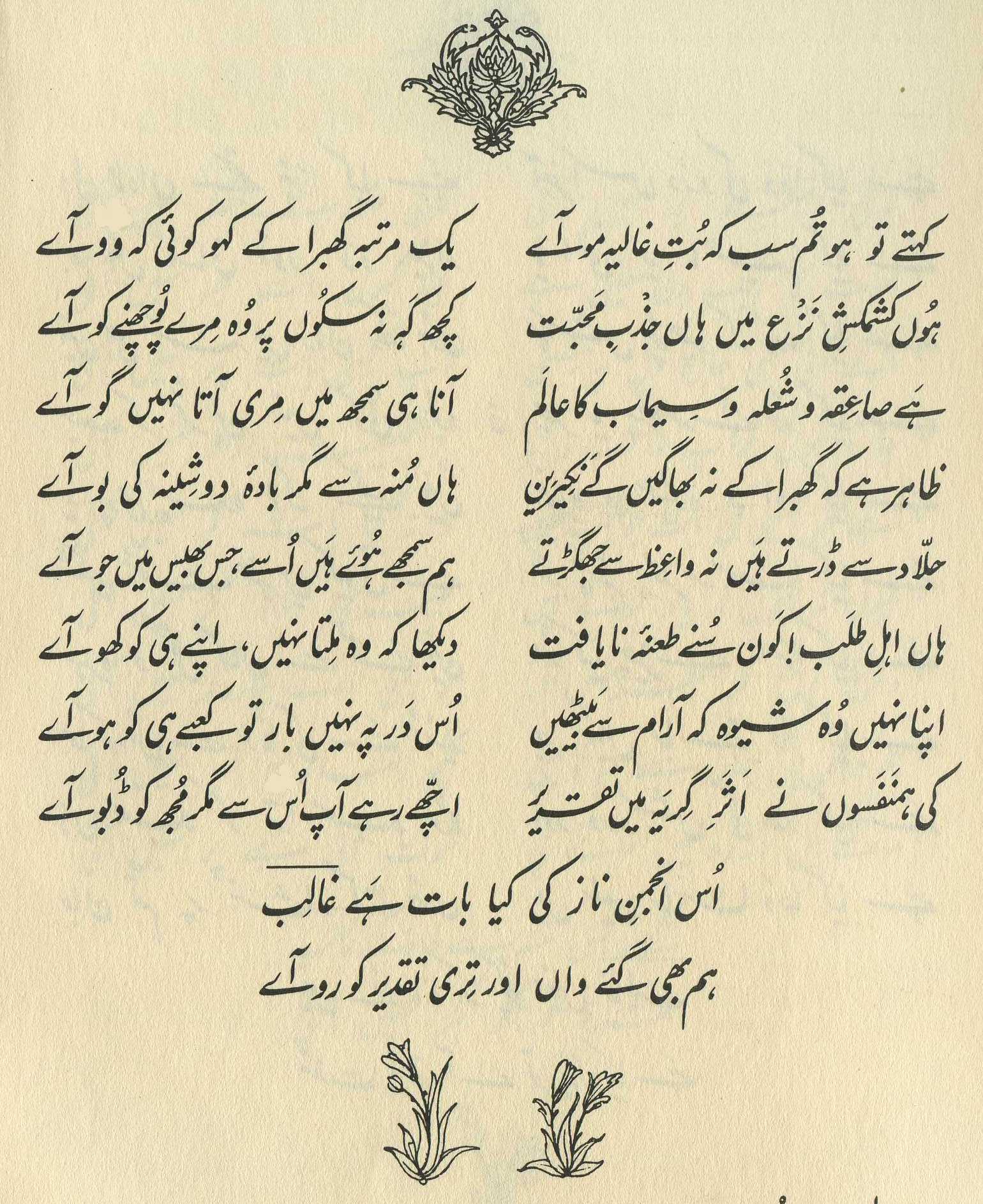
That is, although we came into the world, like flame and mercury, we have no stability. Or flame and mercury are a simile for the beloved's mischievousness, and refers to her coming. (175)
== Nazm page 175

He says, even though she might come to my house, her state is like that of lightning and flame and mercury. That is, she doesn't take a breath, she doesn't sit down, she doesn't remain; the moment she comes, the question of going arises. I don't understand whether such a 'coming' is counted as a 'coming' at all. (235)
is that lightning that would touch the ground. In our life the style of restlessness is that of of lightning and flame and mercury. Although we came into the world, it was a 'coming' that was hardly a 'coming' at all-- otherwise, we would have found some life.
[Or:] The beloved shows her glory/appearance and then vanishes, like mercury, flame, lightning. Who would call that 'coming'? That is, the heart finds no comfort in it. Ghalib: 36,5 . (315)
[See his comments on Mir's M 1219,1 .]
Possibly even through a correction by Ghalib himself, one late manuscript replaces the first line with the decidedly inferior . Arshi discusses his reasons for rejecting this reading in his introduction, p. 78. (He rightly observes that the traditional first line offers images of extreme speed, which are appropriate to the second line; the new first line offers images that have in common merely turmoil).
Here's a beautiful use of what I call an 'A,B' structure, in which the two lines can be linked in different ways, and we're left to make our own choices about their relationship. The first line has an (unstated) subject, such that it turns into something like 'It is...' or 'There is...'. And what is it that there is? A 'situation' or 'world' of three extremely fast-moving, slippery, wildly evanescent and ungraspable things. So what is the subject-- what is it that constitutes such a 'situation' or 'world'? Here are the obvious candidates:
=The duration of the beloved's 'coming' to visit me (the uncapturably brief, brightly shining period of her visit).
=The thought of the beloved's 'coming' to visit me (the very idea of such a world-transforming experience).
=Human life, upon our 'coming' into this transitory world.
=The concept of 'to come', in its own right.
Surely the last possibility is the most radical, the most piquant, because it is capable of subsuming and including all the others. The lover wrestles with the very idea of what it can mean 'to come'-- in a world in which all these other difficulties conspire to make the concept impossible to (almost literally) 'grasp'.
The second line manages to repeat three times: 'to come' doesn't 'come' into the speaker's understanding-- even though X might or would 'come' (the subject is colloquially omitted). If X is the beloved, this reading works perfectly. But X might also refer to death. Or it might refer to the idea of 'to come' itself, in a slightly warped invocation of a well-established idiom: the paradoxical-looking 'doesn't come, although it might/would come' (see 191,8 ).
graphics/lightningfire.jpg