Verse 11851oaa))e
G13
1
you all say, 'the idol with preciously-perfumed hair {might/would come / has come}'
2
one time may someone become flustered/agitated and say, 'she's come!'
'A kind of perfume (said to have thus been called by Mu'awiyah as "a thing precious"); civet'. (Steingass, p. 879)
'To be confused, confounded, flurried, or flustered (by, or in consequence of, -se); to be perplexed, bewildered, or embarrassed (by); to be perturbed, disturbed in mind, agitated, disquieted, distracted; to be alarmed, scared, dismayed'.
| References | |
|---|---|
| Arshi, Imtiyaz Ali | Ghazal# 216 |
| Raza, Kalidas Gupta | 413 |
| Hamid Ali Khan | Open Image |
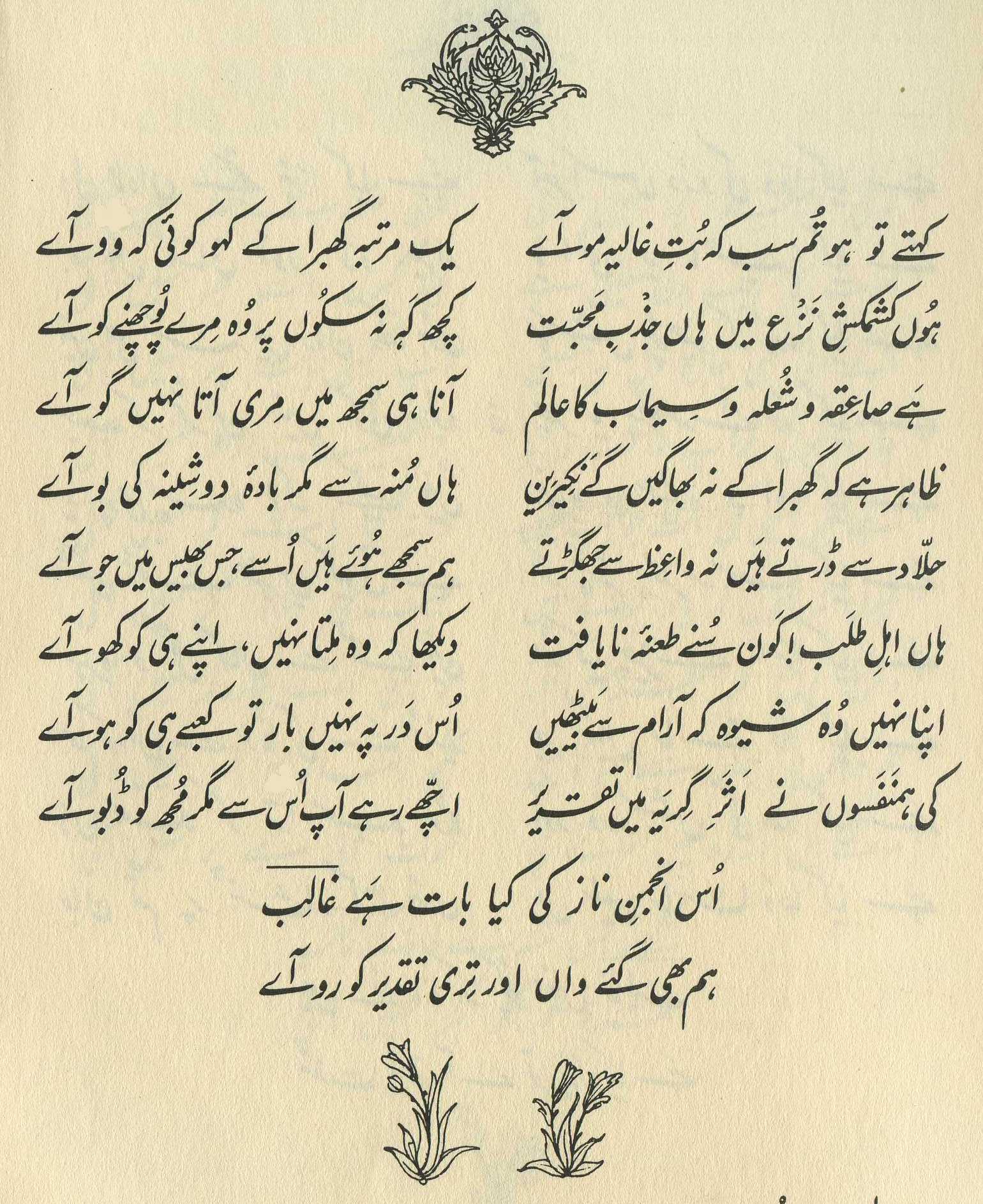
[1851:] One thing you should know is that when I present myself in the Presence [of the king], then usually the King wants Rekhtah from me. So how can I recite those previously-composed ghazals? I compose a new ghazal and take it with me. Today I wrote a ghazal in the afternoon. Tomorrow or the next day I will go and recite it. I am writing it to you too. Do it justice: if Rekhtah rises to the level of an enchantment or a wonder, then will it take this form, or some other shape? [He sets down the whole ghazal, in exact divan order.] (Arshi, p. 316)
==Urdu text: Khaliq Anjum vol. 3, pp. 1098-99. NOTE: Khaliq Anjum also includes a transcript of 191 in this letter, but that's an error on his part, based on an earlier scribal error, since {191} was actually composed in 1853.
==another trans.: Russell and Islam , p. 83
To tell the truth, the King's Zafar 's] opening-verse was somewhat better than this:
[either death would come, or the hostile-tempered idol would come
let it not be, oh Lord, that neither this one would come, nor that one would come!] (175)
== Nazm page 175

He says, oh friends, oh companions, oh dear ones, oh sympathizers, you're all offering me the prayer/blessing that 'may the Lord grant that that idol with preciously-perfumed hair would come'. Let it be that for once all you people become nervous and suddenly say, 'She's come'. (234)
: whose hair would be perfumed.... The point of saying 'with perfumed hair' is that the scent of her hair will give notice of her coming....
From reading the first line it seems that they are all saying, may the Lord grant that she would come-- that is, they say [the singular] , they don't say the respectful [plural] . And [the second line] apparently seems like a complete non sequitur. But no, the real situation is the opposite of this. In the prayer/blessing people say, because of the [singular] word 'idol', may the Lord grant that the idol with preciously-perfumed hair would come []. But when she appears and shows herself before them, then how would courtesy, and her dignity and grandeur, permit them to say [in the singular] . (314)
This ghazal is printed in the Dihli Urdu Akhbar 13,19 (11 May 1851), with this introduction: 'This week a ghazal of Janab Navab Asadullah Khan Sahib Bahadur, with the pen-name of Ghalib, came into our hands; so we have recorded it in the paper'. (317)
Ghalib has done some serious contorting of vowels in his rhyme -syllables in this ghazal. In order to make this particular verse work, we have to pronounce as , and spell as (because ghazal convention requires symmetrical spellings too in the rhyme-syllables). The only commentator I've noticed who criticizes him for this is Shadan (p. 371). Similar problems arise in other verses; in all cases I've adjusted the spelling to reflect the exigencies of the rhyme-syllable. That looks awfully strange in some cases, but to have non-rhyming rhyme-syllables would also look awfully strange.
Nazm is right! While Zafar's verse is pert and punchy (and swingy in that characteristic way of his), Ghalib's is ponderous and obscure. Still, let's see what we can make of it.
The first line quotes a phrase that 'all you people' say, and the second line quotes a phrase that the speaker would like to hear spoken instead. But what exactly is the problem with the first phrase, that is fixed in the second? Several possibilities suggest themselves, as we shift the stress from one element of the line to another:
=Line 1 is in the subjunctive (she might come); Line 2 is in the perfect (she has come; literally and colloquially, 'she came'), revealing the thrill of her actual arrival.
=Line 1 is in the subjunctive singular (probably because of , as Bekhud Mohani explains); Line 2 is in the plural perfect of respect, and thus shows more deference.
=Line 1 is conventionalized, she's given a pompous formal epithet; Line 2 is simple and direct, she's referred to as 'she' (whether her coming is hypothetical or actual).
=Line 1 is said habitually ( ); Line 2 would be said once.
=Line 1 is presumably spoken in a formal way to suit the epithet; Line 2 would be said 'nervously' or 'anxiously' ( ).
These contrasts aren't mutually exclusive, of course; the ardent lover might well have several of them churning around in his mind together. The most obvious interpretation is surely that the lover is tired of hearing formal subjunctive wishes or predictions that she 'might' or 'would' come, and longs to hear the brief, startled, anxious little ejaculation 'she's here!'. Ghalib has cleverly massaged the verb forms so that both lines end in -- though in the first line it's more plausibly the singular subjunctive (though the plural perfect can't be ruled out), while in the second line it's the plural perfect (the singular subjunctive can't quite be ruled out, but the works against it). These varying possibilities are surely also part of what he means us to enjoy: the piquant interplay in the verbs between identity of form and great differences of meaning.
Why does the idol have exotic, Persianized, 'preciously-perfumed hair' []. Where's the connection with the rest of the verse? Bekhud Mohani is the only commentator who tries to address the problem: he claims that her hair is so lavishly perfumed that its scent would precede her and give warning of her approach. This seems implausible, especially since in the second line she apparently manages to arrive quite suddenly and surprise everybody, despite her perfumed hair. It's possible to argue that some kind of formal epithet belongs in that slot, to enhance the contrast with the second line, but why this particular one?
The letter quoted above shows that Ghalib was exceptionally proud of this ghazal. For another ghazal about which he boasted in even more extravagant terms, see 111,1 .
Note for meter fans: in this ghazal, the last syllable of is a short 'cheat syllable' that doesn't count as one of the official syllables of the meter. This is permissible, but it tends to give this important, normally well-pronounced part of the verb ending a much smaller emphasis than usual; the line seems, when recited, to end in a kind of dying fall, with a little attached to a big like a small echo. This makes for a slightly awkward effect.
On the translation of as 'she's come', see 38,1 .
Compare 438x,4 , in which her coming devastates the gathering-- but how, exactly?
graphics/she.jpg