Verse 51851oaa))e
G13
1
we neither fear the Executioner , nor quarrel with the Preacher
2 a
we consider/understand it [to be] Him-- in whatever guise, whoever would come
2 b
in whatever guise, whoever would come-- we've understood it/him
| References | |
|---|---|
| Arshi, Imtiyaz Ali | Ghazal# 216 |
| Raza, Kalidas Gupta | 413 |
| Hamid Ali Khan | Open Image |
As if he doesn't know anyone except the Lord.
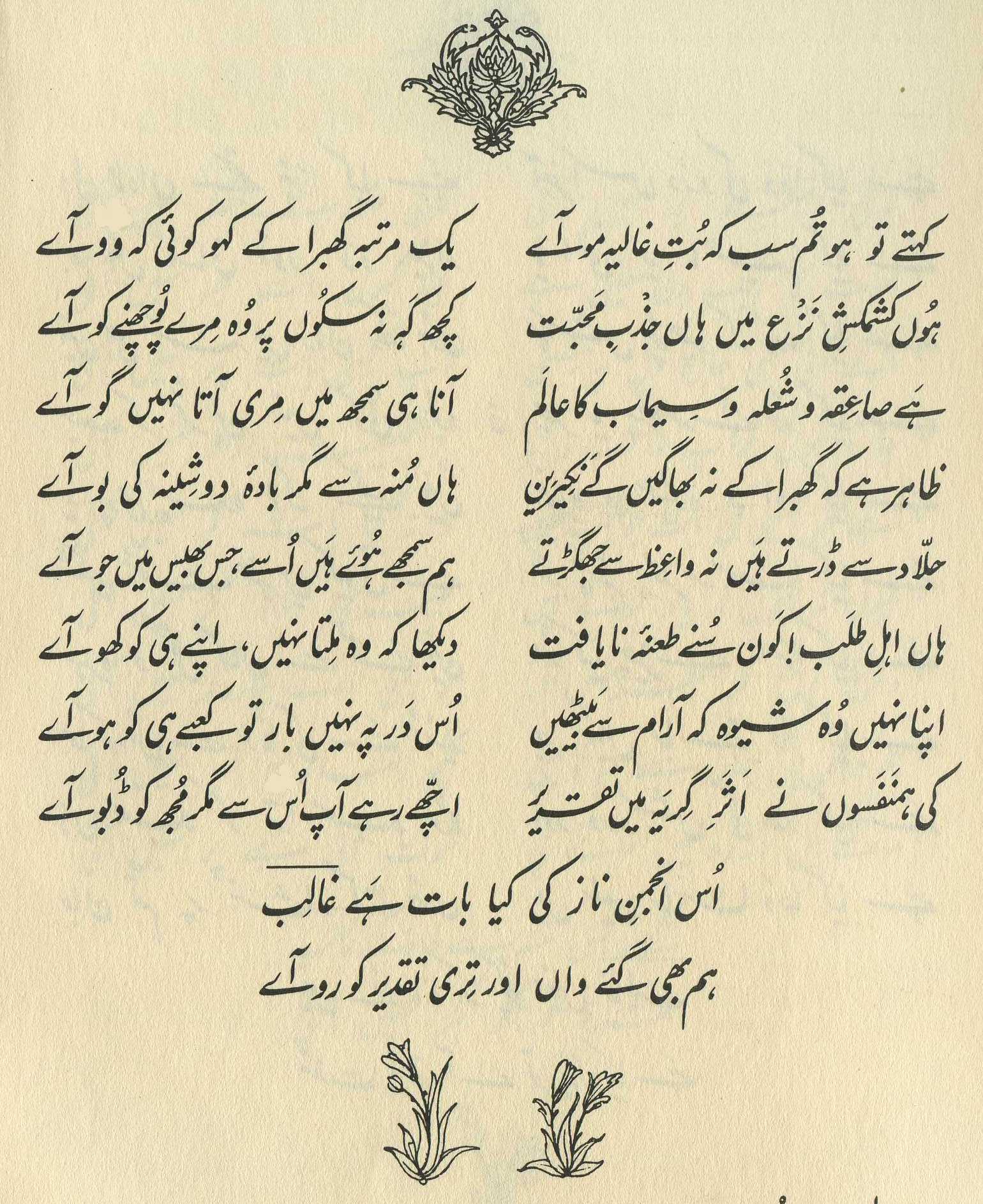
==Urdu text: Yadgar-e Ghalib , p. 158
That is, whomever we see, we know him to be You. But between the Executioner and the Preacher there's no particular affinity . If instead of Preacher he had said Judge [], then it would have been good, for he's the very one who issues decrees for the killing of those who say 'I am God/Truth' [as did Mansur . (176)
== Nazm page 176

[In refutation of Nazm's criticism:] The Judge gives decrees, he doesn't argue with criminals. This was why Mirza said Preacher and didn't say Judge. There's also the second reason that when, on the Judge's order, the Executioner has come, then the reading is also given that we fear neither the Judge's decree, nor the Executioner's terrifying aspect, nor the glittering sword. (316)
There's another subtle meaning: that whoever comes, in whatever guise, we've understood him. It can also mean that no magic of appearance can have power over us. Whether he would be an Executioner or a Preacher, and in whatever guise he may come before us, we recognize his true essence. Through the effect of this meaning, there's a tone of pride and disdain in the verse, that the people of the world are not worthy of our attention. By means of the Executioner and the Preacher, two worlds are established in the verse. The Executioner carries out the punishment of this world, and the Preacher tells us about the next world, and frightens us with punishment there. We know the true essence of both.
== (1989: 287) 2006: 311
The first line offers two parallel phrases (with nice internal rhyme), and as usual it's left up to us to decide on their relationship. If they're taken as parallel examples of a single state of mind, then we're left with two instances of withdrawal from, or indifference to, all worldly concerns. This reading is the general consensus of the commentators.
But if they're taken in opposition or contrast to each other, then as Faruqi says, 'two worlds are established in the verse', that of the Executioner and that of the Preacher. As he observes, each of these agents seeks to frighten people-- the Executioner, with the threat of imminent punishment in this world; the Preacher, with the threat of eventual punishment in the next world. The line suggests typical, and understandably human, reactions to each: to fear the Executioner who is an immediate threat, and to quarrel with the hectoring Preacher, who is not so dangerous in the short run. The line also makes it clear that the speaker displays neither of these typical human reactions: he can't be intimidated by threats or violence, in this world or the next.
Why is he so fearless? The second line too is carefully arranged to yield two perfectly good readings. The commentators uniformly support (2a): he's fearless because no matter whom he sees, and no matter in which guise he sees him, he considers him to be the Divine (or at least highly divinized) beloved. But then, why does the speaker think this? Either because he's mystically enlightened, and knows that in fact nothing but God exists (as in 162,4 ), so that he's quite right not to be afraid of these two threateners; or because he's mad with passion, and quite absurdly sees the face of the beloved in everyone and everything, so that he's naively or foolishly unafraid of even the most dangerous threateners.
But Faruqi rightly emphasizes the presence of (2b) as well. In Urdu as in English, 'to understand' can take as its object a clause ('she understood the remark to be a compliment', 'you understand him to be a friend') as in (2a); but it can also simply take a direct object ('you understand me'; 'nobody understands his poetry') as in (2b). Thus it might be that the speaker simply 'understands' whoever comes, in whatever guise they come-- they can't even puzzle him, much less deceive or intimidate him. In what sense does he 'understand' them? Does he consider them to be entirely illusory? To be only contingently real? To be human agents of a Divine power? To be foolish tricksters trying cynically to intimidate? To be petty and naive little mortals not worthy of notice? To be genuine threats, but ones he somehow can't take seriously? We are left to decide for ourselves.
This is, in short, a radically 'fill-in-the-blanks' kind of verse. There are so many ways to put it together, and to 'understand' the authority-figures of this world and the next, that it's impossible to pin it down at all. As Kurt Vonnegut said in 'Cat's Cradle', unexpected encounters are 'dancing lessons from God'.
On as 'to consider', see 90,3 .
graphics/disguise.jpg