Verse 5after 1847iirbhii thaa
G5
In this meter the first long syllable may be replaced by a short; and the next-to-last long syllable may be replaced by two shorts.
1
if a single/particular/unique/excellent lightning-bolt flashed before the eyes, then so what?
2
If only He/she had conversed! --for I was even/also thirsty-lipped for speech
'One, single, sole, alone, only, a, an; the same, identical; only one; a certain one; single of its kind, unique, singular, preëminent, excellent'.
| References | |
|---|---|
| Arshi, Imtiyaz Ali | Ghazal# 41 |
| Raza, Kalidas Gupta | 397 |
| Hamid Ali Khan | Open Image |
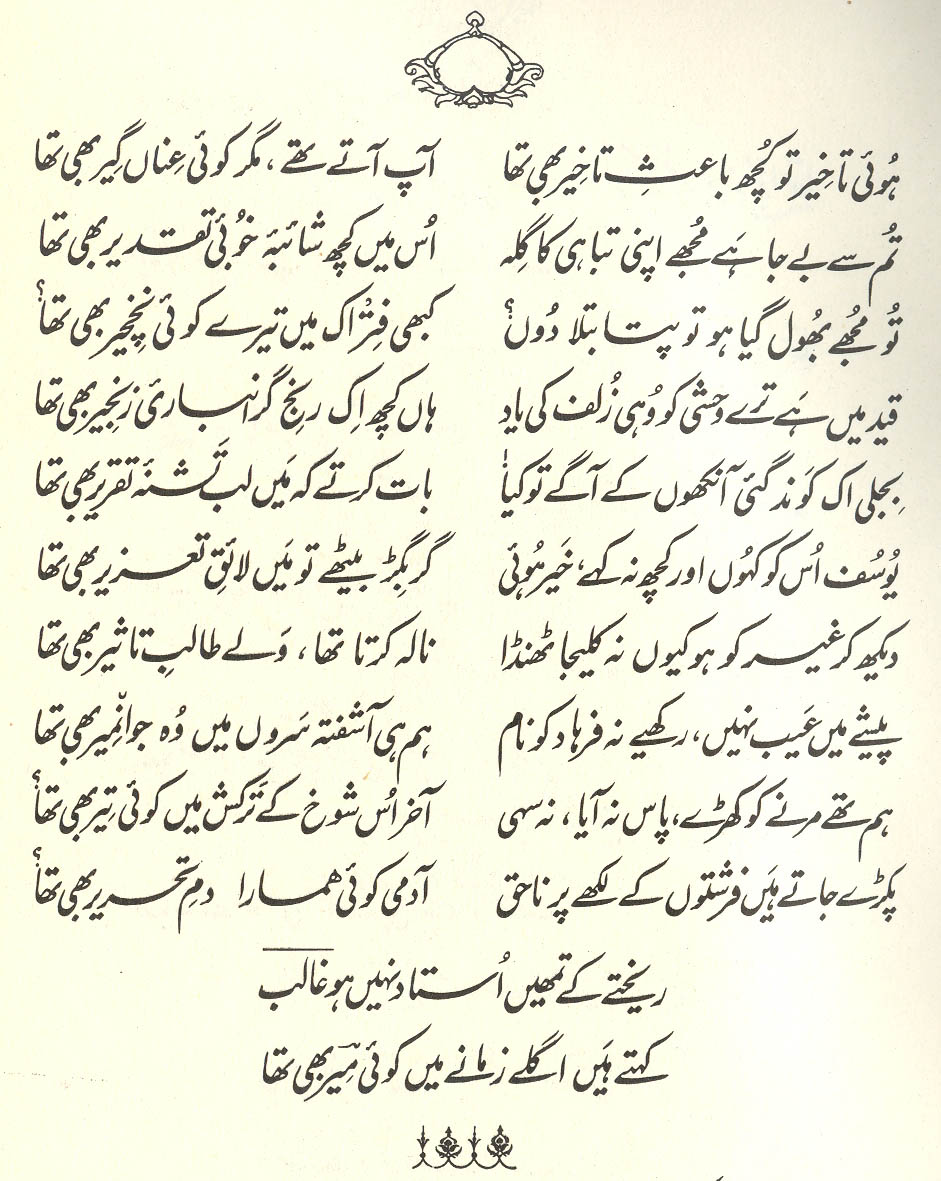
Here he has expressed the idea that if the beloved showed her face for a single moment, then what comfort can that be?
==Urdu text: Yadgar-e Ghalib , p. 128
That is, if she gave one glimpse of herself and then went away, then so what? She should have conversed with me, for I was longing for that as well. (36)
== Nazm page 36

In the first line the word 'lightning' came in. Thus the poet's mind moved toward 'thirsty-lipped'. That is, only lightning flashed, rain didn't fall. That is, I saw the face, but didn't hear any words. Lightning flashing is a sign of rain coming down. (87)
In Urdu poetry [], this kind of implication s, which would be in a complete utterance and a complete sentence, are very few. (104)
If we give it more attention and thought, then we realize that in this verse Ghalib has imagined himself to be a stand-in for Hazrat Moses . He says to the Lord (by way of mischievousness), only seeing one glimpse of You cannot satisfy me. I was longing to speak with you. The foundation of this verse is that in truth, a bolt of lightning flashed before Hazrat Moses's eyes, and he fell unconscious. (364)
Khvajah Hali has also said that a specialty of Ghalib's is that he has used in his poetry in Rekhtah , no less than in his poetry in Persian, metaphor and implication and allegory , which are the life of literature and the faith of poetry. Poets composing in Rekhtah have paid small attention to this. Metaphors have undoubtedly been used as part of the idioms of Urdu, but with no particular purpose. Rather, metaphors have dripped constantly from their pen with no purpose, in their ardor for idiomaticness.
Ghalib used the kind of implications that assume the form of a whole utterance and a whole sentence. In Urdu poetry such examples are very few. One such shining example is this verse. (140-41)
God revealed himself to Hazrat Musa, the Islamic counterpart of Moses , on Mount Tur, in the form of dazzling light. Here, the use of for the lightning bolt cleverly opens a range of reactions to it (see the definition above): a 'single, sole' one; 'only one' of it; a 'certain one'; a 'unique, singular, preeminent' one. Thus with his usual 'mischievousness' [], Ghalib expresses dissatisfaction: a mere lightning bolt, even an excellent one, is hardly sufficient! It's dismissed with the enjoyably idiomatic 'so what?' [].
The desire to hear the Divine speech would surely come next-- and the wordplay of being 'thirsty-lipped' for speech makes it clear that speech is like water in its indispensability and life-sustaining power. (Indeed, comes from the Arabic root , 'to pour', so an analogy to water is not farfetched.) Bekhud Mohani nicely points out that lightning without rain amounts merely to frustration and sterility.
Being 'thirsty-lipped' also suggests that not only the ears, but the lips too, wish to participate-- that is, the speaker longs not just to hear the Beloved's words, but to reply, to have a conversation (as would suggest). The semi-divinized human beloved is also quite possible as the subject of the verse: a conversation with her sometimes seems to be about as attainable as one with God, anyway. (And her house is even harder to get into than Paradise, as we learn from 31,3 .)
For other verses about lightning and the Divine presence, see 60,11 and 149,2 .
In this verse the beloved seems most probably to be God, but it's also not impossible that the lightning could be a glimpse of the (human) beloved's radiant presence.
graphics/lightning.jpg