Verse 3after 1847aa;Nhotaa
G5
In this meter the first long syllable may be replaced by a short; and the next-to-last long syllable may be replaced by two shorts.
1
after a whole lifetime of abstinence/continence, he would have granted admission once/finally
2
if only Rizvan alone/himself were the Doorkeeper of the beloved's door!
'Timidity, cowardice; --apprehensiveness of doing wrong; abstinence from anything doubtful; --the fear of God; --temperance, continence, chastity'.
'Once, one time, all at once; at last, at length'.
| References | |
|---|---|
| Arshi, Imtiyaz Ali | Ghazal# 40 |
| Raza, Kalidas Gupta | 396-397 |
| Hamid Ali Khan | Open Image |
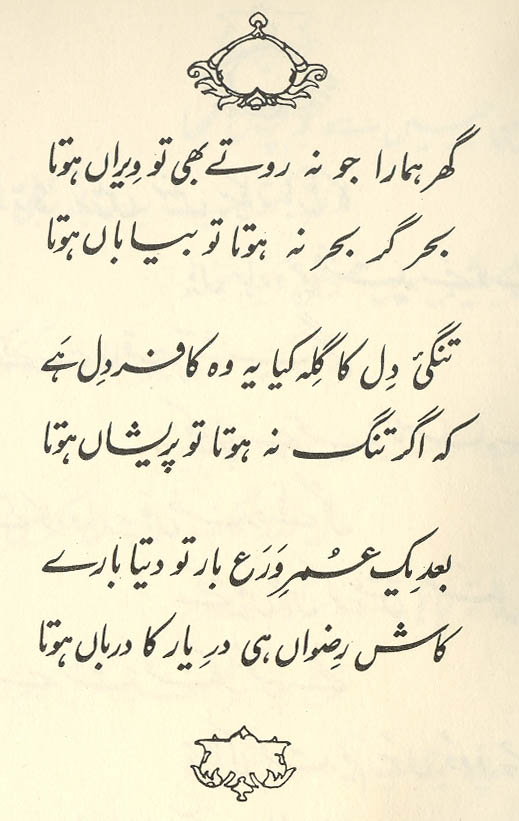
That is, Rizvan has at least this much to be said for him, that after a whole lifetime of worshiping, he allows one to enter Paradise. (31)
== Nazm page 31

Urdu text: Vajid 1902 {31}
If only the doorkeeper were Rizvan (who is the doorkeeper of Paradise), it could have been hoped that after a lifetime of worship he would not have prevented me [from entering]. (61)
The point is that entry into Paradise is possible, but access to the beloved's house is impossible. (77)
../apparatus/txt_sets.html ABOUT : This simple-looking little adverb can mean either 'once' or 'finally'. Often it's used straightforwardly, usually with the sense of 'finally'. But sometimes it's used in clever ways that evoke both possibilities. Other such examples: 43,4 ; 105,1 . In any case, the present verse is one of the very few instances in which the word doesn't occur at the beginning of the second line.
This ghazal, only three verses long, is unusual in not having a formal closing-verse .
The verse relishes its wordplay: and ; and . There are wild sound effects too: by my count, of the 22 long and short vowels in the words of the verse, 15 are either or , while only 7 are everything else combined.
The first line is uninterpretable in isolation, so that under conditions of mushairah performance we would have to wait for the second line before we could grasp the meaning. And then in the second line the amusing, subtle powers of speech-- exclamatory in this case-- are once again displayed to advantage. To say that the beloved's Doorkeeper is as forbidding as Rizvan, the guardian of Paradise, might seem an obvious simile. But here, thanks to the power of implication , it doesn't even need to be said that the beloved's Doorkeeper is far more severe than Rizvan. Instead, the lover merely exclaims, 'Oh if only it were just Rizvan at her door-- after a lifetime of submission, he would let me in!'.
The unselfconscious exclamation, and that understated, casual little , work wonders: they convey both the informational, or , point, and the lover's reaction to it. The lover is so cavalierly dismissive of Rizvan that he isn't even aware of being dismissive of him: his whole mind is fixed on the far harsher, far more unjust Doorkeeper who actually confronts him.
For after all, he doesn't want to get into Paradise, he wants to get into the beloved's house. And having said that, we at once realize that there's a real difference between the two. The beloved commands a Paradise more truly heavenly than the official one. God is more fair-minded and approachable than the beloved, and Rizvan more mellow and compassionate than her Doorkeeper. It would be very difficult to read this verse as addressed to a divine rather than human beloved; for more such verses, see 20,3 .
graphics/door.jpg