Verse 1after 1847aa;Nhotaa
G5
In this meter the first long syllable may be replaced by a short; and the next-to-last long syllable may be replaced by two shorts.
1
even/also if we hadn't wept, then our house would have been desolate
2
if the sea were not the sea, then it would be the desert
'(be + aab + aan), s.m. Desert, wilderness'.
| References | |
|---|---|
| Arshi, Imtiyaz Ali | Ghazal# 40 |
| Raza, Kalidas Gupta | 396-397 |
| Hamid Ali Khan | Open Image |
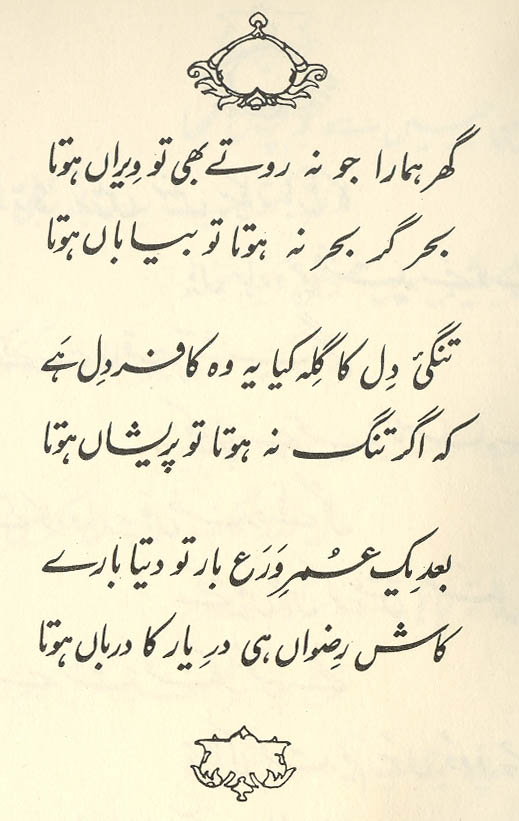
That is, because of weeping the house is becoming a sea; if we did not weep, then it would be a desert. (31)
== Nazm page 31

In short, ill fortune never under any circumstances refrains from manifesting itself. (61)
If I had not stayed at home and wept, then madness would have taken me into the desert, and in that home I would have spent my time sifting the dust. It's necessary for the drying up of tears to mean becoming a desert; otherwise there wouldn't be any reference to the sea. (76)
The first point worth noting in the verse is the affinity between weeping and the sea. If we consider both lines together, then it becomes clear that because of the abundance of weeping the house has not remained a house, but rather has become wholly a sea. The 'if the sea were not the sea' statement is not only a generalized statement, but rather applies especially to this house that has already become desolate through the abundance of tears.
A second question can arise, of what the relationship is between weeping and desolation. It seems that weeping and wailing and lamenting create not desolation, but tumult and confusion. But between weeping and desolation there are two subtle connections. One is that people have grown irritated with the sound of continual lamentation and have left the house, and a mood of desolation has been created. The other (and more enjoyable) suggestion is that the abundant flow of tears has created a flood. In a flood, people leave their houses and flee. A flood is more suitable also because without it a house cannot turn into a sea.
The desolation brought by the flood creates another point: that in such a situation, when others have left the house empty, the speaker is present right there and is seeing the spectacle of the desolation-- either because he had no strength for flight, or because he prefers death by drowning ove r life. Or else, again, because he is so settled within the four walls of this house-- or rather, imprisoned within them-- that he cannot flee.
Thus in the whole verse two pictures emerge. One is the overruling command of inescapable fate-- that is, the chain of destiny-- which is made of water. And the second is the picture of some oppressed one or madman who is constrained by the desolation he himself has brought on himself.
But the tone of the verse is not hopelessness or sorrow or regret, but rather there's a sort of pride in it, a contentment and joy at his condition. This mood is common in Mir -- that the theme is one of ruin and destruction or defeat, but the tone is one of pride and dignity. Here are some obvious examples:
M 6,1 ; M 103,7 ; M 950,9 ; M 297,4 .
Ghalib got a lot from Mir, especially this tone: the talk is of destruction, but the style is one of pride or dignity.
== (1989: 48-49) 2006: 64-66
Compare 17,2 , in which weeping and desertification are linked in an equally evocative way.
Once again we see the common 'A,B' pattern: two independent statements, one in each line, with no logical link supplied. In this case the degree of parallelism is considerable as well. Here are some possibilities:
1) These might be two independent statements about similar conditions in very different places. How striking, how thought-provoking-- our house has certain perverse tendencies involving water and desolation, and the sea has similar ones.
2) Or the second statement might be a kind of explanatory analogy, helping us interpret the first. Just as the sea is so inherently desolate that if it were not a wet desolation it would be a dry one, the same is the case with our house. (And just as it seems impossible for the sea not to have been the sea, it would be similarly impossible for us not to have wept.)
3) Or the second statement might be meant to be directly mapped onto the first. Our house is a sea, because of the turbulence, volume, and saltiness of our tears, and it has the same irresistible tendency toward desolation that the sea does, such that if it were not a sea it would be a desert. That is, neither our house nor the sea would ever be a place where people could live.
One reason this verse feels so flowing is that the semantic rhythm of the phrases harmonizes well with the rhythm of the metrical feet. Also, in a wonderful example of affinity, the word , meaning 'desert', is derived from the literal + , 'without water' (see the definition above). Here is a verse that invokes the wild powers of water-- and the only place where 'water' itself appears is in a word that denies its presence. That second line is especially hypnotic.
The same line of thought, about the irremediable perversity of the 'house' (or heart), continues in the next verse, 31,2 .
Compare Mir 's take on the relationship between tears and desertification: M 1103,7 .
graphics/ruins.jpg