Verse 2after 1847aa;Nhotaa
G5
In this meter the first long syllable may be replaced by a short; and the next-to-last long syllable may be replaced by two shorts.
1 a
about the distress/'narrowness' of the heart, as if there could be a complaint! --this is such an infidel heart
1 b
about the distress/'narrowness' of the heart, what a complaint there is! --this is such an infidel heart
2
that if it were not distressed/'narrow', then it would be anxious/'scattered'
'Straitness, narrowness, tightness, closeness; scantiness, scarcity, distress, difficulty'.
'Dispersion, scattering, confusion, disorder, derangement, perplexity, bewilderment, perturbation, distraction; distress, embarrassment, trouble, misery.'.
| References | |
|---|---|
| Arshi, Imtiyaz Ali | Ghazal# 40 |
| Raza, Kalidas Gupta | 396-397 |
| Hamid Ali Khan | Open Image |
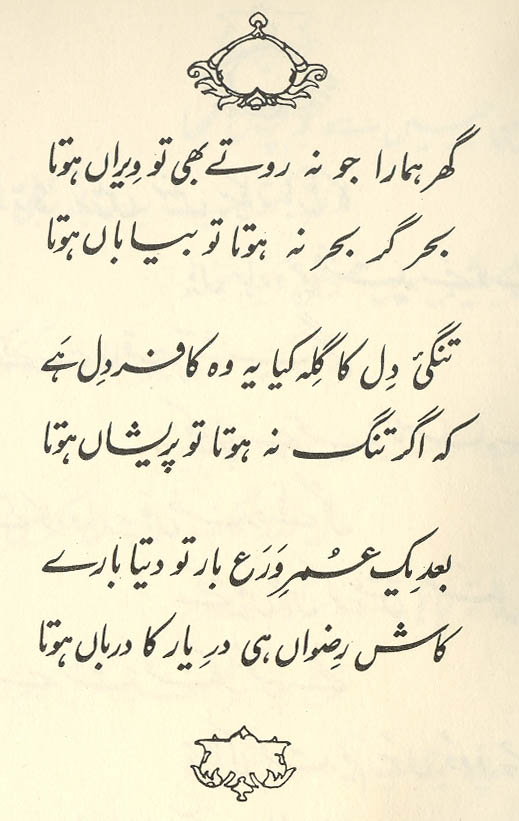
== Nazm page 31

In this verse too, he presents with another device and in other words the theme of the opening-verse [ 31,1 ] above. (61)
(1) We are so unfortunate that if the heart were happy, then it would be so happy that the excess of happiness would make it anxious (the heart would be torn apart).
(2) If the heart remains sad, then what cause for complaint? It is such an enemy of peace that if it were satisfied, then it would be anxious at the absence of anxiety and difficulty. (76)
has two meanings: 1) sorrowful; 2) it's the opposite of , that is, it's the state of being contracted. has two meanings: 1) sorrowful; 2) it's the opposite of , that is, it's the state of being spread out. There's an between the two words, and in this is the pleasure of the verse. (348)
As Bekhud Dihlavi points out, this verse has much in common with the previous one, 31,1 . In both verses, the lover's heart/house domain is depicted as irremediably perverse and turbulent. But this verse is somewhat less multivalent, since its two lines are logically connected in a clear and specific way.
Instead, its great source of pleasure is its wordplay, as Chishti observes. If the heart were not 'narrow'/distressed, it would be 'scattered'/anxious (see the definitions above). The two abstract nouns and have literal meanings that are almost opposite; they also have common metaphorical meanings that are almost the same. This well-exploited juxtaposition provides an excellent gauge for the perversity of the heart.
There's also the effortless multivalence generated in the first part of the first line by the powers of . 'As if there could be a complaint!' (1a)-- that is, complaining is useless, for if the infidel heart changed its ways, it would just flip them over into something equally vexatious. Or: 'What a complaint there is!' (1b)-- that is, what deep cause for complaint the infidel heart constantly gives, and how innately aggravating it is.
The colloquial, easy rhythm, just a natural good-natured scolding or lament, is perfect. The rueful, affectionate tone of (with meaning 'that', but also here something like 'such a') is tolerant, resigned, perhaps almost proud of such absolute perversity. (Sometimes the owners of badly behaved dogs talk about their pets like this.)
Compare the similar tone in which the heart is referred to in 107,6 . And compare the juxtaposition between undesirable narrowness and undesirable distractedness in 203,3 .
graphics/heart.jpg