Verse 61855aadnahii;N
G9
In this meter the next-to-last long syllable may be replaced by two shorts.
1
in the world grief and joy may be together-- what do we care about that?!
2
the Lord has given us {such a / 'that'} heart-- that is not joyous
'Together, one with another, one against another; at once'. (Steingass p.212)
| References | |
|---|---|
| Arshi, Imtiyaz Ali | Ghazal# 115 |
| Raza, Kalidas Gupta | 458-459 |
| Hamid Ali Khan | Open Image |
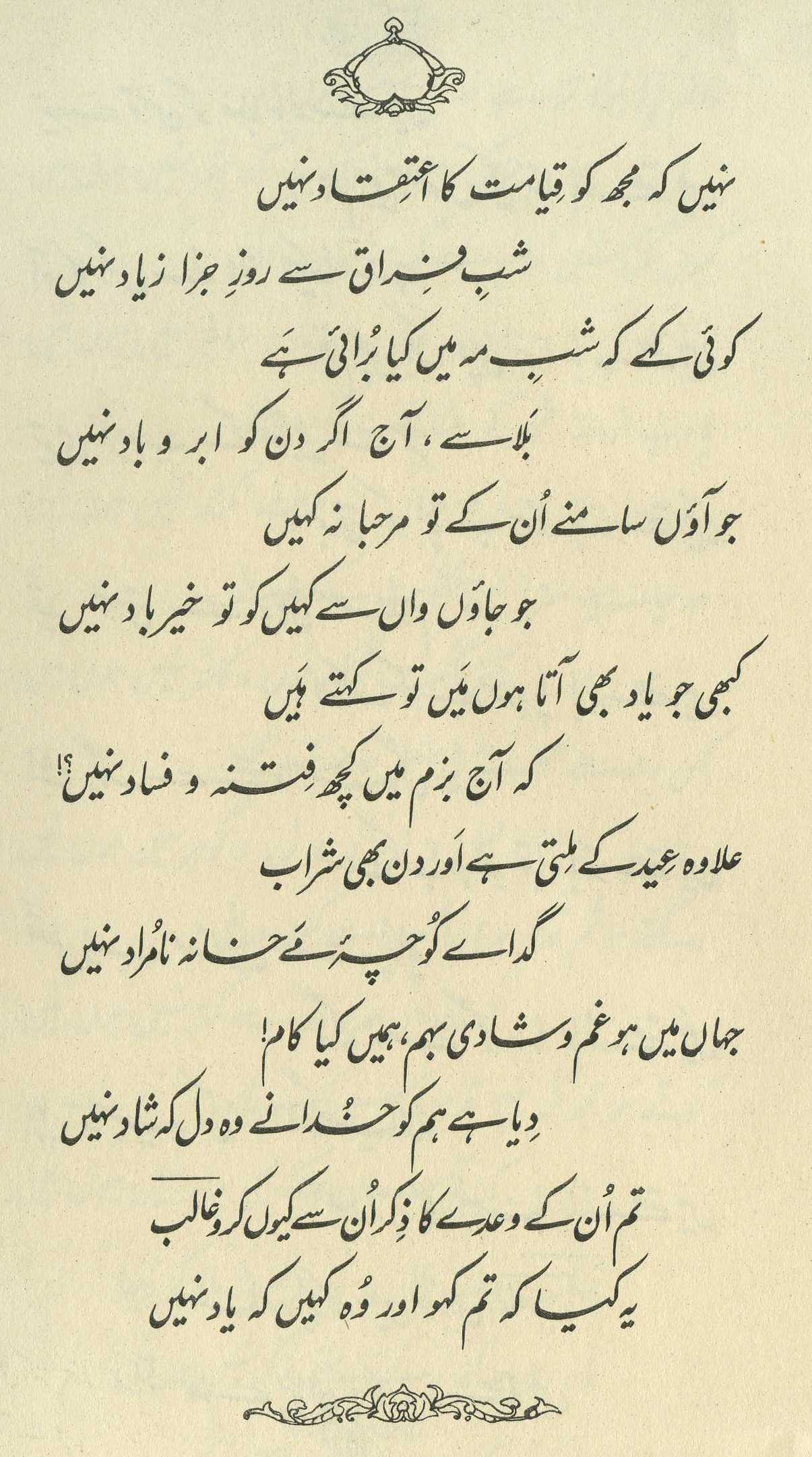
They mention the coexistence of grief and joy in the world, where they wish to express contempt for the delight and pleasure of the world. In this verse, the author has created the freshness of expressing a vain longing for the coexistence of grief and joy. He says -- that is, we are deprived, we've never experienced even that happiness that is mixed with grief. And by expressing a vain longing for grief-mixed happiness, the meaning emerges that the poet feels extreme grief, such that he expresses a longing for such contemptible and useless happiness, and this is the cause of eloquence [] in this verse. (112)
== Nazm page 112

In the world if grief and joy occur together, then let them. Our heart is never happy. Why do people grieve because the world's happiness is unworthy since after it grief always occurs, so that sorrow and happiness appear together? We are so deprived of joy that we've never experienced, in addition to sorrow, any happiness at all. (214)
In the first line, the repetition of nasal [] and sounds adds to its musicality. To the extent that it's a question of a commentary, [Nazm] Tabataba'i has written a very fine one. [It is quoted.]
But there's another aspect as well. The coexistence of grief and joy is the law of nature. In the Qur'an it's been said [94:5-6], 'So, verily, with every difficulty, there is relief: verily, with every difficulty there is relief'. If there's grief, then there's also happiness, and if there's happiness then there's also grief. But our melancholy is not such that in our heart there's nothing but grief. The expression in the second line is the limit of eloquence. If he had said, 'the Lord has given us a heart that is entirely devoted to grief', then it would have been another matter entirely. He has said, our heart is that heart that is not joyous. By the logic of the reading, it emerges that the heart is utterly empty; there's not even grief in it. Because if the Lord had given us grief, then He would have bestowed happiness as well. When He didn't give grief, then it's as if He gave nothing....
[Consider one of Ghalib's Persian verses, which can be translated as:] 'I am not even an autumn-stricken tree, because the tree to which autumn comes is one to which spring also sometimes comes, and it sometimes prides itself on its flourishingness. I am that tree upon which autumn has not come, and which remained utterly deprived.' The Urdu verse is more eloquent [], because its second line is an example of perfect negation.
== (1989: 160-61) 2006: 182-83
It might seem that this verse would be relatively translatable, but in fact it's not. The sound effects are of course uncapturable-- look at how well works in the first line. But it's the second line that's the real killer, as Faruqi observes. The combination of the flowing, alliterative sounds and the effortless, fluid, yet stark dignity of the phrasing simply can't be captured in English. , although it looks so straightforward, loses painfully much no matter what you do with it.
Just for a thought experiment, consider how it would be if the line read , which is in standard word order. (Of course, it wouldn't quite scan, but let's leave that aside for the moment.) The effect would be much less colloquial, and we would lose the strong emphasis (exasperated but perhaps fond as well) both on the , which has been created by bumping it up to the beginning of the line, and on , which has been carefully located at a metrically emphatic point. Since the meter consists of foot A, foot B, foot A, foot C (- = - = / - - = = / - = - = / - - =), the beginning of the second occurrence of foot A echoes the beginning of the line itself, and is almost (though not quite) preceded by a quasi-caesura. Needless to say, this kind of thing, so effective in Urdu, is impossible to capture in English.
And I think another part of the loss is the untranslatability of . You can't really say in English, 'the Lord has given us such a heart that it's not joyous' (and even if you could somehow finagle it, it wouldn't convey the same meaning). But in Urdu, the effect is that he's given us not just 'a' heart, but emphatically a special, particular heart (perhaps even a one-of-a-kind one) with a unique quality of its own: it simply, flatly, once-and-for-all is 'not joyous'. But there's also an equally untranslatable undertone of familiarity, of acceptance, of exasperated indulgence-- 'oh, that heart!'
Compare the similar tone in which the heart is referred to in 31,2 .
This verse always reminds me of the two urns of the gods from the last book of the Iliad. Here's the passage in the Lattimore translation (The Iliad of Homer, trans. Richmond Lattimore, University of Chicago Press, 1951, p. 489). Achilleus says comfortingly (?) to Priam,
There are two urns that stand on the door-sill of Zeus. They are unlike
for the gifts they bestow: an urn of evils, an urn of blessings.
If Zeus who delights in thunder mingles these and bestows them
on man, he shifts, and moves now in evil, again in good fortune.
But when Zeus bestows from the urn of sorrows, he makes a failure
of man, and the evil hunger drives him over the shining
earth, and he wanders respected neither of gods nor mortals.
The source of the trouble, in Homer as well as in this verse, is not in the luckless individual but in the divine power that has created his perverse destiny. The 'man of sorrow' has a fate, or a heart, so unrelievedly bleak that he longs-- vainly, of course-- for the very mixture of (trumpery, transient) joys and sorrows that the rest of us complain about.
graphics/heart.jpg