Verse 51855aadnahii;N
G9
In this meter the next-to-last long syllable may be replaced by two shorts.
1
in addition to Eid , wine is available even/also on other days
2
the beggar in the street of the wine-house is not disappointed
'Having the desires unrealized; unsuccessful, unprosperous; disappointed; dissatisfied'.
| References | |
|---|---|
| Arshi, Imtiyaz Ali | Ghazal# 115 |
| Raza, Kalidas Gupta | 458-459 |
| Hamid Ali Khan | Open Image |
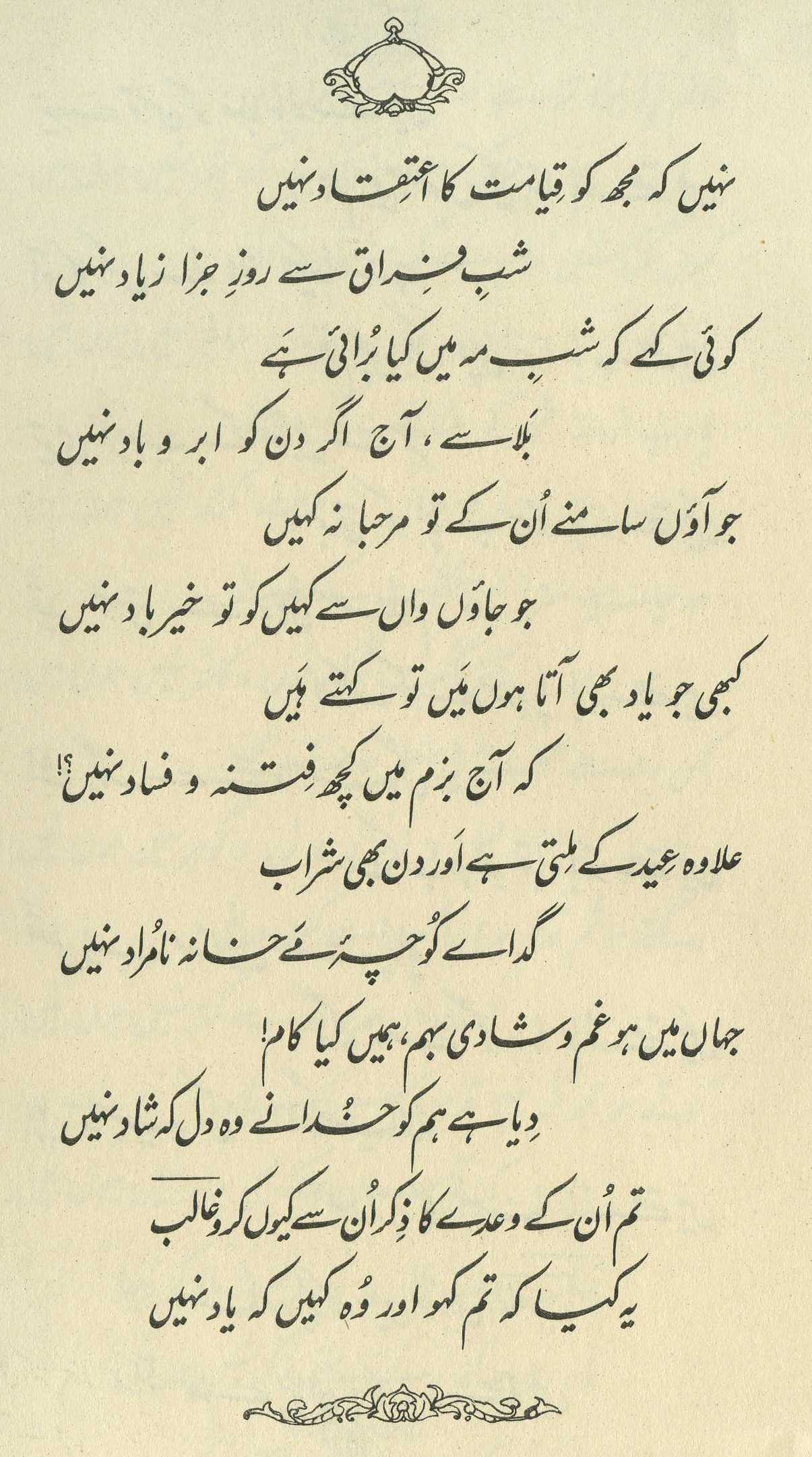
That is, in the world the only real desire and goal is wine; the unsuccessful person is the one who would not obtain wine. The first line is in the tone of a Faqir : 'My friend [], not just Thursday, but other days too, something can be had there'. (111)
== Nazm page 111

On the day of Eid, more charity is given to the poor and needy, and is given most especially. He says, in the winehouse no special regard is paid to Eid, the generosity of the winehouse-keeper [] continues every day. (162)
The Faqirs of the street of the winehouse never wander around empty-handed. It's not at all dependent on Eid. Wine is available every day. He shows the open-heartedness [literally, 'ocean-heartedness', ] of the rakish ones [], and the narrow-heartedness [] of the pious ones []. That is, there [among the pious ones] gifts are given on Eid alone. Here [among the rakish ones] charity is given every day. It's possible that by 'beggar in the street of the winehouse' he might refer to himself. (214)
Like a mushairah verse, this one sets up a piquant, uninterpretable first line. But even when, after a duly suspense-building pause, we get to hear the second line, we still can't put together any one single meaning. It's clear that a strong contrast is intended between the fortunate, non-disappointed beggars of the wineshop street, and all other, ordinary beggars who frequent other streets. But what exactly is the nature of the contrast? Depending on how we shift the stresses on different contrasts with the first line, here are some possibilities:
=Beggars in other streets receive gifts only on Eid.
=Beggars in other streets receive wine only on Eid.
=Beggars in other streets are disappointed because they receive gifts only on Eid.
=Beggars in other streets are disappointed because the gifts they receive on Eid don't include wine.
=Beggars in other streets are disappointed because they receive wine only on Eid.
Isn't this a real tour de force of structure? Such a simple-looking verse, and yet it effortlessly generates-- in fact, it can't be prevented from generating-- so many possible readings.
All the meanings are 'rakish' [] and full of 'mischievousness' [], because they all favorably contrast the virtue and generosity of the winehouse-keepers and wine-drinkers with that of the pious, dutiful Eid-observers. Some meanings even have the additional fillip of implying that wine is given in charity on Eid (as of course it is not).
There's also the elliptical, suggestive feeling of the second line, with its strong hint of mystical possibilities.
graphics/winehouse.jpg