Verse 31855aadnahii;N
G9
In this meter the next-to-last long syllable may be replaced by two shorts.
1
if I would come before her, then she wouldn't say, 'Welcome!'
2
if I would go from there to somewhere [else], then no 'Farewell!'
'Welcome to ampleness, or to a spacious or roomy place; welcome! hail! God bless you! bravo!'.
'May he prosper; farewell!'
| References | |
|---|---|
| Arshi, Imtiyaz Ali | Ghazal# 115 |
| Raza, Kalidas Gupta | 458-459 |
| Hamid Ali Khan | Open Image |
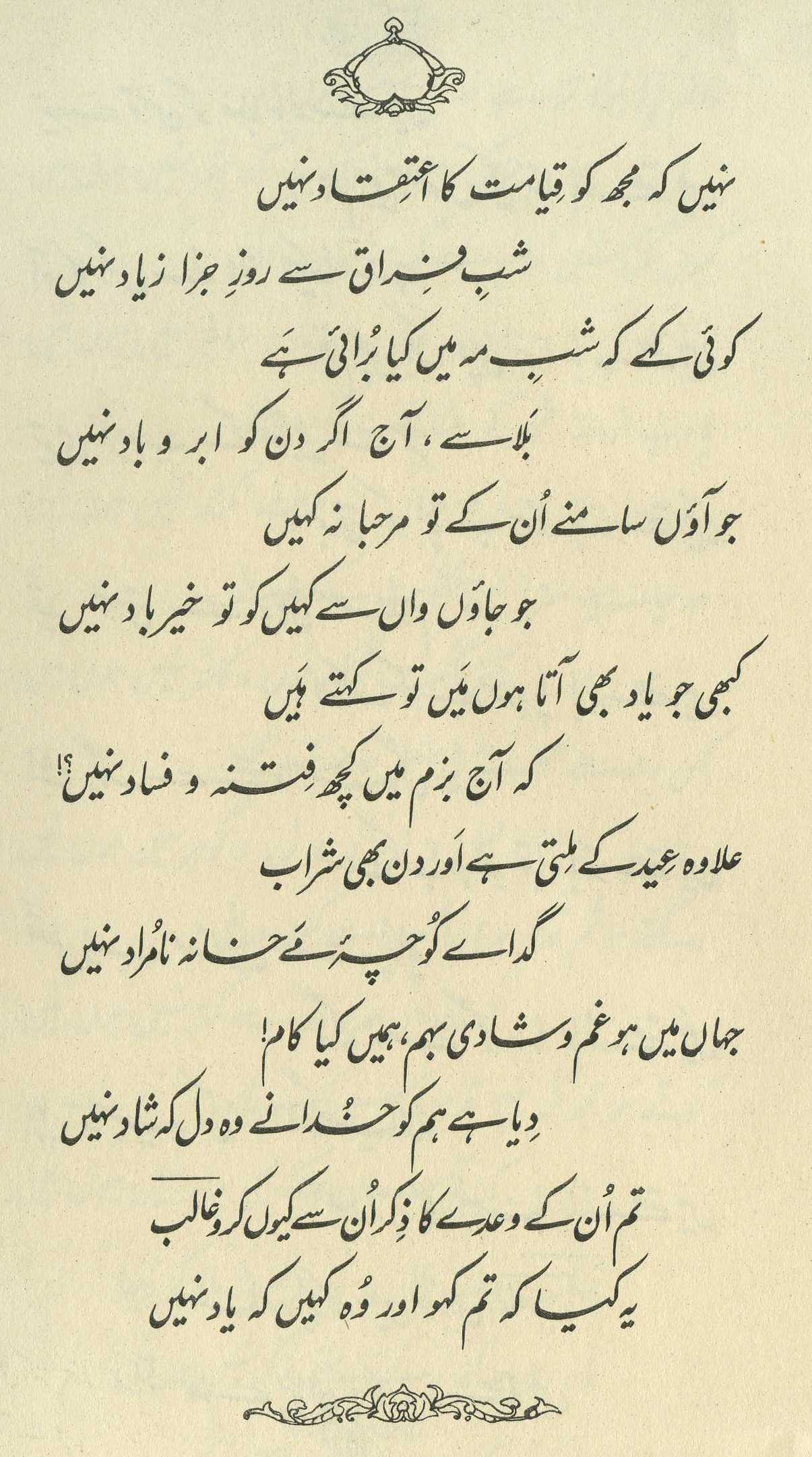
It's a complaint about unkindness. And has the meaning of 'direction', and it ought not to be considered redundant []. The poets of this [=Nazm's own] era are often in error about this: in and and they consider to be redundant, and avoid using it. Thus when they write they declare the to be redundant, and have abandoned it; and this opinion itself is erroneous. (111)
== Nazm page 111

In this verse Mirza Sahib complains of the beloved's unkindness and indifference. The meaning is that when I go to meet her, when she sees me she's not happy, and when I take my leave, she doesn't say 'farewell'. On both occasions she shows carelessness/indifference. (162)
When somebody comes, then the Iranis say 'Welcome!' and when he goes, then they say 'Farewell!'. Whether they have any acquaintance or relationship with that person, or not. (213)
The verse feels like the first half of a small informal verse-set that might include this one and the next one, 107,4 .
Both of these verses, simple and transparent, non-multivalent, non-ambiguous, seem like 'translatables', and yet in another sense they also don't. There's a lot of 'ghazal world' knowledge that the reader must have in order to understand the relationship of lover and beloved that could give rise to these verses. Can they really be made into anything in English?
graphics/welcome.jpg