Verse 31816abmujhe
G1
1
oh Lord , from whom is justice/recompense owed for this/that distractedness/unease?
2
now I feel envy of the tranquility/ease of prisoners!
'Distraction, perturbation, uneasiness; misery'.
'Statute, law; equity; justice; crying out for justice, complaint; revenge'.
'To dispense justice; to do justice (to), to appreciate, to give due praise (to), to praise duly'.
'Ease, rest, repose, quiet, tranquillity; convenience, comfort; indulgence, enjoyment'.
| References | |
|---|---|
| Arshi, Imtiyaz Ali | Ghazal# 164 |
| Raza, Kalidas Gupta | 237 |
| Nuskhah-e-Hamidiyah | 249-250 |
| Asi, Abdul Bari | 260 |
| Gyan Chand | 377-378 |
| Hamid Ali Khan | Open Image |
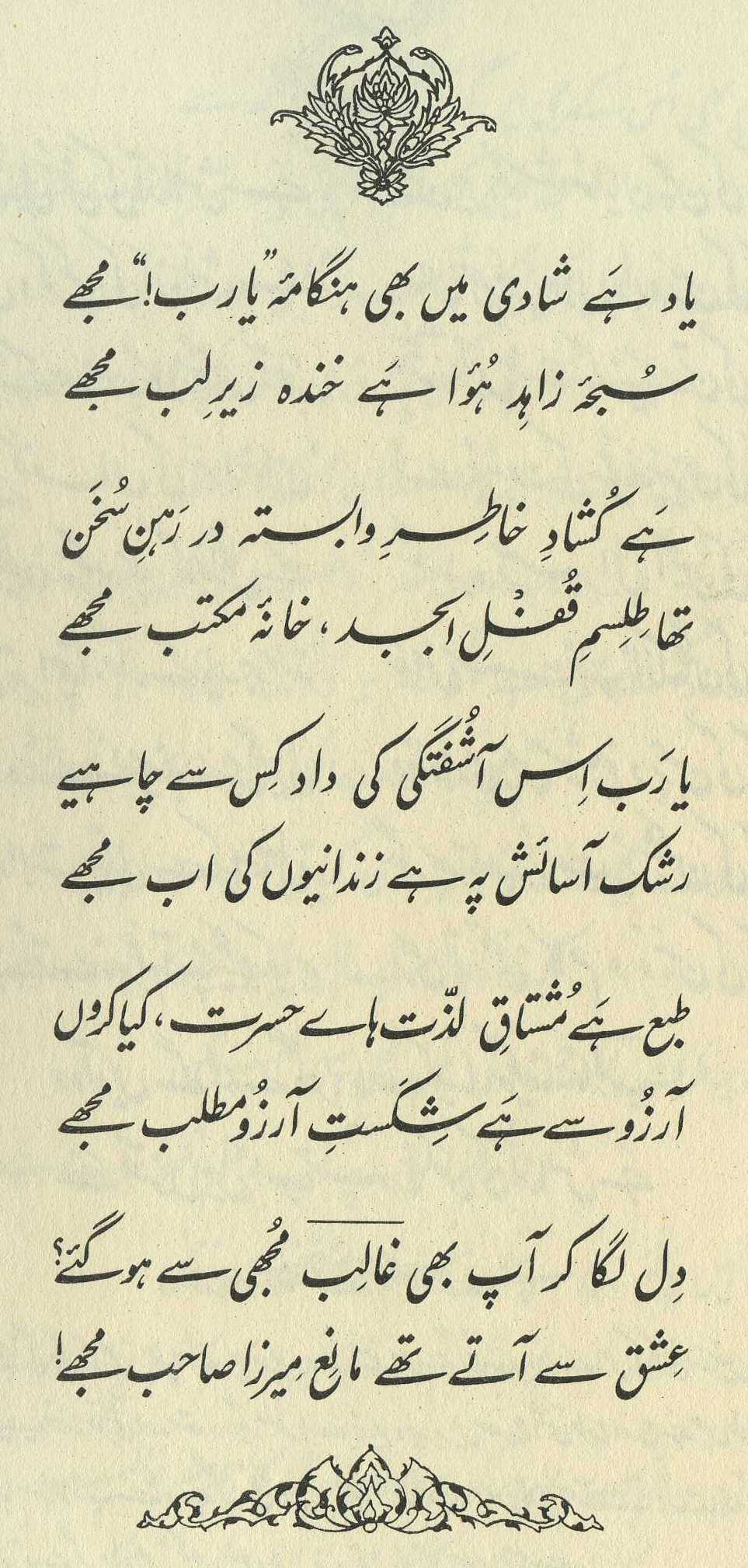
, that is, ; and from 'now' the meaning emerges that when I was in prison, then I had an ardor for desert-wandering; now that I'm in the desert, I feel envy of the people in prison. (228)
== Nazm page 228

He says, 'Oh Lord, from whom would I expect justice/recompense for my desert-wandering? Because when I was in the prison cell, the ardor for desert-wandering used to keep me restless, and now that I am a wanderer in the desert, I envy the people in the prison. (286)
The second line tells us that the one to whom the troubles of prisoners would seem to be repose, and such repose that he would envy it-- what kind of troubles, what kind of difficulties, must he be enduring, and what must be passing through his heart! (403)
The commentators take the obvious interpretation, and of course it works. But the structure of the verse makes it equally clear that we're invited to go beyond the obvious. The first line is , and spectacularly interrogative: it asks the Lord from whom justice or recompense would be expected, for 'this'-- or 'that', as an equally possible reading-- 'distractedness'. We thus can't tell what kind of 'distractedness' is meant, or by whom it is or might be felt, or from whom there might be possible 'justice' or 'recompense'. Under mushairah performance conditions, we have to wait, with our curiosity piqued, for the second line.
The second line, also , is spectacularly exclamatory. It doesn't address the question asked in the first line in any straightforward way. But it does present two available candidates for the slots of 'distractedness'-sufferer and 'justice'-provider that were created in the first line: the speaker himself, and 'prisoners'. And the 'justice'-provider slot is a versatile one. For to 'do justice to' [] needn't mean actually to redress a wrong; it can also mean, as the phrase does in English, to properly appreciate, to understand, to give credence to (see the definition above).
How are we to assign these two parties to these slots? As usual, we're left to decide for ourselves. Here are some possibilities, depending on which elements of the verse we choose to emphasize:
=From whom might the speaker claim justice/recompense for this extreme degree of distractedness? He formerly thought that a prisoner's lot was the most painful one, but now he realizes that it's possible to suffer indescribably much more-- and since he's not (any longer?) in an outwardly painful situation, like a prisoner, no one can understand his distractedness.
=From whom might the speaker claim justice/recompense for his distractedness? Certainly not from the prisoners, since their distractedness is nothing at all compared to his own, so they can't understand and sympathize and 'do justice to' what he suffers.
=From whom might the speaker claim justice for his distractedness, oh Lord? Prisoners are justly punished for their crimes, and without being guilty of any crime he is suffering far more painfully than any real criminals-- so where can he, an innocent person, find justice?
=From whom might the speaker claim justice/recompense for his distractedness, oh Lord? If not from the Lord himself, then certainly not from anyone else, for who can understand what he suffers?
On the complexities of , see 53,4 .
A verse with similar-- or even richer-- structural ambiguities: 35,8 . And more to the point, a verse that also juxtaposes a condition of (undesirable) 'narrowness' to one of (undesirable) 'distractedness': 31,2 .
graphics/prisoncell.jpg