Verse 11816abmujhe
G1
1
even/also in joy I remember the clamor/tumult of 'oh Lord !'
2 a
a quiet/'under the lip' laugh/smile has become the prayer-beads of the Ascetic , to me
2 b
the prayer-beads of the Ascetic have become a quiet/'under the lip' laugh/smile, to me
'A convention, an assembly, a meeting; a crowd; --noise, tumult, commotion, confusion, uproar; sedition, disturbance, disorder; an affray; assault'.
'Laughing, smiling; a laugh; laughter; --a laughing-stock'.
'Under the lip, slightly uttered, inarticulate, mumbled; in an under-tone, in a whisper, softly; inarticulately'.
| References | |
|---|---|
| Arshi, Imtiyaz Ali | Ghazal# 164 |
| Raza, Kalidas Gupta | 237 |
| Nuskhah-e-Hamidiyah | 249-250 |
| Asi, Abdul Bari | 260 |
| Gyan Chand | 377-378 |
| Hamid Ali Khan | Open Image |
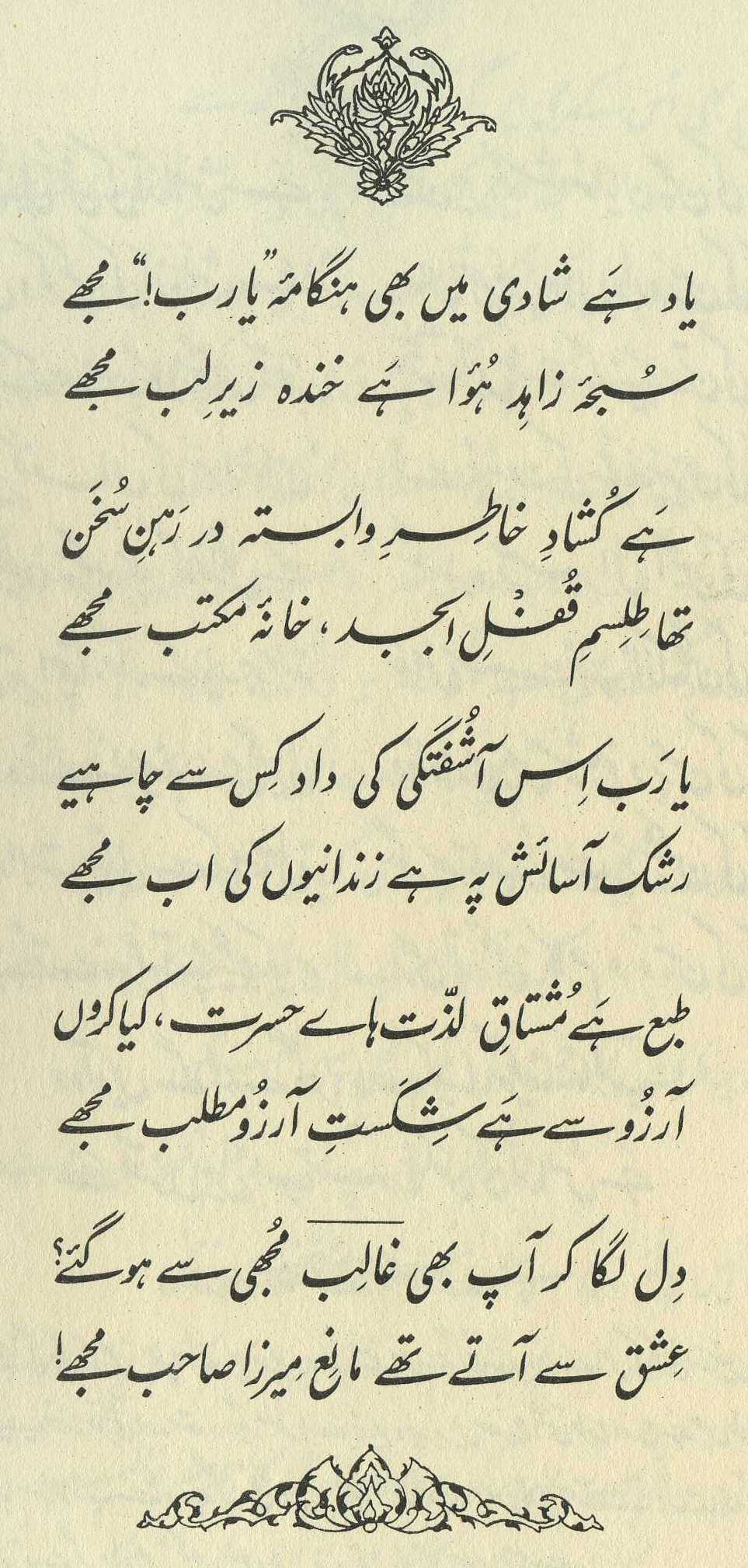
The meaning of in Persian idiom is that of a cry to the Lord for help, and by the prayer-beads of the Ascetic is meant the hidden 'zikr' that is done very softly on the lips. He says that even in joy I haven't forgotten the clamor of ; my hidden smile is as if it's the prayer-beads of the Ascetic. (228)
== Nazm page 228

He says, 'Even in joy I remember the clamor of . Even my smile is as if it's the Ascetic's hidden zikr.' The meaning is that in no state do I remain heedless of remembering God. (285)
The word is full of meaning. That is, I used always to lament anyway; nowadays some additional distresses have come upon me, the deep impression of which is still on the heart. Even in a state of happiness, when the image of those distresses appears before me, as it often does, with that thought I writhe and begin to call on the Lord. So when this is my state in the clamor/tumult of joy, it can be guessed what kind of difficulties and troubles those must be, and what state my heart must be in. (402)
Here's a classic verse of 'symmetry', with two readings of the striking second line, each of which works elegantly, though of course differently, with the first line. Does the here refer to a 'laugh', or a 'smile'? The juxtaposition with the 'clamor, tumult' in the first line may suggest quiet laughter, while the curving necklace of prayer-beads (I'm avoiding the specifically Catholic term 'rosary') can readily be compared to a smile.
In either case, the two main readings generated by the 'symmetry' of the second line work well with both:
=(2a) A small, private smile/laugh has become, to the speaker, the Ascetic 's prayer-beads-- because what the Ascetic does with his prayer-beads, the speaker does with his private 'zikr'-embodying smile/laugh. That is, even when smiling/laughing in (the appearance of) joy, he is really engaged in prayer.
=(2b) The Ascetic's prayer-beads have become a small, private laugh/smile to the speaker-- because the thought of the ostentatious outward piety of the Ascetic, who makes a great show of using his prayer-beads, amuses him. Unlike the Ascetic, the speaker can and does remember the Lord even in seemingly distracting or discordant circumstances.
Another that is appears in 255x,5 .
graphics/prayerbeads.jpg