Verse 41816abmujhe
G1
1
the temperament is ardent for/from the pleasures of grief/longing-- what can I do?
2
'desire/longing' means/intends 'the breaking/deficiency of desire/longing', to me
'Pleasure, delight, enjoyment; sweetness, deliciousness; taste, flavour, relish, savour; —an aphrodisiac; an amorous philter'.
'Grief, regret, intense grief or sorrow; --longing, desire'.
'Wish, desire, longing, eagerness; hope; trust; expectation; intention, purpose, object, design. inclination, affection, love'.
'Breaking, breakage, fracture; a breach; defeat, rout; deficiency, loss, damage'.
tlab>> : 'A question, demand, request, petition; proposition; wish, desire; object, intention, aim, purpose, pursuit, motive'.
| References | |
|---|---|
| Arshi, Imtiyaz Ali | Ghazal# 164 |
| Raza, Kalidas Gupta | 237 |
| Nuskhah-e-Hamidiyah | 249-250 |
| Asi, Abdul Bari | 260 |
| Gyan Chand | 377-378 |
| Hamid Ali Khan | Open Image |
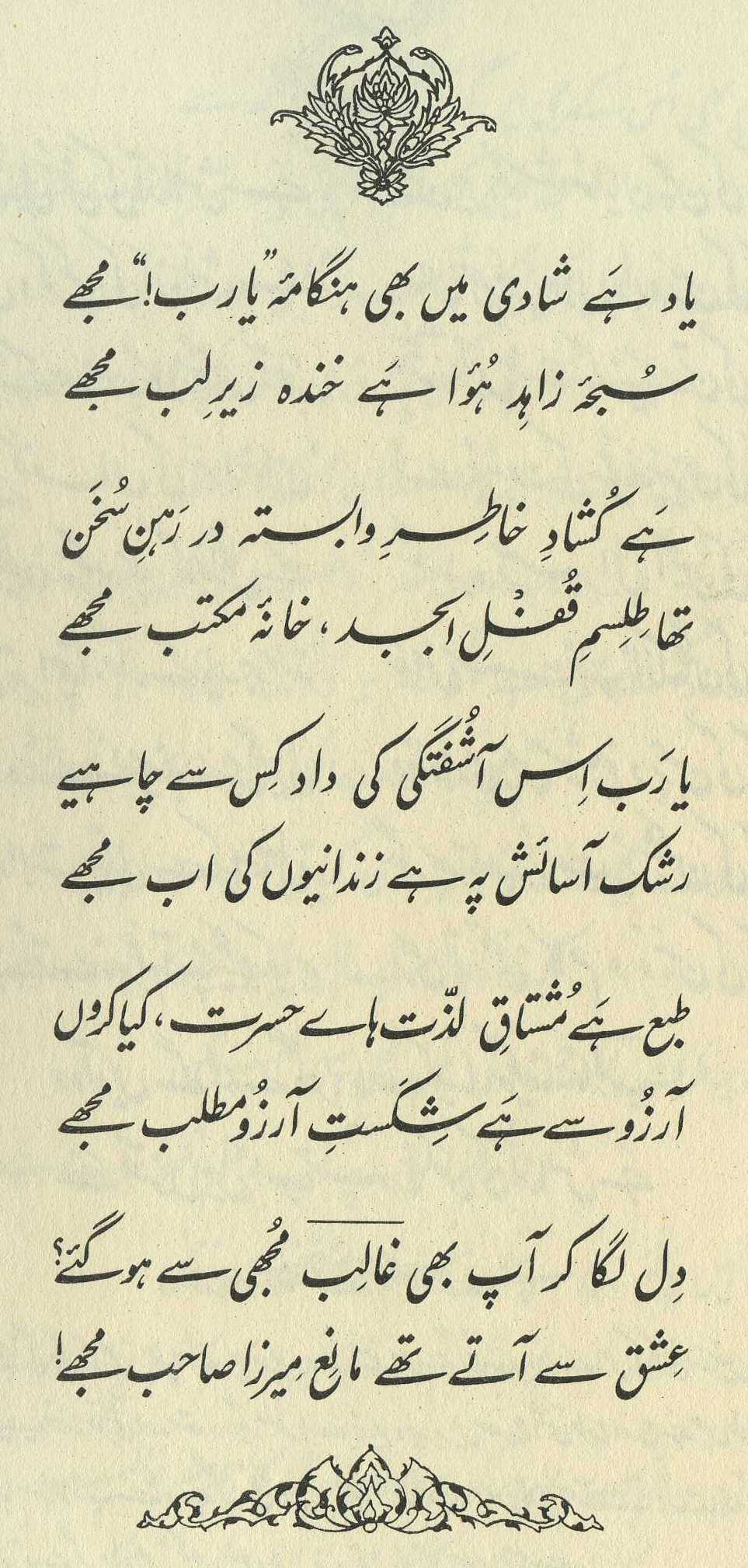
Here, he has used to mean hopelessness and vain longing. He says, 'I find so much pleasure in hopelessness and vain longing, that I hope that hope would be cut off, and I would have the pleasure of vain longing'. In this verse in place of is the idiom; both these words are used in colloquial Urdu.... In short, the refrain doesn't accept that connection . It ought to have been . Atish too has said something similar:
[through the mouths of the wound-slain ones
to my murderer, congratulation is meant/intended] (229)
== Nazm page 228 ; Nazm page 229


He says, 'My temperament is ardent for longing and vain longing. That is, through longing and vain longing I obtain the pleasure of life. I hope only with this intention: that it would be broken, and I would obtain the pleasure of vain longing to my heart's content.' (286)
I'm under duress. My temperament is ardent for the pleasure of failure. I don't feel longing so that it would be fulfilled, but rather so that it would not be fulfilled, and the pleasure of deprivation would be vouchsafed to me. (403)
Here's a classic example of the clever use of multivalent vocabulary: means 'grief', or 'longing', or 'desire', while means 'desire', or 'longing', or 'hope', or 'expectation'; means either 'breaking' or 'deficiency' (see the definitions above). So the crucial second line can be read in at least the following ways
=Through longing/hope/purpose, the speaker's goal is the defeat of longing/hope/purpose (that is, the time when he realizes that he'll never get what he longs/hopes/seeks for).
=By 'longing' the speaker really means 'the defeat of longing', since only by longing and then having that longing prove vain can he achieve the feeling of defeated, lost, longing that he craves: thus he 'longs' for the defeat of longing.
=By 'longing' the speaker really means 'the deficiency of longing', because there's never enough longing to suit him, and so he always 'longs' for more.
=What the speaker really seeks are the pleasures of grief/longing [], so as far as 'desire/longing' [] goes, his only wish is that it would be proved vain, so as to increase his grief/longing.
The result of such and casuistry is a vexatious kind of ambiguity. Even between the two words for 'longing' (see the definitions above), should we take and to refer to the same basic feeling, or to two subtly different kinds of longing (with the former more despairing, the latter more active)?
The verse refuses to give us much help with such problems: it even, in the second line, cultivates an aphoristic resonance. It also offers itself as a paradox: if 'longing' is equated with 'the defeat of longing', isn't that like a 'catch-22' situation, or a snake swallowing its own tail? And of course, the 'to me' reminds us that the speaker could be wrong in his judgments-- his perceptions could be skewed by his own warped or even crazed emotional life.
After a while the hovering cloud of possibilities becomes both confusing and irritating. The parsing of 'longing' becomes like running around and around on a wheel while batting away a swarm of gnats. And the real source of vexation is that there doesn't seem to be anything behind it all, anything that makes the verse worth struggling with. It feels like cheap (metaphysical) thrills on the poet's part.
graphics/longing.jpg