Verse 81821aryaad aayaa
G11
In this meter the first long syllable may be replaced by a short; and the next-to-last long syllable may be replaced by two shorts.
1 a
now that/this is a desolation-like desolation!
1 b
is this a desolation-like desolation?!
1 c
is there any desolation-like desolation anywhere?
2
having seen the desert, the house/home came to mind/recollection
'Desolation, depopulation, destruction, ruin, dilapidation; desert place'.
'A desert, a steppe, an arid plain; a forest'.
| References | |
|---|---|
| Arshi, Imtiyaz Ali | Ghazal# 27 |
| Raza, Kalidas Gupta | 328 |
| Nuskhah-e-Hamidiyah | 74-75 |
| Hamid Ali Khan | Open Image |
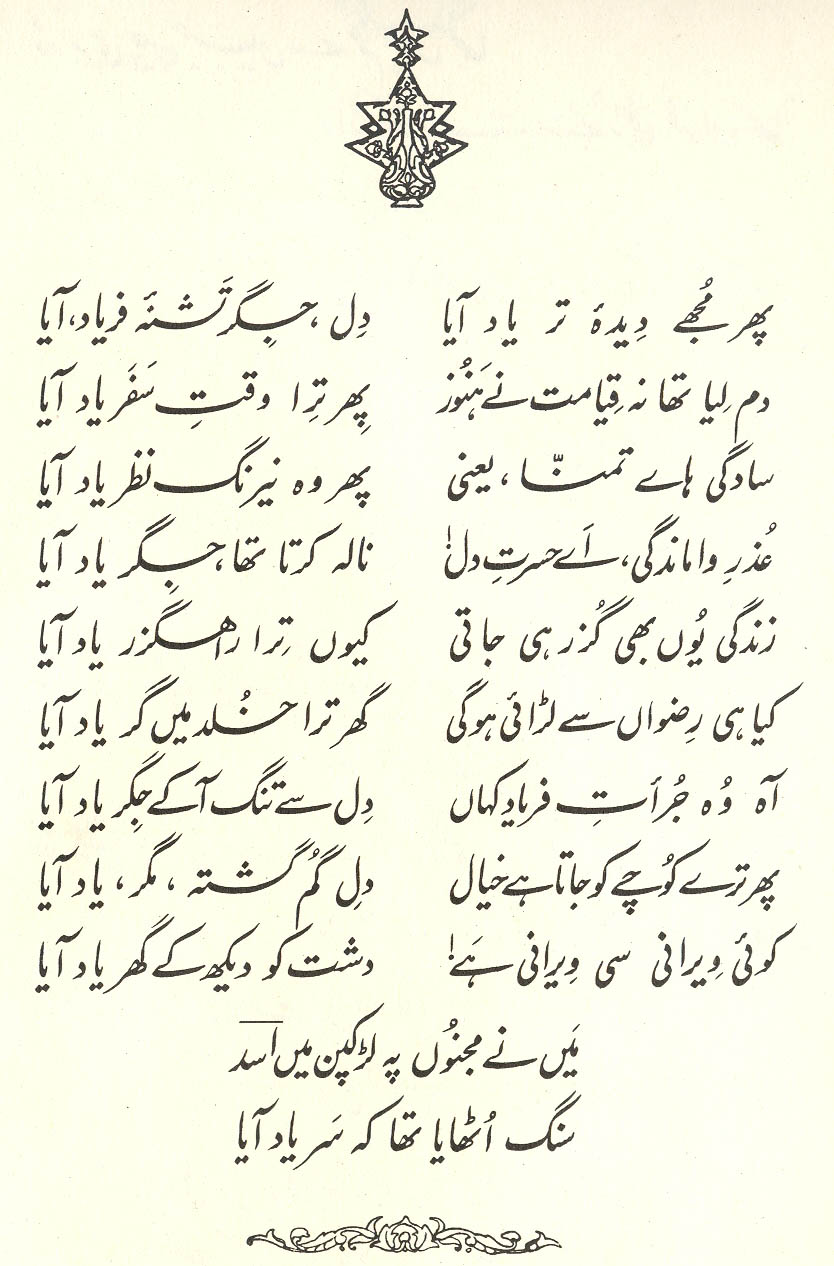
In this verse the meaning that is at once present is that the desert in which we are is so desolate that having seen it, home comes to mind. That is, fear is felt. But after a bit of attentive thought, this meaning emerges: that we used to consider that nowhere would there be a desolation like that of our house, but the desert too is desolate to such an extent that having seen it, the desolation of home comes to mind.
==Urdu text: Yadgar-e Ghalib , p. 130
Here he used exaggeration in the desolation of the desert because an extreme was necessary in the desolation of home. That is, in the desert he saw such desolation that 'my house was just like this'. The simile is that of reflection. Maulvi Altaf Husain Sahib Hali, the author's pupil , has here objected to a simile, and he has taken the meaning that when having seen the desert, there began to be fear, then home came to mind: 'Let's flee from here!' And this meaning too is not outside the idiomatic. (35)
== Nazm page 35

The heart said, 'Come on, let's go home, let's abandon a stroll like this [through a desolate, frightful wilderness];. But this theme seems devoid of pleasure [] in the ghazal. (84)
According to the intonation, ko))ii can be for disdain and generality both. (173)
Literally the first line can be translated: Is this wilderness like some wilderness? A rhetorical question that implies complete negation of the statement underlying the question, i.e., the wilderness is not at all what the poet considers to be wilderness. is an abstract noun and means 'the feeling of being a wilderness'; desolation, the state of being in ruins, of being uninhabited.
-- wilderness; brushland (not lush jungles and forests, but barren or scrubby land). Also, usually in Urdu, is used either in opposition to the word (lit., door; inhabited area; habitation), or in a close compound with it: , lit., wilderness and inhabited area; everywhere; the whole world.
It should be pointed out that grammatically speaking there is no mention of the poet in the entire couplet. There is no 'I.' Only three nouns are used: , , . The juxtaposition in the first line consists of a repetition of the first noun, ; the latter two nouns are juxtaposed in the second line.
If the first line is considered to be evoked by the desolation of the house in which the poet lives and whose ruination he has brought about himself through his crying and through his neglect under the influence of his passion, then the total meaning will be something like this: How desolate is my home! Wilderness reminds me of it. (It is not unlike wilderness in desolation.)
But if we consider the first line to have been evoked from a sight of the , then the total meaning can be something like this: Some wilderness, indeed! I remember my home at the sight of the , for my home was far more desolate.
== Naim 1970 , pp. 21-22
What a ravishing first line, and how alluring it is to recite-- full of long vowels, especially , so that it's rhythmic and sonorous, repetitive in a way that's suggestive rather than tedious. It demands to be recited over and over, in a hypnotic variety of intonations, doesn't it? It's full of mood , and about as idiomatically as a line can be.
That being said, we have if anything more than the usual number of choices about exactly what it means. Its idiomatic flair doesn't help with the semantics. The second line at least gives us two clear entities, the 'desolation'/wilderness and the home, and assures that the former reminds us of the latter. But the first line might be spoken either in admiration ('This/that really is a desolation/wilderness!') as in (1a); or else in scorn ('Do you call this/that a desolation/wilderness?'), as in (1b).
Moreover, the question also arises, does the first line apply to the desert, or the home? It might be that neither wilderness nor home is sufficiently desolate to suit the lover, so that he asks whether there's any real desolation anywhere at all (1c). (Compare the use of similar imagery in 40,3x .)
And strictly speaking, it's not the case that the desert 'reminds' the speaker of home. Rather, when he sees the desert, he 'remembers' home. Possibly this is because they are similar, but possibly it's because of the contrast. When he sees the desert, he might remember his house--
=because both of them are so extremely desolate (the desert and the house evoke each other)
=because both of them are insufficiently desolate (the desert is no more desolate than the house)
=because the desert is more desolate than the house (thus making him happy to think of the change)
=because the desert is less desolate than the house (thus making him nostalgic for home)
The verse is so protean, and so vigorously colloquial, that it can work perfectly well in all these senses. Really, don't you love the way Ghalib is able to pull things like this off, and even make them look simple and easy?
For another such ambiguously structured verse, see 203,3 . For similar ambiguities of reference between 'desert' and 'home', see 6,14x and 319x,6 .
Note for grammar fans: The grammar in the second line is dodgy in exactly the way it is in 35,6 ; see that verse for discussion.
Compare Mir 's equally brilliant take on the same idiom, and on the recollection of home: M 700,11 . Unusually, Ghalib's version is simpler and plainer (on the surface) than Mir's. But how about Mir's M 1226,5 , which is almost as simple, but adds the dimension of house-hunting?
graphics/desert.jpg