Verse 101821aryaad aayaa
G11
In this meter the first long syllable may be replaced by a short; and the next-to-last long syllable may be replaced by two shorts.
2
had picked up a stone-- when {I came to my senses / 'the head came to mind/recollection'}
'The condition of being a child, the state of childhood; boyhood, childhood'.
| References | |
|---|---|
| Arshi, Imtiyaz Ali | Ghazal# 27 |
| Raza, Kalidas Gupta | 328 |
| Nuskhah-e-Hamidiyah | 74-75 |
| Hamid Ali Khan | Open Image |
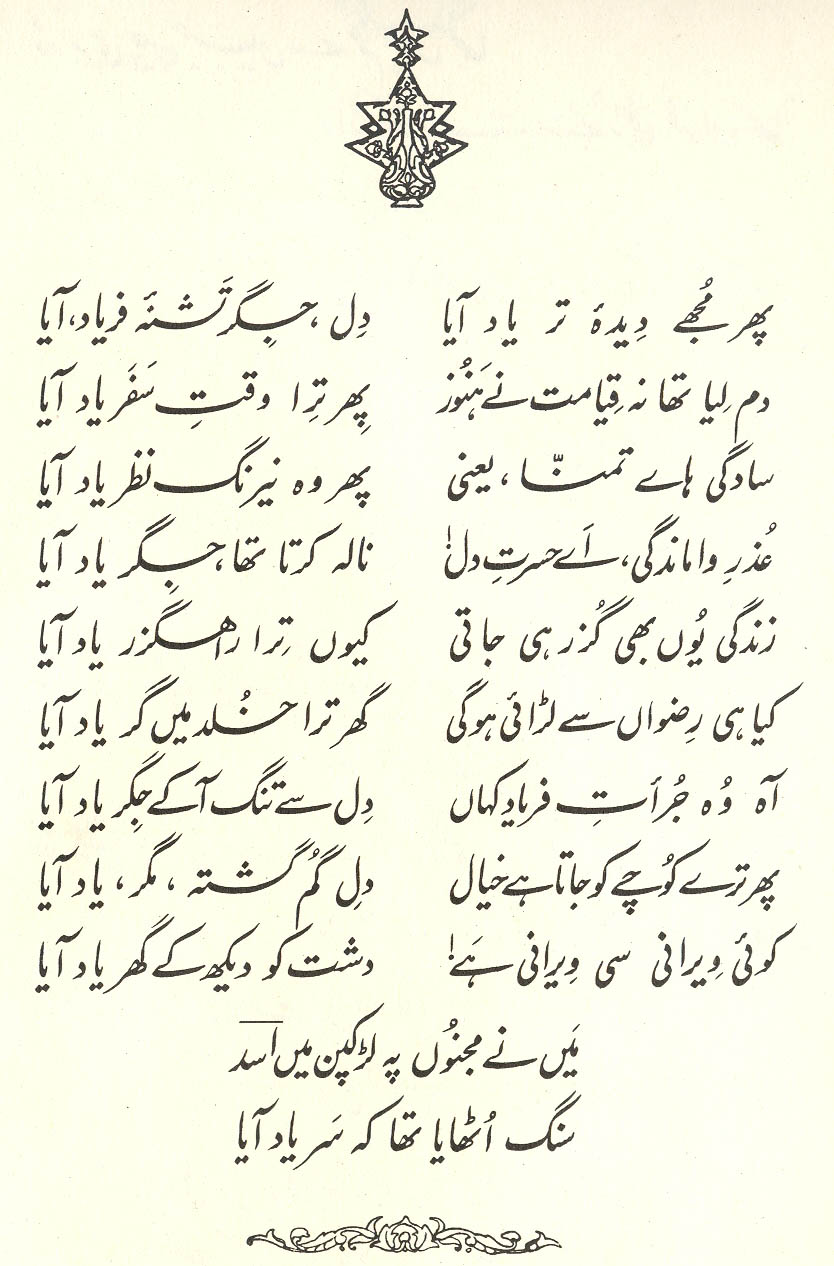
That is, then they would have struck my very own head. (35)
== Nazm page 35

He says, in the time of my boyhood, imitating the boys, I had picked up a stone against Majnun. But at once I recollected myself. That is, the thought occurred, in my head too this same kind of madness of passion is accumulated. That is, my temperament from childhood onward was that of a lover. (69)
In childhood, I had picked up a stone against Majnun. But my power of empathy was so strong that I felt pain, and I reflected that such a person is worthy of compassion. If someone would treat me that way, I would feel pain. (84)
ABOUT STONE-THROWING: In the ghazal world, boys mock and taunt madmen, and follow them around throwing stones at them. Being the crazed madmen that they are, the lovers sometimes even relish this experience. Other verses that refer to such stone-throwing: 69,3x ; 77,1 , with salt on the stone; 92,5 ; 130,2 ; 138,3 ; 165,3 ; 214,8 ; 239x,3 .
Majnun is the consummate mad lover. Who more than he would receive a shower of stones from mischievous or hostile boys? Even from the future lover who speaks in this verse, he barely escapes, when at the last moment the boy comes to his senses.
What an elegant verse of idiom-play! The idiom means to get hold of oneself, to gain control of oneself; but of course its literal meaning is 'for the head to be remembered'. Tthe young future lover might indeed have a premonition that his own 'head' would someday be as vulnerable as Majnun's. As usual, Ghalib has used his chosen idiom in both its colloquial and its dictionary senses.
Needless to say (at least, I hope it's needless), this is not an 'autobiographical' verse about the early years of the poet Ghalib himself, but a glimpse of the archetypal childhood of the archetypal lover whose first-person voice is the subjectivity of the ghazal world.
Compare Mir 's elegantly ambiguous treatment of a very similar theme: M 1312,6 .
graphics/majnun.jpg