Verse 61821aryaad aayaa
G11
In this meter the first long syllable may be replaced by a short; and the next-to-last long syllable may be replaced by two shorts.
1
ah, where is that courage of lamentation/complaint?!
2
having become annoyed with the heart, the liver came to mind/recollection
'Exclamation; lamentation; cry for help, or redress; complaint; charge; suit'.
| References | |
|---|---|
| Arshi, Imtiyaz Ali | Ghazal# 27 |
| Raza, Kalidas Gupta | 328 |
| Nuskhah-e-Hamidiyah | 74-75 |
| Hamid Ali Khan | Open Image |
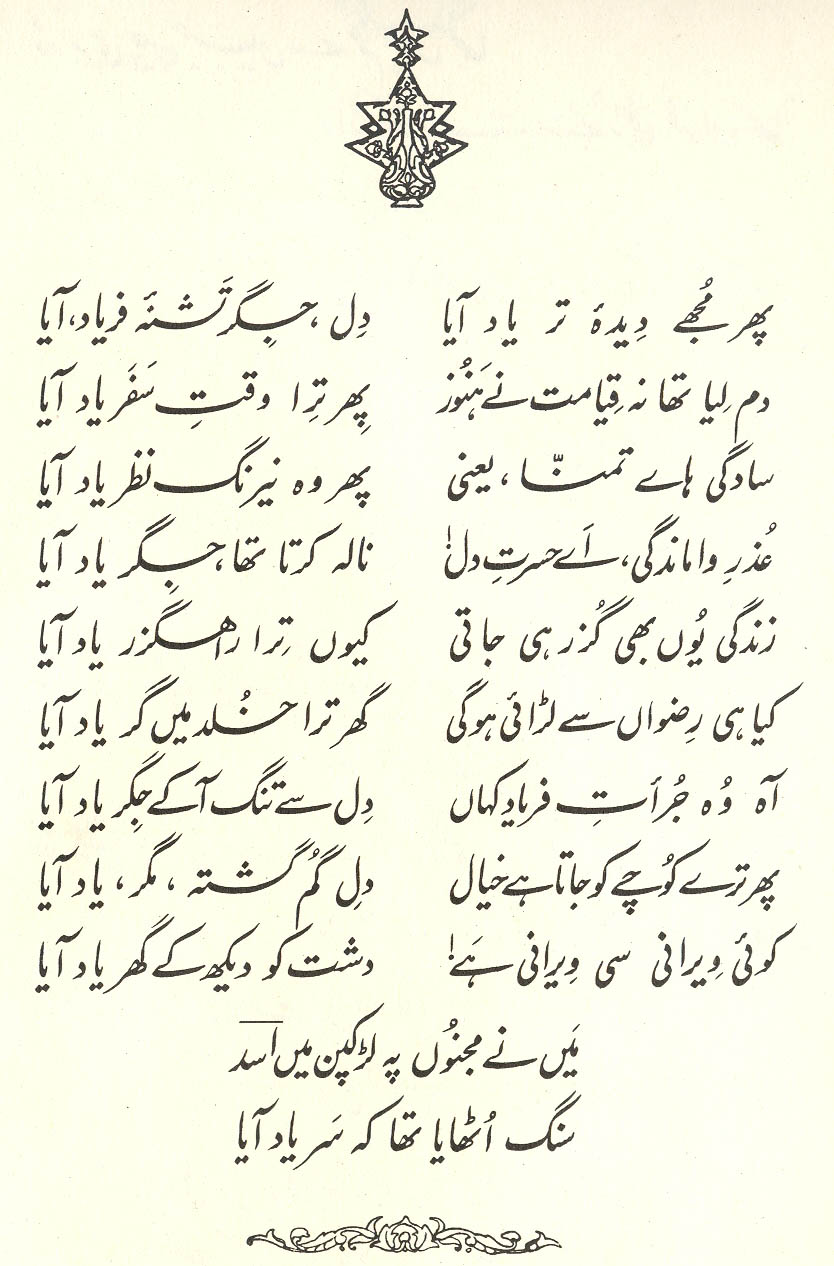
That is, that liver that long ago turned to blood comes to mind, upon seeing the heart's lack of strength and courage. (35)
== Nazm page 35

The liver came to mind, because it had more strength for lamenting than did the heart. But alas, that now even the liver has no strength for lamenting. (35)
He says, the courage I used to show in lamenting, during the days when the liver was with me-- now that the liver has been worn away, that courage is there no longer. The heart hesitates in lamenting due to fear, and the cause is fear of the beloved's disgrace. If the liver were in the breast, it would never have shown this kind of indecisiveness. Whether the lament had any effect or not, it would certainly have lamented. (68-69)
Here's another verse that plays, even more explicitly than does 35,1 , on the distinction between heart and liver. For more on the role of these two organs in the ghazal world, see 30,2 .
The first line is a rhetorical question, preceded by a sigh. The sigh, , is perfect; it's the real charm of the verse. It forms an ideal preface: not only is the sigh an example of onomatopoeia (that it, it sounds like what it means), but it also reveals exactly the problem the verse is about. If all the lover can do is sigh, he really doesn't have much energy for lamenting, or much heart for making his complaint.
So of course, as Hasrat points out, when the lover is irritated by the weakness of the heart, his thoughts naturally turn to the liver. Here the liver 'came to mind' or 'was remembered'-- phrases that can apply either to something available, or to a nostalgic memory of something departed. But even if the liver is still around, it's obviously not in good shape, or else the exclamation in the first line would make no sense.
Note for grammar fans: The grammar in the second line is just as dodgy in Urdu as it is in English. The first clause, , requires an implied subject of something like ; the second clause, , requires an implied indirect object of something like . To juxtapose them like this, and then omit both subjects, is really pushing the boundaries of what's tolerable. (For another example of just this kind of dodgy second line, see 35,8 .) But then-- the point does get across. And how much sense does it make to look a great poet in the eye and tell him he has to obey grammar rules?
Note for meter fans: On , see 4,4 .
graphics/heartwreck.jpg