Verse 31821aryaad aayaa
G11
In this meter the first long syllable may be replaced by a short; and the next-to-last long syllable may be replaced by two shorts.
1
simplicities of longing-- that is
2
again/then that marvel/enchantment/deceit of sight came to mind/recollection
'Plainness, absence of ornament; artlessness, simplicity, openness, frankness, sincerity, purity'.
'Fascination, bewitching arts, wiles; magic, sorcery; deception; --deceit; trick; pretence; evasion; --freak; --a wonderful performance, a miracle; anything new or strange'.
| References | |
|---|---|
| Arshi, Imtiyaz Ali | Ghazal# 27 |
| Raza, Kalidas Gupta | 328 |
| Nuskhah-e-Hamidiyah | 74-75 |
| Hamid Ali Khan | Open Image |
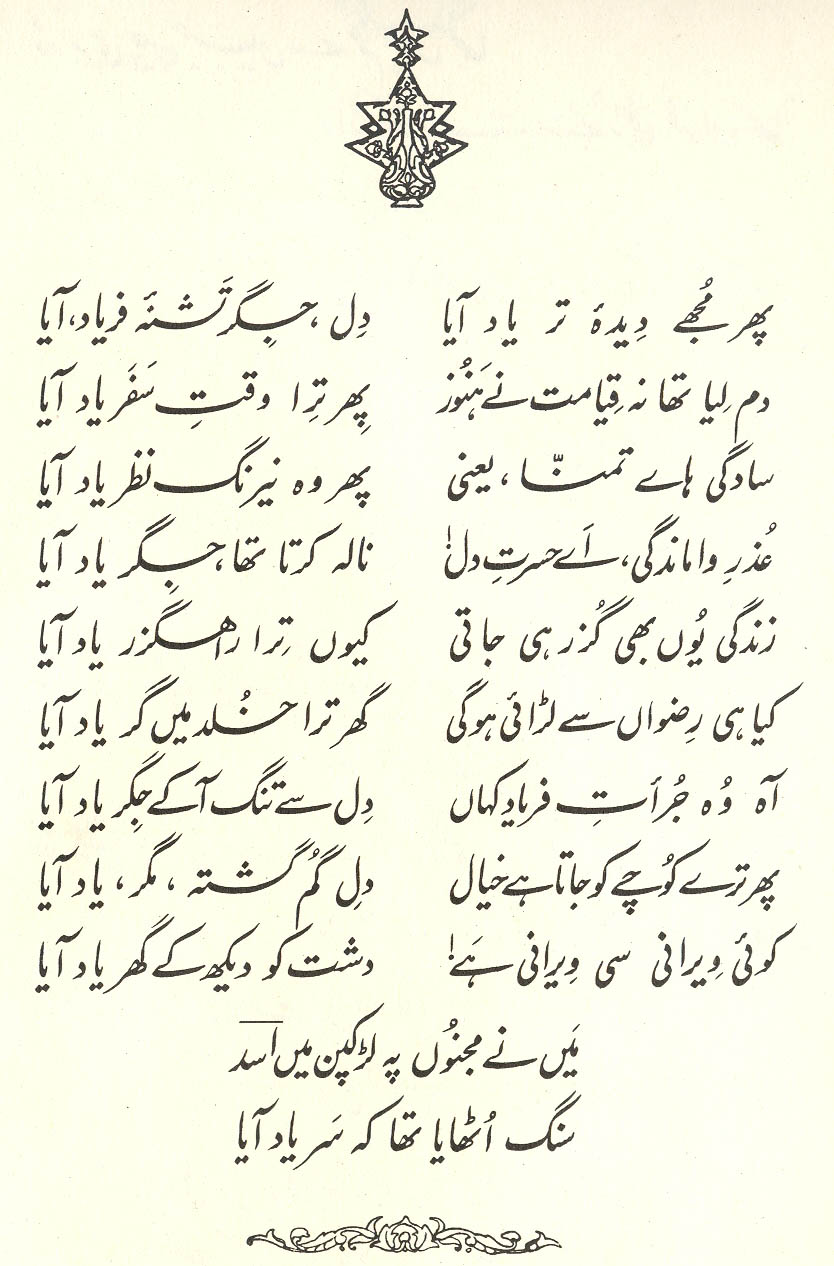
In the first line is omitted . He says, look at my simplicity of longing. That is, the thing that is impossible and will not happen-- through my simplicity and foolishness that is what I long for. (34)
== Nazm page 34

The meaning is that those things that the glance of the beloved said through hints and suggestions, the lover in his simplicity considered as a means to accomplishing his longing-- or rather, he came to believe perfectly in his success. But the result was nothing at all. It became clear that it was a trick of the beloved's glances, but there was a kind of pleasure in them; thus they come to mind again. (67)
The simplicity of my longing is worth seeing-- again it is remembering that same enchanting beloved whose glances have the power of magic and who is never slow to change. That is, despite my knowing the beloved's changeableness, still my heart longs for her-- in that aspect, is without an . (83)
Once again we see the power of speech. The first line is simply an exclamation, and the , 'that is', only purports to explain it. Thus this verse is a classic case of Ghalib's permitting (or forcing) us to decide for ourselves how to connect the lines. Here are some of the possibilities:
=Because of the simplicities of longing, that marvel of sight then came to mind. (Line 1 is the cause of line 2. In the lover's heart, longing directly begets memory.)
=Because that marvel of sight again came to mind, there were simplicities of longing. (Line 2 is the cause of line 1. In the lover's heart, a passing (or recurring?) memory gives rise to deep longing.)
=There were simplicities of longing, and that marvel of sight again came to mind. (Lines 1 and 2 are parallel descriptions of the lover's condition; his life is one in which longing and memory are inextricably merged.)
=What simplicities of longing!-- That is, again that marvel-- or 'deceit', or 'trick'-- of sight came to mind. (Line 1 is a wry, retrospective exclamation at the folly of the mood depicted in line 2. The lover marvels at his own naivete and haplessness.)
The ambiguities of (see the definition above) are similar to those of 'simplicity' in English. Is it a neutral or complimentary term, with moral connotations of sincerity and straightforwardness? Or is it somewhat patronizing, so that it suggests intellectual naivete and gullibility? These ambiguities are multiplied by the complexities of (see the definition above). What exactly is the speaker longing for? A real beloved? An ideal beauty so powerful that it's spellbinding in itself? An enchantment formerly created by the beloved?
Alternatively, could he be longing for a magic show of some particular kind? A cheap sleight-of-hand trick, even though he knows it's fake? There's no need at all for the to be a human being: it can be anything we ourselves imagine it to be-- for surely we all have our own such naive fantasies and impossible visions. (And even if we know they're chimerical, we are still vulnerable to them.)
In the first line Ghalib has pluralized into ; this is as conspicuous in Urdu as 'simplicities' would be in English. No doubt the pluralization complicates the meaning, but how exactly? Doesn't such complication seem to undermine the very simplicity of 'simplicity'? As usual, we are left to decide for ourselves. For a similiar but even more awkward pluralization see 'tough-lifednesses' in 1,2 .
Here's my long-ago attempt at a translation (1985) .
graphics/amazement.jpg