Verse 21821aryaad aayaa
G11
In this meter the first long syllable may be replaced by a short; and the next-to-last long syllable may be replaced by two shorts.
1
Doomsday had not yet/still taken a breath
2
again/then the time of your journey came to mind/recollection
| References | |
|---|---|
| Arshi, Imtiyaz Ali | Ghazal# 27 |
| Raza, Kalidas Gupta | 328 |
| Nuskhah-e-Hamidiyah | 74-75 |
| Hamid Ali Khan | Open Image |
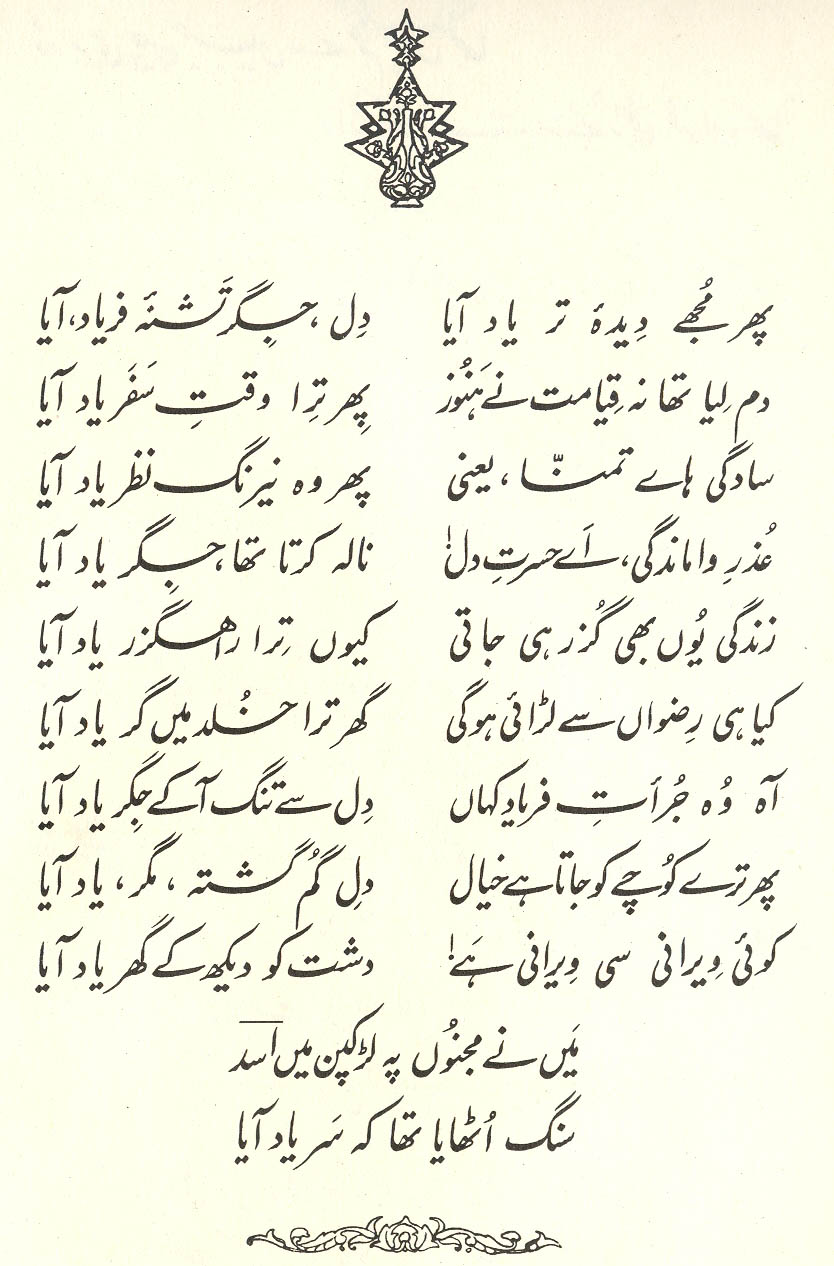
The terrible mood of the time of taking leave of the friend had passed, and the memory of her departure that keeps returning to awareness from time to time, he has envisioned as Doomsday taking a breath. Few such eloquent [] verses have been seen in the Urdu language. The state that in reality occurs on such occasions, he has depicted in two lines; this theme couldn't be depicted better in any poetic style.
==Urdu text: Yadgar-e Ghalib , p. 129
To take a breath-- that is, to pause and be at rest. And Doomsday is a metaphor for restlessness and agitation. That is, restless in the heart had not been able to be at peace, when again your leave-taking and departure came to mind. (34)
== Nazm page 34

The turmoil and commotion of Doomsday had not even abated, when the time of your departure came to my mind, and my restlessness gave rise to a new Doomsday. (82)
[Compare his discussion of Mir's M 45,1 .]
Another lovely example of how poetically effective it is to refuse to specify the relationship between the two lines. Is 'Doomsday' to be equated with 'the time of your journey', so that the beloved has barely left when the lover starts helplessly remembering the Doomsday of her departure? Or are these two independent events, so that Doomsday itself barely distracts the lover for even a moment from the obsessive memory of her departure? Hali chooses the first reading, and Bekhud Mohani chooses the second.
Both readings are of course entirely plausible, but the second reading has an extra delight, in its tone of impatience: the actual Doomsday is just an interruption in the lover's compulsive reliving of the time of the beloved's departure-- and best of all, not even a major interruption, just a small bother. It occupies about one moment of his attention, it barely has time to take a breath, before he's impatiently brushed it aside and is back to his obsessive remembering of the real Doomsday, that of her departure.
Then both and , such unpretentious little words, multiply the possible times and connections.
Here's my long-ago attempt at a translation (1985) .
graphics/doomsday.jpg