Verse 11816aahkaa
G3
1 a
the heedless one, with the illusion of coquetry, is self-adorning; otherwise, here
1 b
oh heedless one, with the illusion of coquetry you are self-adorning! --otherwise, here
2
the curl/crest of the grass is not without the comb/crest of the breeze
'Unmindful, forgetful, neglectful, negligent, heedless, inadvertent, inattentive, remiss, thoughtless, careless; indolent; imprudent; senseless, unconscious'.
'Thinking, imagining, conceiving (esp. a false idea); — opinion, conjecture; imagination, idea, fancy'.
'A comb; a (cock's) comb, a crest.
'The east wind, or an easterly wind; a gentle and pleasant breeze; the morning breeze; the zephyr'.
| References | |
|---|---|
| Arshi, Imtiyaz Ali | Ghazal# 20 |
| Raza, Kalidas Gupta | 146-147 |
| Nuskhah-e-Hamidiyah | 65-66 |
| Asi, Abdul Bari | 67-68 |
| Gyan Chand | 101-103 |
| Hamid Ali Khan | Open Image |
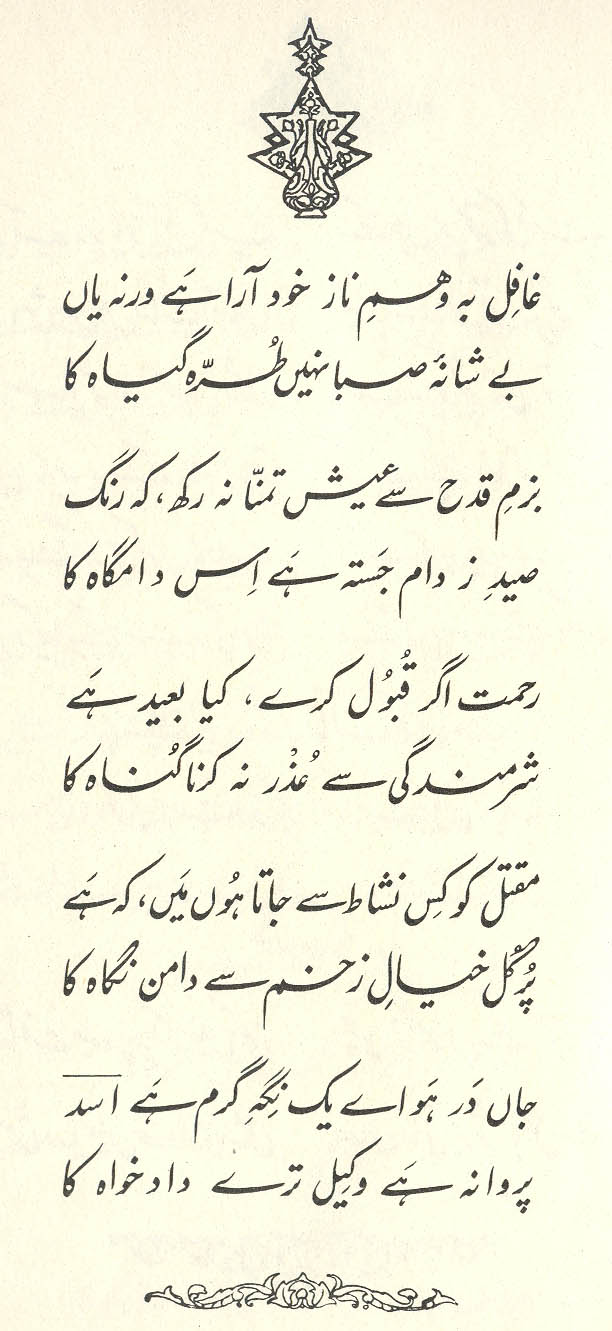
That is, people are ignorant of the mysteries of Truth; from the element of pride and coquetry that is in their temperament grows the illusion that we did this, and it came about through our scheme. Although whatever exists, it all comes from Him. In this verse the Divine Pleasure has been given the simile of the spring breeze. (41)
== Nazm page 41

People are ignorant of the secrets of Reality and the adornedness of the world; otherwise, they wouldn't pride themselves on their uniqueness and their power. If the curtain would be lifted from their eyes, then it would be revealed to them that they have no right to pride themselves on their power, their creativeness, their discrimination, their inventiveness. They would see that the Creator of the world has given even to grass, the lowliest of the lowly, the comb of the breeze for its curls. (101-02)
They call the spring breeze a ' Messenger ', and the task of a Messenger is to convey someone's command and words to some place. Thus the spring breeze is a sign from the True Self alone. (115)
This one always reminds me of the lovely King James Bible way of putting it, 'And why take ye thought for raiment? Consider the lilies of the field, how they grow; they toil not, neither do they spin: And yet I say unto you, That even Solomon in all his glory was not arrayed like one of these. Wherefore, if God so clothe the grass of the field, which to day is, and to morrow is cast into the oven, [shall he] not much more [clothe] you, o ye of little faith?' (Matthew 6:28-30).
The word (see the definition above) does wonderful work here. It can mean a curly lock of hair (something natural) or else a crest, or plume, or turban-ornament (something artificial and coquettish). Using it in conjunction with 'comb' tilts the balance toward curls or ringlets, but the other meaning hovers in the background and gives the grass's adornment its own touch of coquetry and .
The image of the 'comb of the breeze' allows for two possible readings. It is certainly a playful and pleasant breeze-- what exactly is it doing to the curls of the grass? Is its 'combing' merely metaphorical and even perverse, so that it tousles the grass into a disarray that is far more fetching than any contrived order? Or does it actually 'comb' the curls of the grass into a more formal symmetry and order, making them all flow in the same direction, as a brisk spring breeze can sometimes be seen to do? Or is it in fact not a 'comb' but-- with elegant wordplay-- a 'crest' itself (see the definition above), adorning the heads of the curly grasses?
Which makes us think carefully about the , the 'illusion of coquetry'. Is the heedless one being admonished for a clumsy human 'illusion' of coquetry, when she should learn the real thing from watching the carefully breeze-combed curls of the grass? Or is she being admonished for the illusion of 'coquetry', when she should learn from the fetchingly disarrayed grass-curls the irresistible superiority of naturalness?
The contrast of the crucial words 'with', , in the first line, and 'without', , in the second line, is also an enjoyable effect.
And of course all this takes place 'here', in this world. Are we to draw a lesson, as in Matthew 6, about God's care for the least of his creatures? Or does the 'here' merely emphasize the overpowering realness of this sensory world, in which the small arts of humans are no match for the mysterious (artless?) arts of nature? Think of 13,1 .
For more wordplay about combs and crests, see 207,4 .
graphics/grass.jpg