Verse 4after 1838aade mujhe
G1
1
to this extent she's happy with my captivity: that I
2
if [I] would become a curl, then she would entangle/ensnare me in the comb/crest
is an archaic form of
'A comb; a (cock's) comb, a crest;... the shoulder-blade'.
'To entangle, ravel (as thread); to involve, complicate, make intricate; to perplex, confound; to implicate; to entrap, insnare; to inveigle, entice, allure, beguile, mislead, deceive; to divert, entertain; to double (as a hare); to embroil, to involve in a quarrel; to make (one's wits) whirl round; to set (one's brain) to work; to throw into confusion, disarrange, jumble; to intertwine, interlace, to fasten'.
| References | |
|---|---|
| Arshi, Imtiyaz Ali | Ghazal# 210 |
| Raza, Kalidas Gupta | 388 |
| Hamid Ali Khan | Open Image |
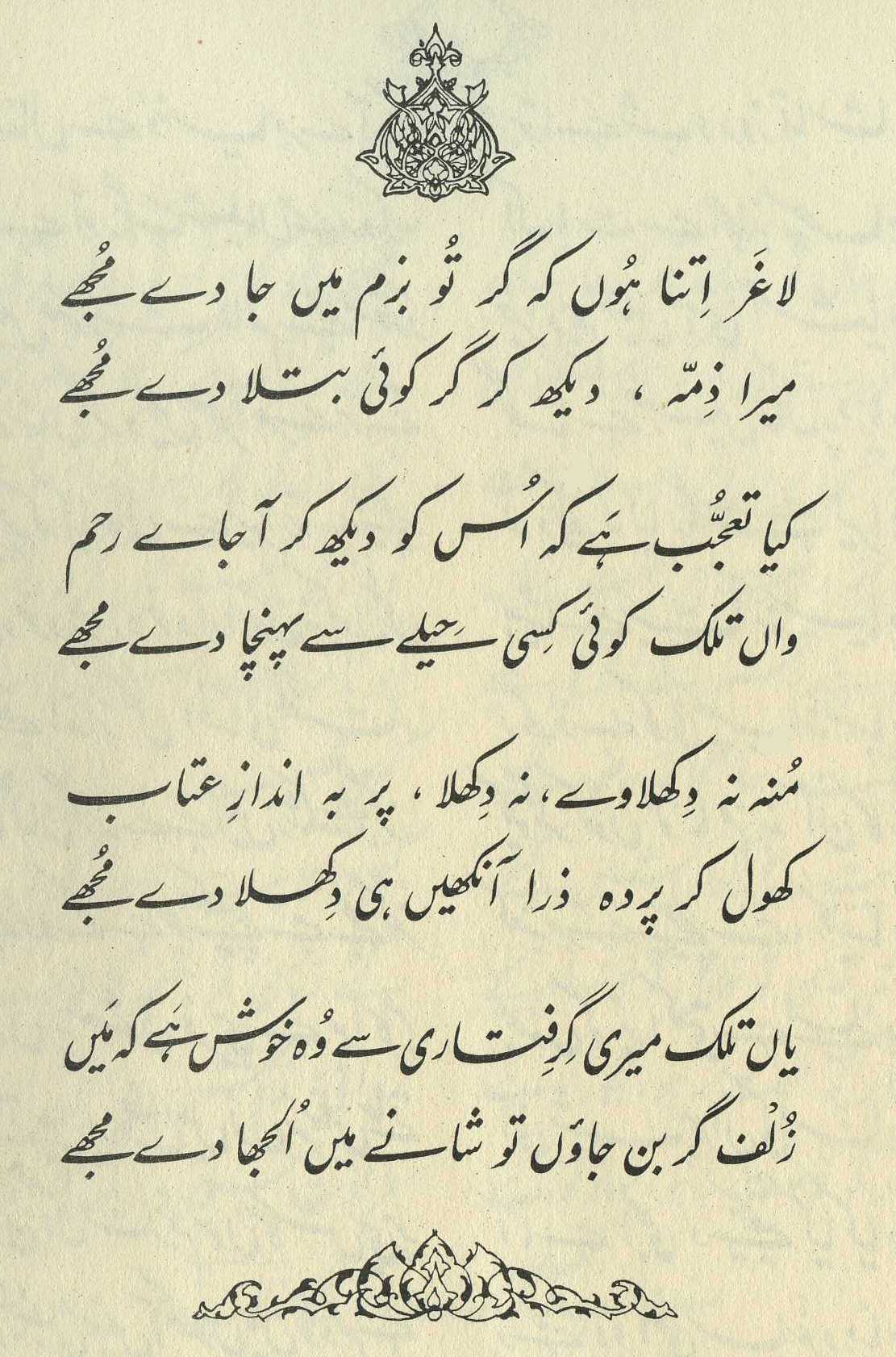
That is, the ultimate extent of captivity is that I would become her curl; but even with that she wouldn't be content, she would entangle me in her comb. (233)
== Nazm page 233

He says, 'She's happy to such an extent with my captivity that if, as an impossible supposition, I would become a curl of hers, which is an implement of captivity, then even that curl of hers she would entangle in the comb and capture'. (292)
Curls are always made orderly, they're not made entangled. But the beloved finds so much pleasure in my captivity that if I would become a curl of hers, then she would entangle me in the comb. No matter what, she's not prepared under any circumstances to free me from the net of her love. (415)
How do we measure how pleased the beloved is to have the lover as a captive? The lover provides an extreme, fanciful metaphorical illustration for the situation-- one that might seem at first to settle the question. But as usual, it really doesn't: it simply raises some new and, as usual, unresolvable questions.
The first words of the first line should alert us: -- literally 'to here'; metaphorically, 'to this extent'. In Urdu as in English, such a phrase can indeed be used like 'to such an extent'-- to introduce an extravagant, exclamatory sense of maximization (as the commentators take it). But in Urdu as in English, it can also be used literally: to introduce a limit or demarcation point: something is carefully asserted 'to this extent', but is thus declared not to apply to some other extent, or beyond this extent. In this second sense, the phrase would have a judicious sound: 'Well, to this extent she's happy with my captivity-- but not beyond this extent'. If we recognize both possibilities-- as surely Ghalib would expect us to-- then we're forced, as so often, to wait for further enlightenment from the second line. (Needless to say, under mushairah performance conditions, the wait will be as long as can conveniently be managed.)
Then the second line flings us abruptly into the metaphorical terrain of the beloved's hair. The measure of her happiness with the speaker's captivity is that if he were a curl, then she would 'entangle' him in the 'comb' (and in proper mushairah-verse style, the punch-word is withheld until the last possible moment). But what exactly would that mean? The image itself requires to be disentangled. A comb is a comb no doubt; but it can also mean a 'crest', and the beloved is known often to wear her hair piled high on her head (she is tall, but wants to look even taller). So perhaps if the lover were a curl, she would fear that he might be a 'stray curl' and would hastily weave him into her piled-up and carefully arranged hair.
But even if the comb is just a comb, what does it mean for her to 'entangle' or 'ensnare' the hair in it? Is it an act of orderliness and acceptance (first she gets the wandering curl firmly embedded in the teeth of the comb, then she proceeds to smooth out and arrange it)? Or is it an act of disorder and even hostility (she seeks to torment the stray curl by seizing it and dragging it this way and that, and 'perplexing' and 'confounding' and 'disarranging' it)? Or is it an act of seduction and renewed entrapment (the comb will 'allure' and 'beguile' and 'entertain' the stray curl, and 'make its wits whirl round')? All these vivid possibilities are fully available; see the definition of above for others as well.
For more wordplay about combs, see 45,1 .
graphics/comb.jpg