Verse 1after 1838aade mujhe
G1
1
I am so thin/gaunt that if you would give me a place in the gathering
2
the responsibility is mine, if anyone would see me and 'tell'
'Lean, thin, gaunt, meagre'.
| References | |
|---|---|
| Arshi, Imtiyaz Ali | Ghazal# 210 |
| Raza, Kalidas Gupta | 388 |
| Hamid Ali Khan | Open Image |
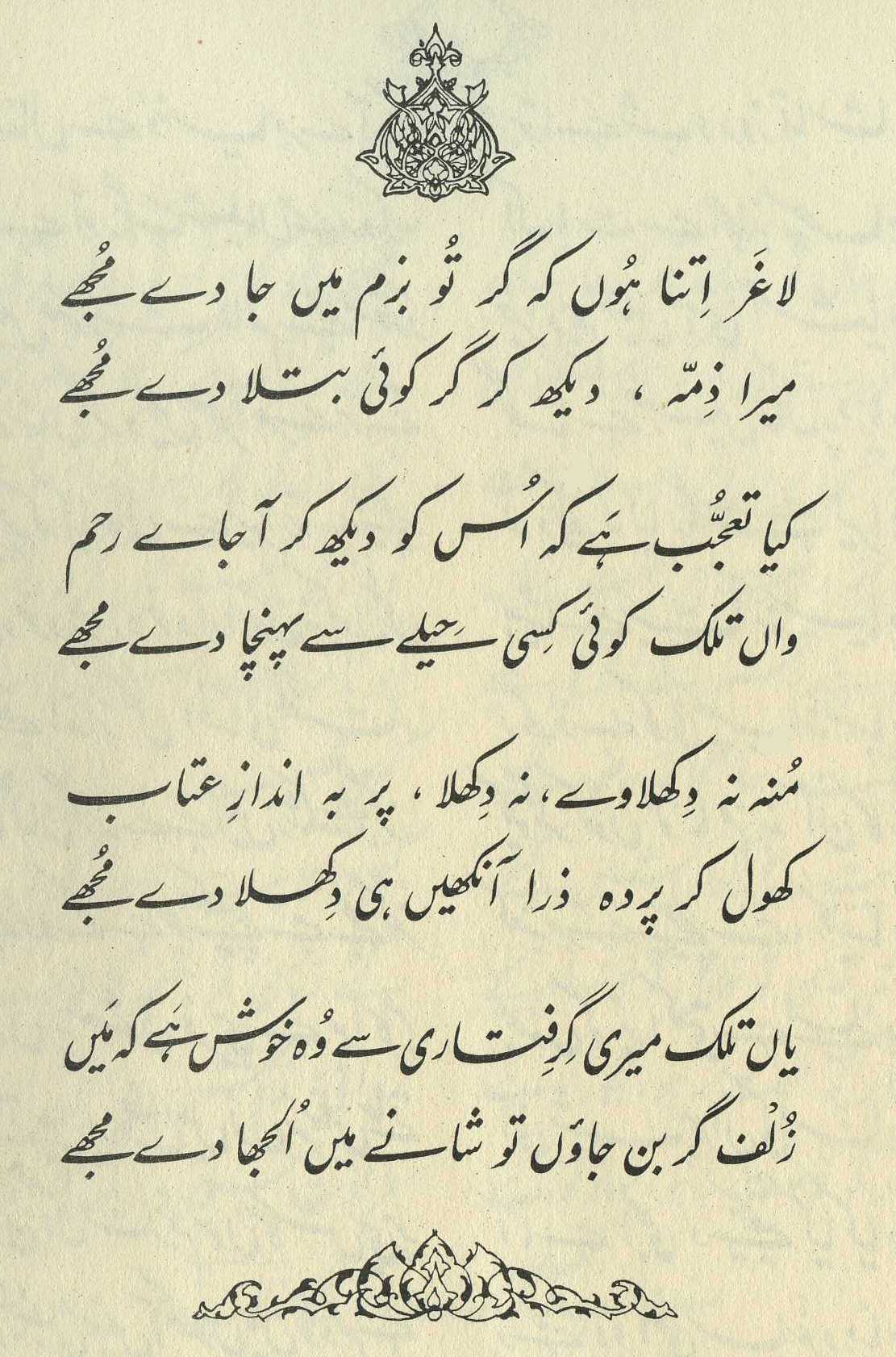
Because of thinness I will not be visible to anyone-- as if anyone will tell! (233)
== Nazm page 233

He says, 'Why do you, for fear of the Rival , renounce meeting me? I've become so thin that if you invite me to your gathering and seat me near you, then nobody would even notice me.' (291)
That is, I've become so thin, and my aspect has become so altered, that if the people who used to recognize me would see me, then they wouldn't be able to recognize me. With great excellence he has shown the result of the excesses of passion (that is, for the aspect to become so altered that even acquaintances wouldn't be able to recognize him); and he's also shown that the beloved wants to invite him into her gathering; if she has any reluctance, then it's this: that there would be disgrace.
[As for Nazm, in his commentary] the meaning of a particularly fine verse has been written in such a way that it begins to seem full of absurd [] exaggeration . (414)
[See his commentary on Mir's M 328,6 .]
That occupies a grammatically 'midpoint' position. If we read the latter part of the second line as , then the suggestion is that someone might see the lover and tell him something-- presumably, tell him to leave, since the lover's permission to enter the gathering is what's at issue, and since his saying 'upon my head be it' also suggests that if he is wrong then the result (his having to leave?) will fall on him, and he won't blame her.
And if we read the latter part of the second line as , then the possibility emerges that someone might, having seen the lover, 'tell' somebody else, or publicly identify him, or gossip, or create scandal. This reading might be thought slightly secondary, since it's less appropriate for the lover to say 'upon my head be it' for consequences (gossip, scandal, etc.) that would probably fall more on the beloved than on himself. Still, the lover might well say it anyway, as a sign of great desperation-- or great confidence that nothing of the sort would happen.
On either reading, the verse offers at least three enjoyable and mutually complementary possibilities:
=People will see the lover and recognize him, but they won't tell (tell him to leave, or tell about him): he looks so wretched and feeble now, that they'll feel compassion.
=People will see him but they won't recognize him, since he's so thin and worn and wracked by passion; so they won't be able to tell (tell him to leave, or tell about him).
=People won't see him at all, since he's so thin that he's basically invisible, so they won't tell (tell him to leave, or tell about him).
Bekhud Mohani gallantly sets out to defend Ghalib from this third possibility, the one endorsed by Nazm. He insists on the more realistic readings, and accuses Nazm of damaging the verse by creating in it 'absurd exaggeration '. But after all, we're dealing with an extravagantly cerebral poet, in an unlimitedly stylized genre, and he has also given us verses in which the beloved has no mouth (for the set, see 91,4 ); and/or has no waist (see 99,4 ). If even the beloved can lack such essential body parts, surely it's only fitting that the lover could be so gaunt that he might almost lack a body entirely. This 'defense' is just one more example of the unhelpfulness of a 'natural poetry' approach to the ghazal.
The lover's physical frailty is also invoked, with another powerful , in the next verse, 207,2 .
graphics/invisibleman.jpg