Verse 3after 1838aade mujhe
G1
1
if you wouldn't show your face, don't show it-- but {by way of / in the style of} reproach/anger
2
having opened the veil a little, just show me only/emphatically your eyes
is an archaic form of ( GRAMMAR )
'Reproving; reproof, reproach, censure, reprimand, rebuke; anger, displeasure'.
'To look angry or threatening, to stare defiantly; to frown, scowl...; to menace, brow-beat, deter'.
'A little; --a little while, short time; a slight or trivial matter; -- adv., Just, would you just, please, kindly'.
| References | |
|---|---|
| Arshi, Imtiyaz Ali | Ghazal# 210 |
| Raza, Kalidas Gupta | 388 |
| Hamid Ali Khan | Open Image |
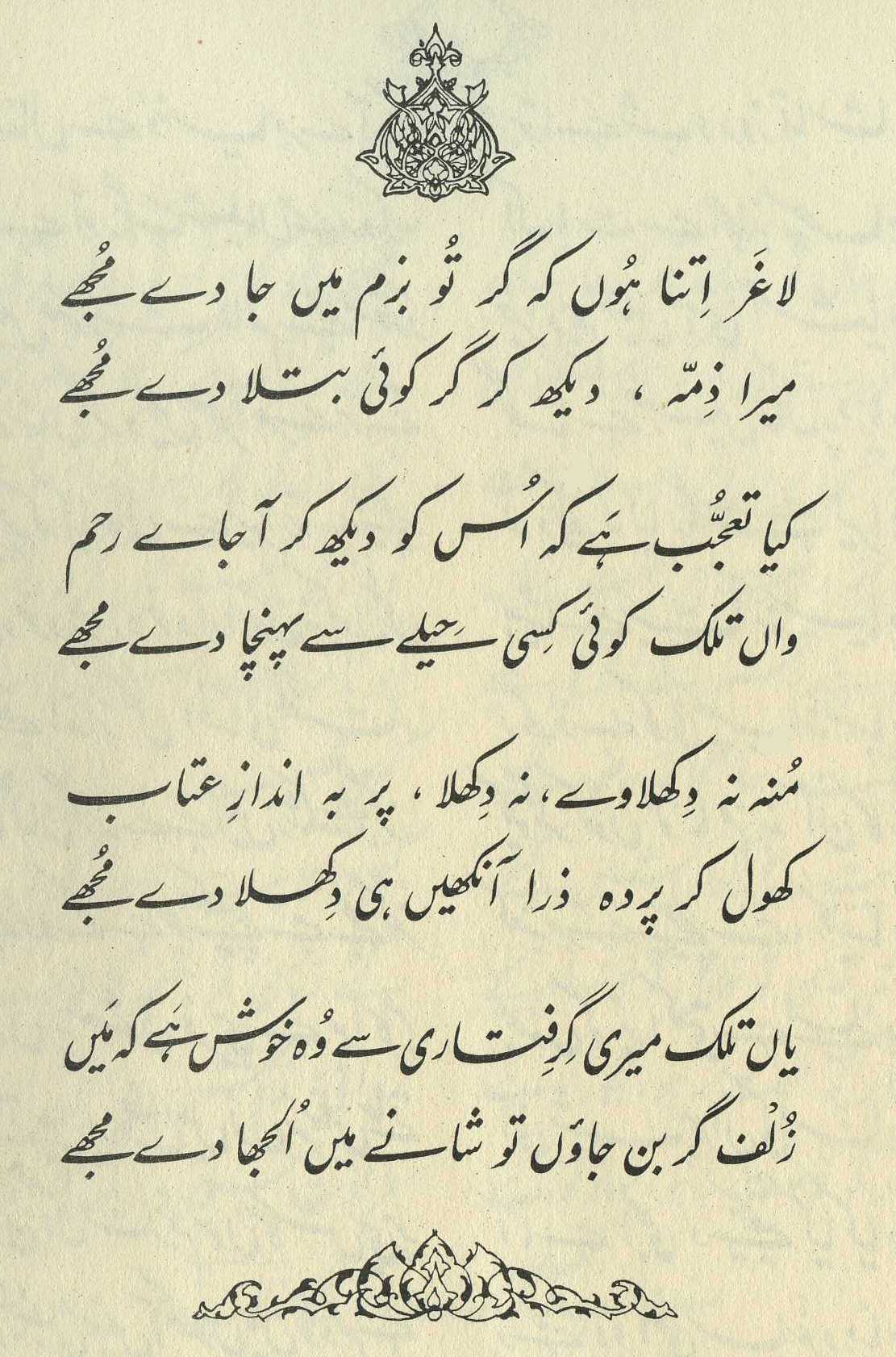
That is, if you won't show your face, then don't show it. Just please slide back your veil, and at least show your eye in anger. And 'to show the eye' [] is an idiom, with the meaning of 'to be angry'. The author has used 'to show the eyes' in the plural form, but the correct/eloquent form is 'to show the eye' in the singular. (233)
== Nazm page 233

He says, 'If you veil yourself from me, and feel ashamed to be before me and to show your face, then don't show your face. But in the style of anger, remove your veil, and at least show me your eyes' ( 'to show the eye' is spoken on the occasion of being angry). I would see at least how much anger there is in your eyes, and what color/mood appears in your eyes on the occasion of anger. (291)
[Disagreeing with Nazm:] 'To show the eyes' and 'to show the eye' are both equally correct/eloquent; whichever one fits in the meter, that's what one ought to say. Not to speak of Mirza Sahib's time, even today this idiom is considered correct with the plural.... And not only this, but here 'to show the eyes' hasn't even been used like an idiom, but rather, with regard to the words. The proof of this is that the author, in the first line, has already said 'in the style of anger'. (414-15)
Platts agrees with Nazm that the idiom 'to show the eye' [] uses the singular form rather than the plural. But Bekhud Mohani's final point rightly suggests a literary effect that the poet is making. I'd like to extend his observation and work it out in more detail.
The first line seems to be entirely about the beloved's refusal to show her face, and its final 'but by way of anger...' could go in all kinds of directions. The line is piquant, but entirely opaque. In classic mushairah -verse style, we have to wait for enlightenment to come from the second line.
And even in the second line, also in classic mushairah-verse style, the 'punch-word' that makes the whole thing amusing and interpretable is withheld until the last possible moment. Only when we hear the final do we realize what all the earlier bits and pieces were leading up to: they were converging on the idiom from all sides, without actually reaching it. Now in retrospect we realize that there are actually three separate occurrences of (which is basically identical in usage to ), plus a reference to the removing or 'opening' of a veil, which surely also suggests 'showing'. And in the first line is a clear specification that the showing should be 'by way of' or 'in the style of' anger; so there's another aspect of the idiom. And the 'eyes' too are present-- though in the plural rather than the singular, and with a restrictive and/or emphatic inserted to separate them from the final . Thus the verse creates a kind of implicit, after-the-fact evocation: the idiom hovers above the verse, visible all the more clearly for being present only in our minds.
There's also the amusing, quasi-paradoxical effect of the lover's begging the beloved, as a favor, to do something that's a sign of anger. If she's angry, why would she agree to do him that favor? And if she's feeling kindly enough to do him the favor, why would she then show such a sign of anger?
Moreover, the perfect placement and multiple relevance of is a delight in itself. Its literal meaning of 'a little bit' is perfect for describing the amount of veil-opening the lover is (by means of in its sense of politeness) requesting-- an amount that will show the eyes but not the rest of the face. And its colloquial sense of 'please' is also perfect for the context: it works in this sense like 'just' in English (which I've included in the translation of line 2, along with 'a little' as well), to minimize the importance or laboriousness of the request and thus make it sound more polite and cajoling.
And finally, that last forceful brings it all into focus. It intrudes firmly into the middle of the idiom, and thus pointedly removes any possibility of its idiomatic integrity. Above all, it centers our attention where it belongs: on the beloved's wonderful, irresistible eyes. Whether they are angry or not, semi-veiled or not, they are still her eyes-- and just a small glimpse of them will almost compensate the lover for the hiddenness of the rest of her face, and even for her anger.
graphics/veil.jpg