Verse 51816aahkaa
G3
1
life is [dependent] on the desire for a single warm/hot glance/look, Asad
2
the Moth is the attorney/advocate of your plaintiff/'justice-seeker'
'Hot, warm; in a state of heat; burning; glowing: fervid; ardent, zealous, fervent; excited; eager, intent on; fiery, choleric, virulent'.
'An ambassador, agent, deputy, delegate, representative, commissary, factor, administrator; --an attorney, a pleader, counsellor (at law):'.
'A petitioner for justice, a suitor; a complainant, plaintiff, prosecutor'.
| References | |
|---|---|
| Arshi, Imtiyaz Ali | Ghazal# 20 |
| Raza, Kalidas Gupta | 146-147 |
| Nuskhah-e-Hamidiyah | 65-66 |
| Asi, Abdul Bari | 67-68 |
| Gyan Chand | 101-103 |
| Hamid Ali Khan | Open Image |
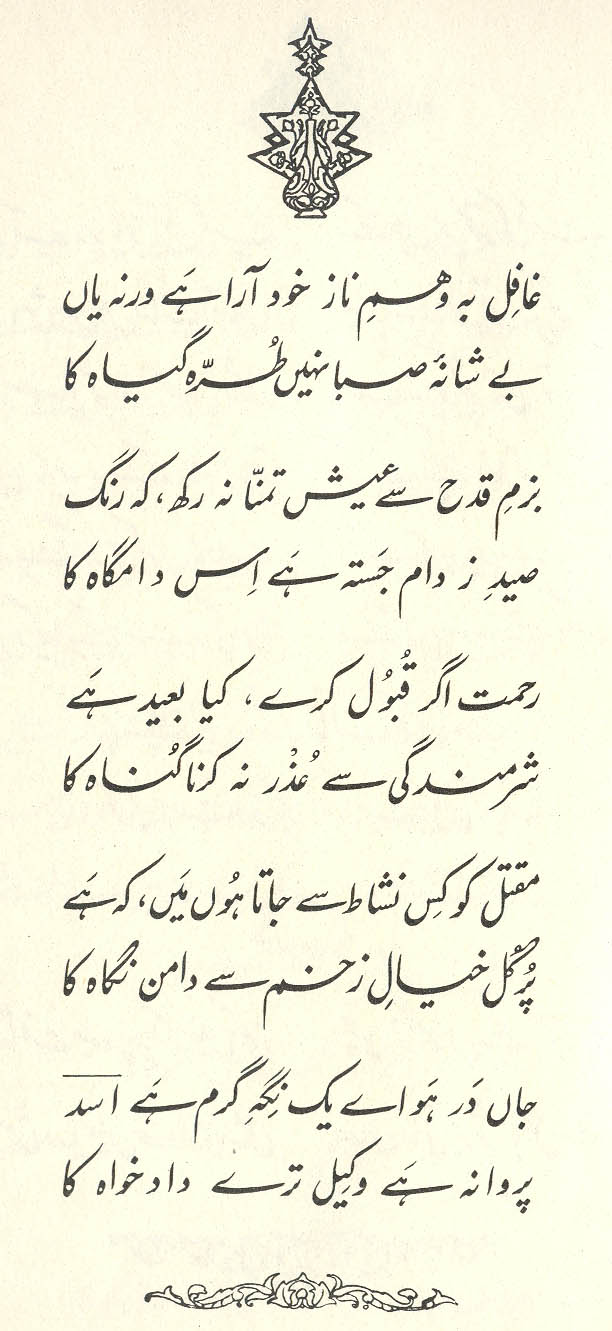
Asad's life is in the longing for one warm/hot glance, as if the advocate of your justice-seeker were someone as enthusiastic as the Moth, who longs to be burnt. (42)
== Nazm page 42

Urdu text: Vajid 1902 {45}
He said, Asad wants to give up his life in the ardor and torment of your glance of kindness, and has appointed the Moth as his advocate and come to your gathering to seek justice. The Moth, burning itself up over the candle, will show you the spectacle of surrendering one's life. In the same way, take his-- that is Asad's-- life. (82-83)
Compare 78,5 . (103)
The classic lover's dilemma (though to the lover it's not a dilemma at all) appears once again-- he lives only in his longing for a glance from the beloved; and a glance from her will slay him. So in fact he is passionately pleading for his death. But what a death! Not a meaningless, ordinary end, but a burning instant of supreme ecstasy and annihilation-- the death of the Moth who flies into the candle-flame and becomes one with the fire. (Or, as Bekhud Mohani points out with reference to 78,5 , the death of the drop of dew when it receives a single glance from the sun.)
There's an elegant ambiguity too about the , which can refer either to the warm 'glowing' glance of eager desire, or (more commonly) to the hot glance of wrath. Perhaps the lover doesn't even care about the distinction, since both would have the same effect.
Moreover, we are in a court setting, for the lover is 'your plaintiff' or 'your justice-seeker' (with the 'you' as the intimate ). Is the beloved the defendant, or the judge? Both together, no doubt, since all power and responsibility belong to her. Is there any hope of justice in such a situation? Perhaps so, since ironically what the plantiff is petitioning for amounts to a death sentence. If the beloved is merciful, she will grant it on the basis of his ardent plea. If she is cruel, she might grant it with a sneer, as an appropriate penalty for insolence.
And the lover feels that this glance is somehow owed to him. He has taken the trouble to retain a suitable advocate or attorney, the Moth. Why is it owed to him? For his devotion, for his passion? Is there any higher standard of justice in the universe than the beloved's whim? For another verse about a plaintiff whom Ghalib himself described in a letter as a justice-seeker [], see 1,1 .
graphics/moth.jpg