Verse 31816aahkaa
G3
1 a
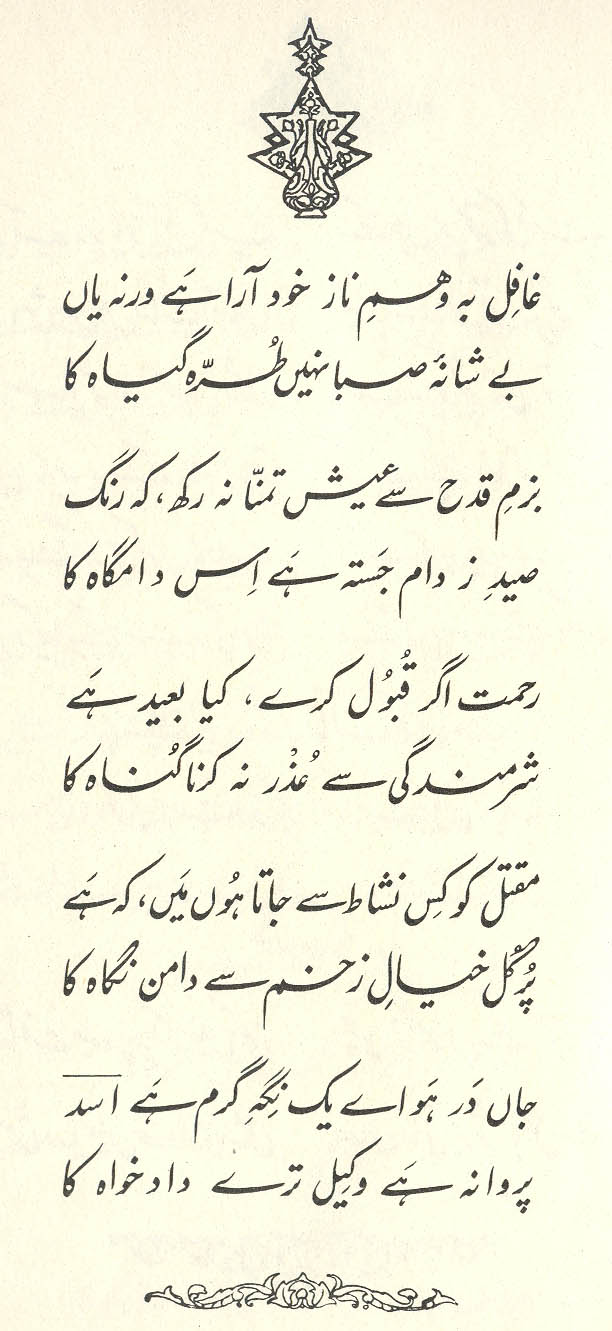
if Mercy would accept one/it
1 b
if one would accept mercy
1 a
how is it [a] remote [possibility]?!
1 b
how remote [a possibility] it is!
1 c
how remote a possibility is it?
2 a
out of shame, {not to / do not} make an excuse for sin
2 b
{not to / do not} make out of shame, an excuse for sin
'Far, far off, distant, remote'.
| References | |
|---|---|
| Arshi, Imtiyaz Ali | Ghazal# 20 |
| Raza, Kalidas Gupta | 146-147 |
| Nuskhah-e-Hamidiyah | 65-66 |
| Asi, Abdul Bari | 67-68 |
| Gyan Chand | 101-103 |
| Hamid Ali Khan | Open Image |
adverbially modifies , which is the object of ; then is the reply to the condition.
== Nazm page 41

He says, to make an excuse for sin is an easy thing. But we want an excuse for a sin worse than any sin; for this reason we can't make an excuse for sin either. But our repentance and shame have reached that level where if mercy accepts them in place of an excuse for sin, what's impossible about that? (82) ../nazm/nazm041.jpg
If we don't make an excuse for sin, then the reason is that we don't consider sin to be sin. Rather, we consider making an excuse for sin to be worse than sin. And we don't give our lips permission to open to make an excuse for sin. It's not strange if the mercy of the Provider would consider our not making an excuse itself, to be an excuse for sin, and accept it, and pardon our sin. (102)
The excellence of this verse is that the very thing which is considered a defect (not to make an excuse for sin), Ghalib has established as a [sign of] skill. (386)
The first line consists of two clauses. In the first one, the grammar of certainly permits the conventional reading (1.1a), which all the commentators prefer, and which places the initiative for mercy-showing in (presumably) God's hands. But the grammar also permits 'if [one] would accept mercy' (1.1b), if we assume that a masculine singular subject has been (quite permissibly) omitted; this less orthodox reading (1.1b) places the initiative-- the choice of whether to accept the divine mercy or not-- in the human hands of the sinner.
Then the phrase has the three readings common to Ghalib's clever setups: (1.2a) how is it [a] remote [possibility]! (that is, it isn't a remote possibility at all, but in fact highly probable); (1.2b) how remote [a possibility] it is! (that is, it's extremely unlikely); and (1.2c) how remote a possibility is it? (a yes or no question).
But the best part of is its brilliant 'midpoint' positioning: it can be considered to apply either to the phrase in the first half of the first line), or to the second line ( ). It really puts the final nail in the coffin of any lingering ideas one might have about pinning down 'the' meaning of the verse.
And then if there could be need of any small brass tacks in addition to that final nail, just look at the possibilities of the second line. The verb can of course be a negated infinitive, 'not to make'; but it can also be a negated neutral imperative, addressed to some unspecified 'you': 'do not make'.
Moreover, there's also the question of . The conventional reading (2a) applies the 'out of shame' to the whole rest of the line: because of shame, not to (or: do not) make any excuse for sin. This is proper behavior: one is too ashamed to even begin to try to make any excuses for one's awful, inexcusable behavior.
But can we really rule out (2b)? On this alternative reading, the deed which is not done (or which one is enjoined not to do) is 'to make from shame, an excuse for sin' []. That is, to make one's shame itself into a justification for further sinfulness. And if this seems a far-fetched reading, just consider the very similar line of argument in 210,1 .
In short, the possible permutations are so numerous that I can't even imagine setting out to explore them all. This is one of the very few 'meaning machine' verses that can claim to rank with the legendary 32,1 .
graphics/rahmat.jpg