Verse 1after 1847aahotaa
G2
1 a
when there was nothing, then God was; if nothing were, then God would be
1 b
when I was nothing, then God was; if I were nothing, then God would be
1 c
when I was nothing, then I was God; if I were nothing, then I would be God
2 a
'being' drowned me; if I were not I, then what would I be?!
2 b
'being' drowned me; if I were not, then what would I be?!
2 c
'being' drowned me; if I were not I, then what would be?!
2 d
'being' drowned me; if I were not, then what would be?!
2 e
'being' drowned me; if I were not I, then so what?!
2 f
'being' drowned me; if I were not, then so what?!
| References | |
|---|---|
| Arshi, Imtiyaz Ali | Ghazal# 44 |
| Raza, Kalidas Gupta | 398 |
| Hamid Ali Khan | Open Image |
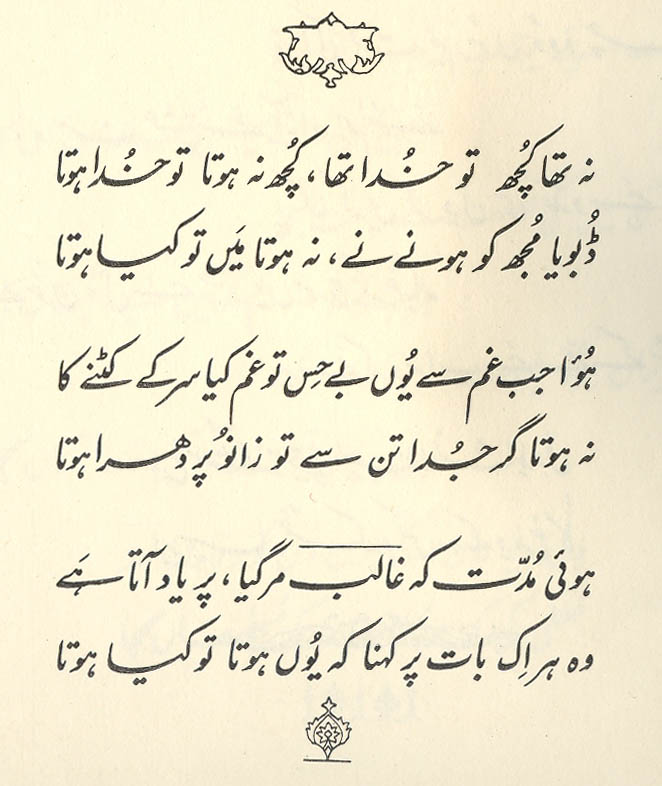
In an entirely new manner he has given non-existence priority over existence, and through a strange expectation he has expressed a longing for complete nonexistence. The meaning of the first line is apparent. In the second line, apparently the thought is expressed, 'If I did not exist, then what harm would it be?'. But the speaker's intent is, 'If I did not exist, it would be worth seeing what thing I would be'-- which means, I would be God. Because in the first line it has already been said, 'If I were nothing, then I would be God'.
==Urdu text: Yadgar-e Ghalib , p.121
He says that this Source, which is insubstantial, cannot become a substance. It is not manifest to the extent that the effects of power and contrivance and wisdom are manifest, perceptible, revealed. And for this reason we make distinctions between the ignorer and the ignored, the active and the passive. The author has composed this verse according to the the Sufistic view: that is, 'When I was nothing, I was God, and having become something, I became alienated from my origin, and to become separate from that benevolent origin turned out to be bad for me'. (31)
== Nazm page 31

With what excellence he's given nonexistence priority over existence-- it's beyond praise. He says that when the world had not been born, then there was only the Lord himself. If this world of possibilities had not been engendered, then too there would have been only the Lord himself. Thus my existence, as it manifested itself, established me as a separate body, and that other body, having taken shape, ruined me. If I had not been born, and did not exist, then just think, what would I have been! That is, I would have been God. (61-62)
The poet has put in this verse such a capacious word as 'drowned'-- the commentary on which could fill volume upon volume.... He inquires from the hearers in a questioning tone, so that they themselves would say just what he is saying about himself. (77)
has two meanings: 1) if I did not exist, then there'd be no loss, no harm; 2) if I did not exist, then I'd be God. (349)
This verse can be placed among the most famous verses of Urdu. The reason for this uncommon fame can be found in the question, filled with helplessness, that has been raised in the second line. The logical structure of the first line too is worth noting. In the commentary on this verse two points have usually been made: (1) When there was nothing, then there was God. If I did not exist, then I too would be a part of that originalness. (2) When there was nothing, even then there was God. If there were no created things at all, even then the Lord's presence would remain. My presence made no addition to the lordship of the Lord.
But in the verse there are some other points as well. The first point worth mentioning is that this verse is among those exceptional and rare verses of Ghalib in which no Persian constructions have been used. Not only this, but in fact in the whole verse only one word derived from Persian ( ) has been used, and that too such a commonly used word that the thought of its being Persian doesn't even arise.
A second point is that the verse alludes to the compulsions of life. That is, humans are compelled to come into existence, and then to remain alive until they face destruction. From their existence or nonexistence no difference would have occurred in the arrangement of the universe-- but they still have to endure their coming into existence, and their death. No one escapes from life and its difficulties. The word is here especially worth attention.
In the light of the above points, it's natural for Shakespeare's drama 'King Lear' [Act 5, Scene 2] to come to mind:
... 'Men must endure
Their going hence even as their coming hither.
Ripeness is all.'
The difference is that Shakespeare, by saying that 'ripeness is all', has saved a little of the honor of authority; and in Ghalib's verse there's end-to-end compulsion and bitter helplessness.
A third point is that in every situation the Lord would have remained present. Upon coming into existence, I realized this oppression. If, God forbid, I were nothing at all, then the Lord knows what state of latency I would be in!
A fourth point is that if I had not been brought into existence, then what would have been the harm?
==(1989: 50-51) 2006: 67-68
This is one of only a handful of ghazals from which Faruqi has selected every single divan verse as superior.
As Faruqi says, this is one of the most famous verses in Urdu, and honestly awe-inspiring in its tangle of complexities of meaning. Hindi/Urdu students can understand it after only a year or so of study; yet it will repay any amount of thought. Can there be another example of so many meanings attained with so little effort? As Faruqi also observes, the vocabulary is simple and plain (and non-Persianized!) in the extreme.
The verse also works as a sort of sophisticated 'mushairah verse', since the first line sets us up to expect an entirely theological theme; the presence of the 'I', and its possible insertion as an omitted subject, don't really occur to us until after we've heard the whole verse. Mahmood Piracha has also pointed out (Sept. 2020) that every single word in the first line appears twice, so that in effect the line consists of six pairs of words.
But then with that second line-- what a shock! After hearing it we realize that the first line consists of one 'when-then' and one 'if-then' sentence, for a total of four clauses; the second line contains in its latter half one 'if-then' sentence that comprises two clauses. In any or all of those six clauses, the subject, which is masculine singular in every case, could also be a colloquially-omitted 'I'. And the final is so brilliantly flung down, so rich in possibilities, that it truly boggles the mind.
In case the bizarre multiplicity of meanings makes your head spin, there are several key operations that generate them in such profusion. Needless to say, the power of speech and the multivalence of are on display; for more on all this see 21,1 . And the choice-- left entirely up to us-- of whether to add or not add the omitted subject 'I' in each of the possible six places where it might appear, generates implicitly twofold meanings for almost every phrase.
And since the lover, God, and the abstract are all masculine singular, all these meanings work:
There are thus these six places at which may or may not be conjecturally inserted, with radical effects on the meaning. The only other special information we need is the knowledge that colloquially means something like 'then so what?' or 'then who cares?' (It works so well that Ghalib promptly uses it again in 32,3 .)
Is this not a two-line complete portable library of possible existential speculations? That's why I consider it a 'meaning machine' or 'meaning generator'-- because of its radical undecideability. For other examples of such wildly proliferating, hypertrophied 'generator' verses, see in this ghazal 32,3 ; and also 21,1 , 45,3 *, 46,7 *, 101,5 , 202,4 , 214,10 , and the brilliantly simple 230,7 .
For another verse with the same apparently sacrilegious overtones, see 230,11 .
Along very similar lines, though ultimately less complex, are Mir 's M 481,6 and M 1076,7 . And for Mir's own show of maximum possible permutations, see M 904,1 . My favorite of such 'Ghalibian' Mir verses, however, is M 1469,3 .
graphics/ocean.jpg