Verse 3after 1847aahotaa
G2
1
it's been quite a while since Ghalib died, but the memory comes--
2 a
his saying about every single thing/utterance, 'If it were thus-- then so what?!'
2 b
his saying about every single thing/utterance, 'If it were thus, then what [a state it] would be!'
2 c
his saying about every single thing/utterance, 'If it were thus, then what would be/happen?'
'Thus, in this wise, in this manner; --just so, for no particular reason; without just ground, vainly, idly, causelessly, gratuitously; to please oneself'.
| References | |
|---|---|
| Arshi, Imtiyaz Ali | Ghazal# 44 |
| Raza, Kalidas Gupta | 398 |
| Hamid Ali Khan | Open Image |
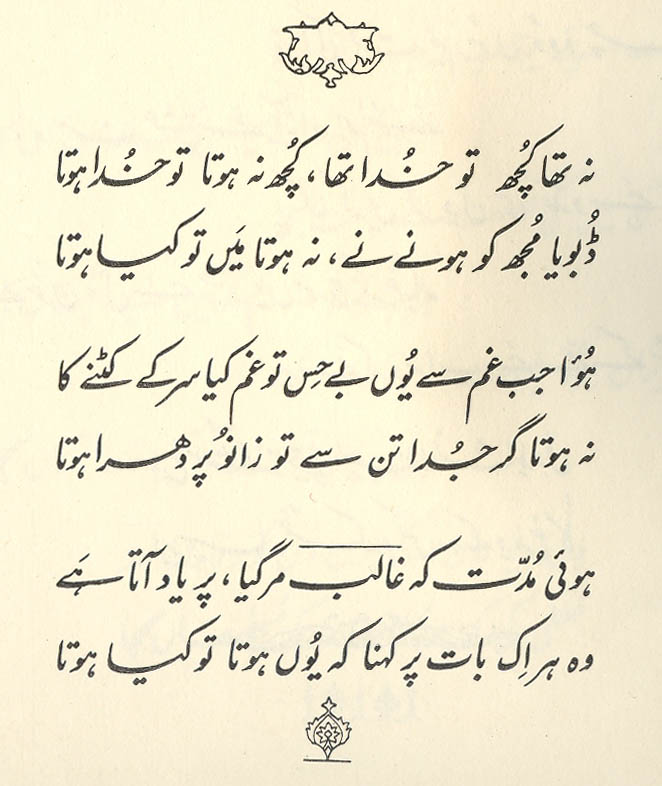
is for contempt. That is, about every deed, whether it be a cause of luxury and ease, or of grief and trouble, he used to say, 'So what?', and used to express contempt for it and consider it trifling. (31)
== Nazm page 31

Urdu text: Vajid 1902 {32}
That is, he was so all-knowing that when any problem was presented before him, he definitely always gave advice about it. (77)
[The commentator Sa'id says:] About everything he used to express longing: that is, 'If it were so, then what pleasure there would be!'. (106)
This is another of Ghalib's 'meaning machine' verses. The commentators might be thought to be unhelpful, since as usual each is content with only one reading, like the blind men describing the elephant. But in fact as a group they prove very useful, since their views can be juxtaposed or amalgamated to show the range of possible readings.
Many of the same effects are present in 32,1 , including use of the same multivalent phrase . The present verse is (and {32,1} might be) spoken after the lover's death, which adds to the punch of the 'so what'-- it expresses despair, futility, an indifference to life that has now found its only possible culmination. But the present verse is spoken by an anonymous, apparently sympathetic friend, a character frequently evoked in the closing-verse because of the helpful presence of the pen-name .
It seems that this one expression, is all the lover used to say, no matter what the circumstances, and is all the friend remembers him by. (On the versatility of , see 30,1 .) If you can choose only one phrase to be remembered by, what a great choice! It can express curiosity (2c), or longing (2b), and/or despair (2a). How better to end a ghazal that begins with the astonishing 32,1 ?
Compare Mir 's verse of similar speculation: M 956,4 .
graphics/questionmark.jpg