Verse 1after 1847aathaa
G10
1
I-- and from the wine-party, {like this / vainly / gratuitously}, thirsty-throated, to come [away]?!
2
if I had sworn off [it], what had happened to the Cupbearer ?!
'Thus, in this wise, in this manner; --just so, for no particular reason; without just ground, vainly, idly, causelessly, gratuitously; to please oneself'.
'To vow to sin no more; to repent (of evil, sin, crime, &c.); to recant; to abjure, renounce, forswear'.
| References | |
|---|---|
| Arshi, Imtiyaz Ali | Ghazal# 39 |
| Raza, Kalidas Gupta | 396 |
| Hamid Ali Khan | Open Image |
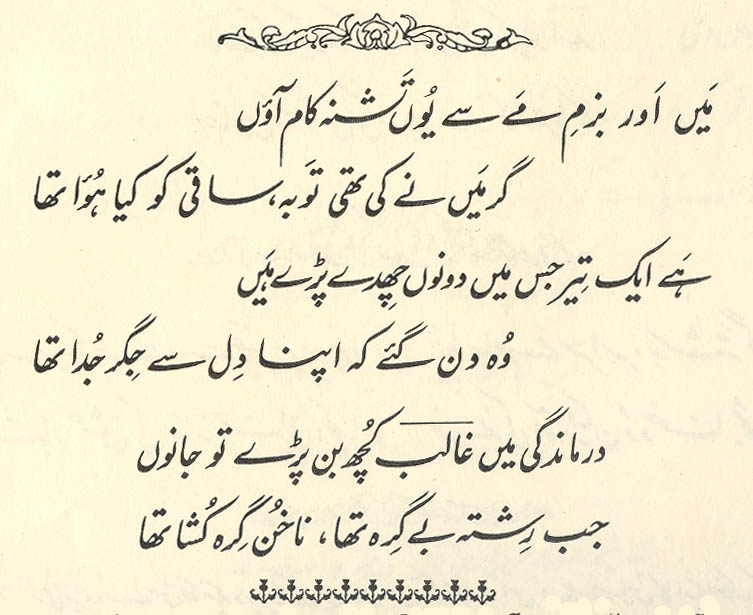
That is, why didn't he make me drink by force?
==Urdu text: Yadgar-e Ghalib , p. 141
That is, it's an occasion for astonishment, that-- I, and not to get wine?! If I didn't drink by myself, then it was the Cupbearer's right/duty [] to make me drink. (30)
== Nazm page 30

Granted that I had sworn off it, and because of my oath had not asked for wine from the Cupbearer-- still, what came over the Cupbearer, that he didn't give me wine without being asked, and didn't force me to drink? The words in which Mirza Sahib has expressed this theme -- only real knowers of the language [] can somewhat appreciate their pleasure. (60)
In Eastern [] poetry, the Cupbearer is a destroyer of piety; that is, his very task is to overcome people's renunciations and forcibly cause any refuser to drink. Thus Dagh says,
[what pleasure the refusal of wine gave me!
he climbed on my chest and made me drink a cask of wine]. (346)
ABOUT : The use of is elegantly multivalent. Did the speaker come away thirsty 'thus, like this', or 'casually, for no particular reason', or 'vainly, idly', or 'to please himself' (see the definition above)? Each possibility opens a new and piquant interpretive direction, and (naturally!) we are given no way to choose among them. Some similarly multivalent uses of : {30,1}; 98,8 *; 180,1 ; 191,4 ; 201,3 ; 201,4 ; 208,11 ; 210,2 ; 219,2 ; 225,1 ; we find a case of in 35,5 . And its intensive or emphatic form, , also occurs: 111,16 ; 168,3 ; 311x,6 . (In 116 , the refrain of seems basically to mean 'like this', although in some verses it could be more multivalent.) Compare the somewhat similar use of in 50,2 .
This small ghazal has no opening-verse ; unusually but not uniquely, it begins just with an ordinary verse.
What a disgrace, and how completely unacceptable! Not only was the speaker not himself last night, but the Cupbearer was obviously not himself either. After all, we know from 12,2 that the Cupbearer is a 'sea of wine', and that the true drinker is 'the stretch of the shore', and that thirst [] is felt according to the drinker's 'capacity' [], so that it becomes a measure of his worth. How could both the Cupbearer and the speaker/lover have acted so contrary to their best selves, as to permit the lover to leave the wine-party with his thirst still unslaked?
No doubt the speaker might have briefly been deluded enough to swear off wine, but if he forgot his proper role, was that any excuse for the Cupbearer to forget his own? And in fact, it's possible that it was the Cupbearer's proper role to prevent the speaker from swearing off wine in the first place; the juxtaposed phrases in the second line are very open to this reading as well, since they're both in the past perfect.
Really a most embarrassing occasion, so that the speaker feels both self-reproach and a sense of grievance against the Cupbearer's negligence. The Cupbearer has been negligent on some other occasions, as in 21,6 ; but usually his performance is superb, as in 18,1 . Something must be done to make sure such a terrible faux pas will never recur. (For more on the idiomatic expression 'I and' see 5,6 .)
graphics/forceddrink.jpg