Verse 11853aamke
G14
1
the Other s would take, in the gathering, the kisses of the cup
2
we would remain like this-- thirsty-lipped for a message
'Message; mission, embassy; news, advice, intelligence'.
| References | |
|---|---|
| Arshi, Imtiyaz Ali | Ghazal# 231 |
| Raza, Kalidas Gupta | 445 |
| Hamid Ali Khan | Open Image |
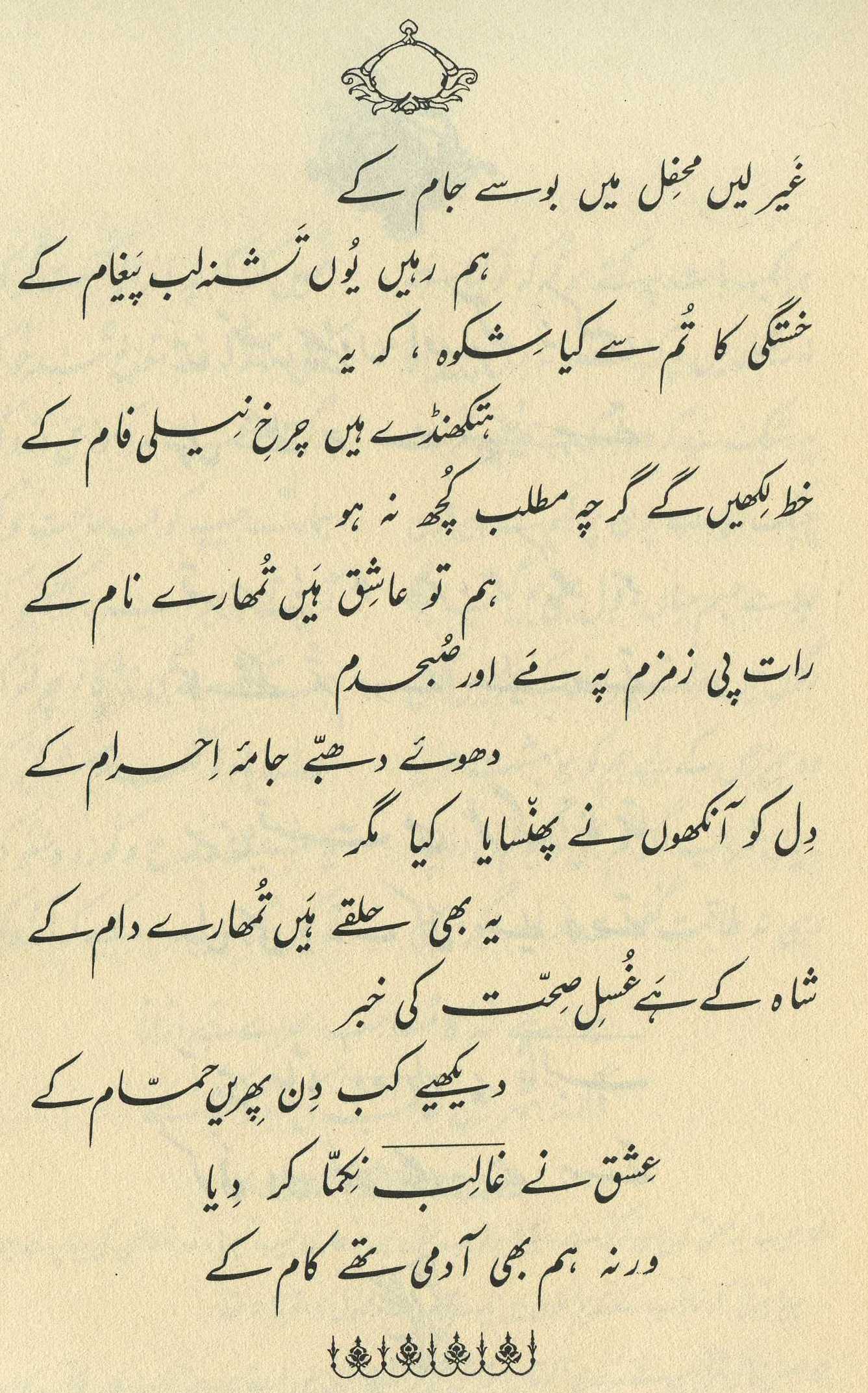
This is a verse in a situation of longing, and by 'gathering' is meant the beloved's gathering, and by 'message' is meant the 'sought-for message', and he has brought in the word 'thirsty' because of wordplay with the word 'cup'. (203)
== Nazm page 203

He says, the gathering is held regularly every day. Every day you go on joking with the Others, you go on giving to the Others, with your own hand, cups full of wine. We are thirsty-lipped for the sought-for message; that is, we remain deprived. Not even by accident are we ever invited to the gathering of coquetry. Longing drips from the words. (261)
The extremity of complaint, the limit of longing drips from it. That is, we who are in every way worthy of it, would never even be invited. 'Like this'-- that is, so much indifference toward us would be established as permissible, that not even false inquiries would be made. 'Would take the kisses of the cup'-- from this there passes before our eyes the scene at the time of wine-drinking, with the Rival s in a state of delightedly drinking wine, and the longing of the deprived rakish one []. (357-58)
The two lines contrast the situation of the true lover with that of the Other s, but how? The commentators' consensus is that he's not invited to the beloved's gatherings at all: he just stays home and tortures himself with visions of how much fun they're having. If we look carefully, however, we see that there are a number of possibilities
=The Others are invited to her gatherings; the speaker is not.
=The Others attend her gatherings; he does not (even if he's invited).
=The Others drink wine; he does not.
=The Others flirtatiously 'kiss' the wine-cups; he does not.
The true lover is, in short, much harder to please than the Others are; they will settle for a nice evening of sociability and drinking, while he is 'thirsty-lipped' not for wine or company or flirtation, but only for a 'message'. Of course, the verse doesn't tell us what the 'message' is about-- but then, it's not hard for us to come up with some ideas. For surely the message would be as thirst-delighting and as intoxicating as wine, it would be as 'kissable' as the rim of a delectable glass of wine.
Moreover, the whole thing is presented in the subjunctive, depicting something that 'would' or 'might' occur. This element of uncertainty adds to the multivalence of the verse. Could all this be hypothetical? If so, the lover may be planning his tactics for the future. Or else the first line could be construed as 'Others may take...' or 'Let others take...', while the second line proposes the behavior that he himself would then adopt.
For more on , see 30,1 ; here its sense of 'like this' seems to be the dominant one.
graphics/wineglass.jpg