Verse 71853aamke
G14
1
passion, Ghalib, made us useless/worthless
2
otherwise, even/also we were a person of use/capability/desire
'Without work, unemployed, idle; --unprofitable; base; --poor, not fertile'.
| References | |
|---|---|
| Arshi, Imtiyaz Ali | Ghazal# 231 |
| Raza, Kalidas Gupta | 445 |
| Hamid Ali Khan | Open Image |
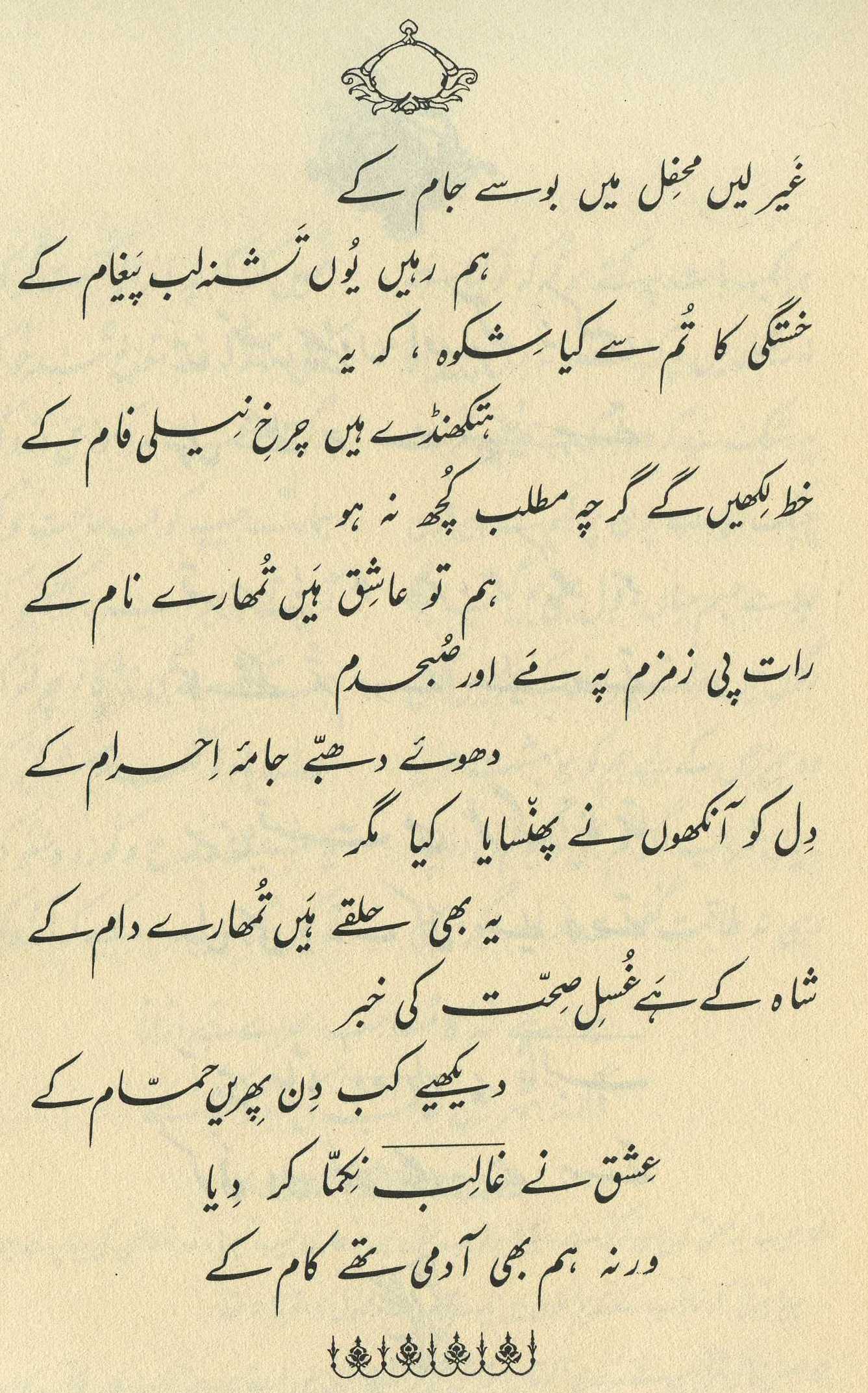
[1862, to Taftah:] There's a parcel from Lalah Balmukund Besabr that came days ago, and still as yet I haven't even opened it. Ten or fifteen ghazals of the Navab Sahib's are lying around--
{180,7} [but with 'weakness' [] substituted for 'passion' []]
That ode of yours came yesterday. Today, before the sun is high, I've looked it over [and corrected it], made an envelope for it, and sent a man to the post office with it. (Arshi 336)
==Urdu text: Khaliq Anjum vol. 1, p. 338
==another Eng. trans: Russell and Islam , p. 280
[1867, to Ahmad Hasan Qannauji:] {180,7}: I'm sixty-five years old. Decline in strength, weakness of intellect, thoughts of death, grief of the end. I'm now no longer as you've seen me. The work [] of poetry and prose goes on simply through the force of fifty years of practice []; otherwise, where is the brilliance of the true temper of thought []? An old wrestler describes the holds, but can't exert the force. Anyway, convey my salaam to the Hakim Sahib, and tell him that he should regularly send his poetry, with no formality. After I have given correction , it will regularly be returned to him. ==Urdu text: Khaliq Anjum vol. 2, p. 786
[1867, to Ahmad Hasan Qannauji:] {180,7}: I'm sixty-five years old. Decline in strength, weakness of intellect, thoughts of death, grief of the end. I'm now no longer as you've seen me. The work [] of poetry and prose goes on simply through the force of fifty years of practice []; otherwise, where is the brilliance of the true temper of thought []? An old wrestler describes the holds, but can't exert the force. Anyway, convey my salaam to the Hakim Sahib, and tell him that he should regularly send his poetry, with no formality. After I have given correction , it will regularly be returned to him. ==Urdu text: Khaliq Anjum vol. 2, p. 786
[No comment is offered.]
== Nazm page 203

It's a clear and simple verse, and then it's not devoid of pleasure. (262)
Passion made us useless. Otherwise, like others, he too were a man of use/capability. From this verse it necessarily emerges that passion doesn't leave any man fit for use/work. (359)
[In an essay read at the Delhi Society, and in conversations with friends in the 1860's, Ghalib quoted the verse in the changed form [with instead of ]. When one friend asked him about the change, he replied, 'The word was connected with that time. Now I am ashamed of the word.'] (337)
The first line gives us , and of course we recognize it as meaning generally 'worthless'. But still, there are many directions in which the second line could go, with many kinds of misery, suffering, and debility that could be adduced as examples.
In good mushairah performance style, we have to wait for further revelation until we hear the second line. And even then, the second line withholds its punch-word until the last possible moment: . Only then do we realize that the opposition between and its derivative opposite, , is at the heart of the verse. The word points us to the most common meaning of : something like 'action, act, deed, work, doing, handiwork, performance; work, labour, duty, task, job'. Ghalib's own use of the verse in letters also points us in that same general direction.
But the position of as a 'punch-word' invites us to give it particular attention, and then of course we recall its double meaning: it also has, through both Persian and Sanskrit, a powerful range of 'desire'-related meanings: 'inclination, wish, desire, longing, inordinate desire; affection, love, passion; sexual passion; lust'. (For more discussion of these double meanings, see 22,6 .)
Moreover, both these meanings of are explicitly 'activated' within the verse: the meaning 'work' is activated by the opposition to , and the meaning 'desire' is activated by the explanatory invocation of . For more on such 'double activation', see 120,3 .
graphics/lover.jpg