Verse 61854aanah hu))aa
G5
In this meter the first long syllable may be replaced by a short; and the next-to-last long syllable may be replaced by two shorts.
1 a
[assigned] to my name is that sorrow that no one [else ever] received
1 b
[assigned] to my name is that sorrow that no one received
2 a
in my work/desire is that affliction/conflict that did not [ever before] arise
2 b
in my work/desire is that affliction/conflict that did not arise
'(Hindi) Action, act, deed, work, doing, handiwork, performance; work, labour, duty, task, job; business, occupation, employment, office, function; operation, undertaking, transaction, affair, matter, thing, concern, interest'.
'(Sanskrit) Inclination, wish, desire, longing, inordinate desire; affection, love, passion; sexual passion; lust; love of pleasure; the object of desire or love'.
'(Persian) Desire, wish; design, intention; --the palate'.
'Trial, affliction, calamity, mischief, evil, torment... --temptation, seduction; --discord, conflict, cabal, faction, civil war, sedition, revolt, mutiny; perfidy; sin, crime'.
| References | |
|---|---|
| Arshi, Imtiyaz Ali | Ghazal# 48 |
| Raza, Kalidas Gupta | 448 |
| Hamid Ali Khan | Open Image |
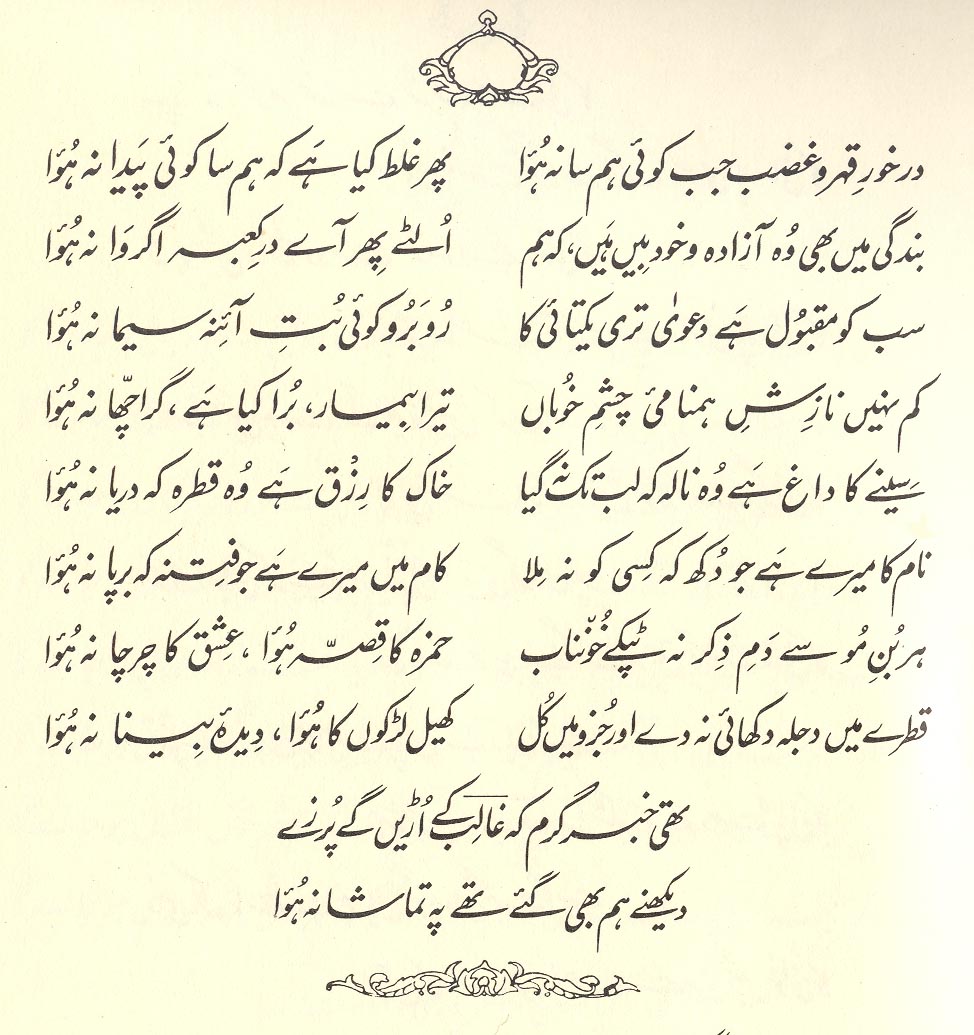
It's clear. (24)
== Nazm page 24

That affliction of Doomsday which has never [before] arisen is absorbed in working on me-- that is, it is collecting troubles and difficulties for me. (48)
In my work/tasks such disturbances and obstacles arise that the people of the world aren't even acquainted with them. (58)
In this verse too [as in the previous one], the juxtaposition of words and the manner of parallelism is worthy of praise. (83)
ABOUT : It's always necessary to reckon with the complexities of , which can mean 'work, activity' or 'desire'-- since the word (m.) descends through both the Indic side and the Persian. (See the definitions above.) There's also a Sanskrit source that gives us the sense of erotic desire (as in , the god of love). And a secondary Persian meaning is 'palate' (for examples see 6,4 , 22,6 , 204,9 ). The word is so important that together its various meanings occupy almost a whole page of Platts. (Platts pp.804-05). Other examples that take poetic advantage of this useful double sense of : 6,4 (all three possibilities); 27,5 ; 51,6x (all three possibilities); 59,3 ; 115,9 ; 137,6x (esp. palate); 180,7 , 208,10 ; 232,8 // 404x,4 . Mir is an even greater admirer of the possibilities of than is Ghalib: for examples see M 7,1 .
No doubt Josh says 'too' because the previous verse, 22,5 , is also a study in parallelism . The formal and semantic similarities between the two lines invite the reader to compare and/or contrast individual elements, and also the lines as wholes.
Nazm's airy dismissal to the contrary, on close inspection this turns out to be a subtly multivalent verse. For are the negations designed to leave a loophole for the speaker (no one else; never arose before), or to apply to the speaker's case as well (no one at all; never arose at all)? A common-sense reading suggests the first interpretation; a strict attention to grammar suggests the second. Certainly neither can be ruled out.
The first line offers two distinct possibilities. (1a): Specially assigned to the speaker's name is that unique kind of sorrow that no one else has ever received; this suggests that God (or fate, or destiny) takes particular care about him, and carefully assigns him the worst kind of sorrow, one that is not assigned to anybody else. (1b): Assigned to the speaker's name is that random batch of leftover, surplus, unwanted sorrow that no one received; this suggests that fate disdainfully treats him as a kind of dumping ground, and offloads onto him all the leftover dregs of sorrow and woe that hadn't been used for others.
The second line offers the same two possibilities, and other complexities as well. (2a): In the speaker's work/desire is that unique kind of affliction that did not ever previously arise; thus his work/desire is more tumultuous, powerful, disruptive than anyone else's has ever been before. (2b): In the speaker's work/desire is that affliction that did not arise at all; thus his work/desire is characterized by-- what? a phantom affliction, a failed turmoil that doesn't really manage to exist? A special 'nonbeing' kind of affliction, that only latently or imperceptibly manifests its power? (Consider 5,3 in this regard.) The implications are not too clear, but the statement itself in the verse is emphatic and unambiguous: the speaker's kind of affliction is that specific kind that 'didn't arise'.
In the present verse, both the main meanings of are of course appropriate: if we take as 'desire', then the speaker's kind of desire is either the wildest, most turmoil-producing kind imaginable, a kind heretofore unseen; or else a strange, unheard-of kind that doesn't create turmoil. Why doesn't it? Because of its hopelessness and his weakness? because of his self-control (see 22,5 for more on this)? Because of its special 'nonbeing' status?
And if we take as 'work, activity', then we have the same choices, along with others. When the speaker tries to work in the world, to achieve his purposes, he creates either the most unprecedented affliction-- or no affliction at all. Then there are the interpretations of the Bekhuds. Bekhud Dihlavi takes to mean not 'in the work I am doing' but 'in the work being done on me'-- by fate, or some other outside agency. Bekhud Mohani offers a similar reading: 'in my work such affliction arises'-- not from the work itself, but in opposition to the work, by some (unspecified) outside force or fate that is engaged in thwarting it.
What an enjoyable, imaginative range of choices! I wonder whether Nazm would agree that all these possibilities in fact exist, or whether he would insist on ignoring most of the meanings and considering whichever ones he favored to be 'clear'.
graphics/misery.jpg