Verse 11854aanah hu))aa
G5
In this meter the first long syllable may be replaced by a short; and the next-to-last long syllable may be replaced by two shorts.
1
when no one became suitable, like us, for wrath and torment
2 a
then how is it a mistake [to think] that no one like us was born?
2 b
then how is it a mistake that no one like us was born?
2 c
then what a mistake it is, that no one like us was born!
2 d
then it isn't at all a mistake that no one like us was born!
'Suitable, proper, fit, becoming'.
t>> : 'Mistake, error; --adj. Wrong, erroneous, incorrect, inaccurate; untrue, false'.
| References | |
|---|---|
| Arshi, Imtiyaz Ali | Ghazal# 48 |
| Raza, Kalidas Gupta | 448 |
| Hamid Ali Khan | Open Image |
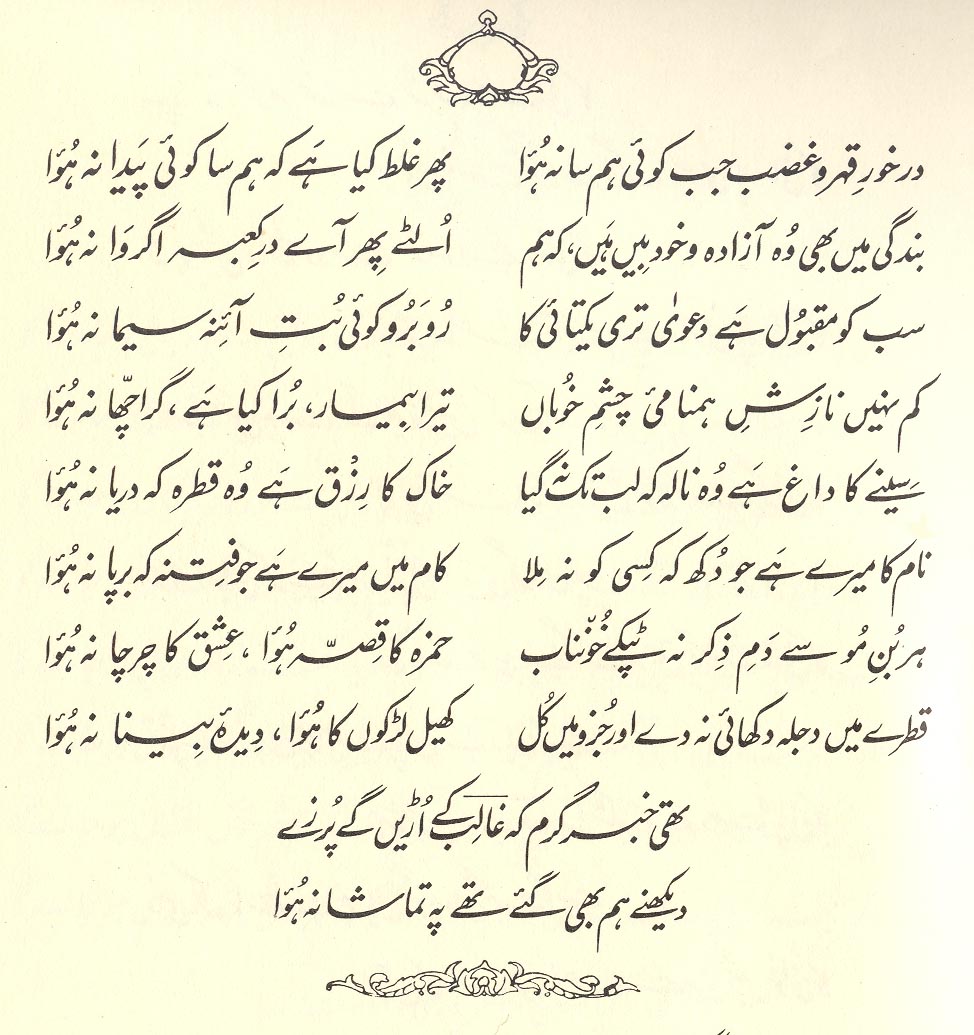
That is, then how is our statement incorrect, that no one like us was born, and no one became so disaster-stricken as we did. (23)
== Nazm page 23

The meaning of the verse is that you don't show tyranny and oppression to the Other . I alone have become singled out for wrath and torment. Then if I say that no lover of yours like me has been born, how is it a lie? Why don't you accept my statement? (47)
That is, even we are peerless in something. (56)
This verse bears witness to Ghalib's inventiveness, through which he has proved himself peerless. In the second line he has made a claim; in the first line he has given a proof of it. (222)
This is the kind of verse we see many of in 21 , in which the first line appears straightforward and the second contains the indefinitely expanding ; for discussion of the multivalence of see 21,1 . Here an additional possibility has been added by the semantics of the situation: perhaps the mistake referred to could be that of the speaker's imagining or claiming his own uniqueness (2a), not the uniqueness itself.
The idea of being , 'suitable, proper, fit', for , 'wrath and torment', also has a piquant doubleness to it. Is the speaker suitable because in his deep unworthiness he deserves such suffering more than anybody else? Or is he suitable because he as a uniquely tenacious lover can endure such suffering, while no one else can? Consider the possibilities:
(2a) then how is it a mistake [to think] that no one like us was born? (After all, we are undoubtedly unique, though in a certain morbid way, and we can claim that as a distinction.)
(2b) then how is it a mistake that no one like us was born? (Why should we consider our uniqueness a mistake? It seems to be a correct decision by God. Why should He impose such a cruel fate on anybody else?)
(2c) then what a mistake it is, that no one like us was born! (If we alone are tenacious and hardy enough to endure the terrible suffering of passion and the wrath of the beloved, doesn't that mean that before us and after us, no such tough-minded lover has appeared or will appear? What a mistake on God's part, not to supply the world with such true and enduring lovers in every generation!)
(2d) then it isn't at all a mistake that no one like us was born! (Since our suffering and/or unworthiness was so great, it was quite proper that nobody else should be put through the same ordeal. It wasn't a mistake, but a deliberate, right choice on God's part.)
The tone of rueful pride appropriate to every one of these meanings makes it a marvel of a verse-- both funny and grim.
Compare Mir 's much bleaker verse about the lover's rarity and extraordinariness: M 1080,5 .
graphics/fierywrath.jpg