Verse 41854aanah hu))aa
G5
In this meter the first long syllable may be replaced by a short; and the next-to-last long syllable may be replaced by two shorts.
1
it's not little/less, the pride/coquetry of name-sharing with the eyes of beautiful/fine ones
2
your sick one-- how is it ill/bad, if he didn't become well/good?!
'An eye that looks half-closed (from modesty, an epithet of beauty), a drooping or languid eye'.
'An eye that looks half-closed (from modesty; an epithet of beauty)'. (Steingass p.393)
| References | |
|---|---|
| Arshi, Imtiyaz Ali | Ghazal# 48 |
| Raza, Kalidas Gupta | 448 |
| Hamid Ali Khan | Open Image |
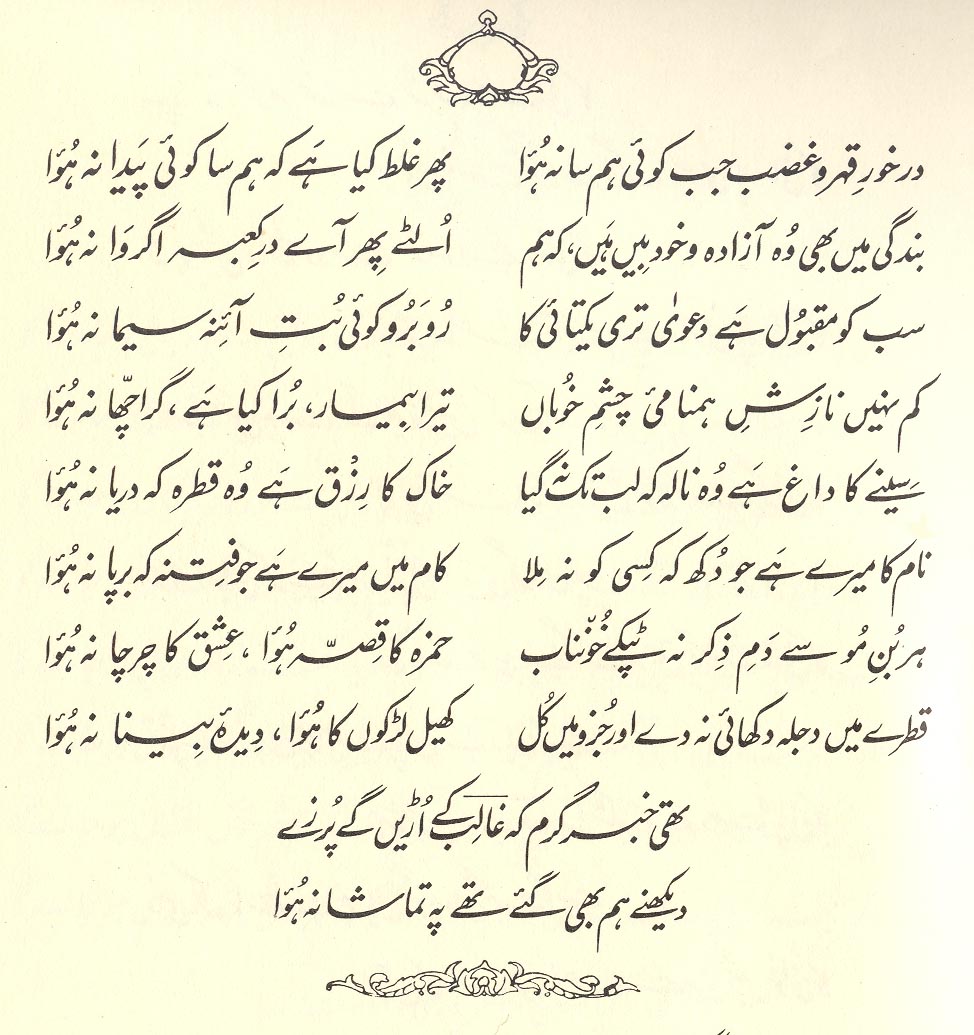
That is, if I remained sick, the eye of the beloved is 'that of a sick person'; is this sharing of a name a small thing? (24)
== Nazm page 24

Urdu text: Vajid 1902 {22}
The beloved's eye is called 'that of a sick person' because a sick person, due to weakness, rarely rises, and shy eyes too don't know how to rise toward a stranger. (58)
[Asi says:] In this verse is the extremity of longing. The love endures his worst state, since it has the same name as something of the beloved's; or rather, he prides himself on it. (83)
As Bekhud Mohani explains, the beloved has , literally 'eyes of a sick person' (or 'sick eyes')-- eyes that are lowered, languid, unresponsive. Perhaps this is because of modesty, or perhaps it is because of arrogance or disdain. The first line sets up the wordplay, but is incomprehensible in itself, since the beloved's eyes have many other epithets as well. The fact that the line is full of ostentatiously Persian words and forms also leads the listener to expect something elaborate, complex, ornate in the second line. In the oral performance conditions of the mushairah , the first line would be lingered over, perhaps repeated. The listeners' curiosity would be aroused, and they would be waiting in suspense for the second line.
Then when we in the audience are finally allowed to hear the second line, we get-- three different things all together, all at once. First, we get a solution to the incomprehensibility of the first line: we learn that the poet has been teasing us with punning references to . Second, we enjoy the effect of an utter contrast in vocabulary and structure: except for -- itself a well-known and commonly used word-- the second line consists entirely of simple Indic words and basic Indic grammar. And third, we get a piquant wordplay based on 'bad' and 'good'-- to go with 'fine' or beautiful ones [] in the first line.
I've tried to suggest it in English with 'ill' and 'well'. The parallel is not perfect, but it does give the general idea. Just as Ghalib has a set of verses that play on easy versus difficult (see 6,5 on this), he has a set, listed above, that play on good versus bad. See 26,1 for a very apposite example, also involving illness versus health.
What we conspicuously do not get is the actual idiomatic expression (see the definition above). We are given both halves of it, and a clear allusion to the full expression, but not the expression itself. Ghalib has left it to us to pull the whole thing together. For other verses that also play on without actually using the phrase, see 72,3 and 200,1 .
In short, this must have been a lovely mushairah verse. The first line sets up some puzzles and expectations, but it goes nowhere on its own. Then the eagerly-awaited second line gives us three complex verbal pleasures, all bursting out at once from nine little words. But they're not really available until the last possible moment: until we hear , we can't fully put the whole verse together. This withholding of the punch-word is another highly effective pleasure that mushairah verses specialize in providing.
graphics/eyes.jpg