Verse 6x1821aamii
G10
2
it passed, dry, through the river-- the intoxicated ones' thirsty-throatedness
'Freedom (from business, &c.), cessation (from work, &c.), finishing and ceasing (from), disengagedness, leisure, rest, repose; freedom from care or anxiety, ease, convenience, comfort, tranquillity, happiness; easy circumstances, competency, affluence, abundance'.
| References | |
|---|---|
| Arshi, Imtiyaz Ali | Ghazal# 134 |
| Raza, Kalidas Gupta | 345 |
| Nuskhah-e-Hamidiyah | 184-185 |
| Asi, Abdul Bari | 217-218 |
| Gyan Chand | 333-334 |
| Hamid Ali Khan | Open Image |
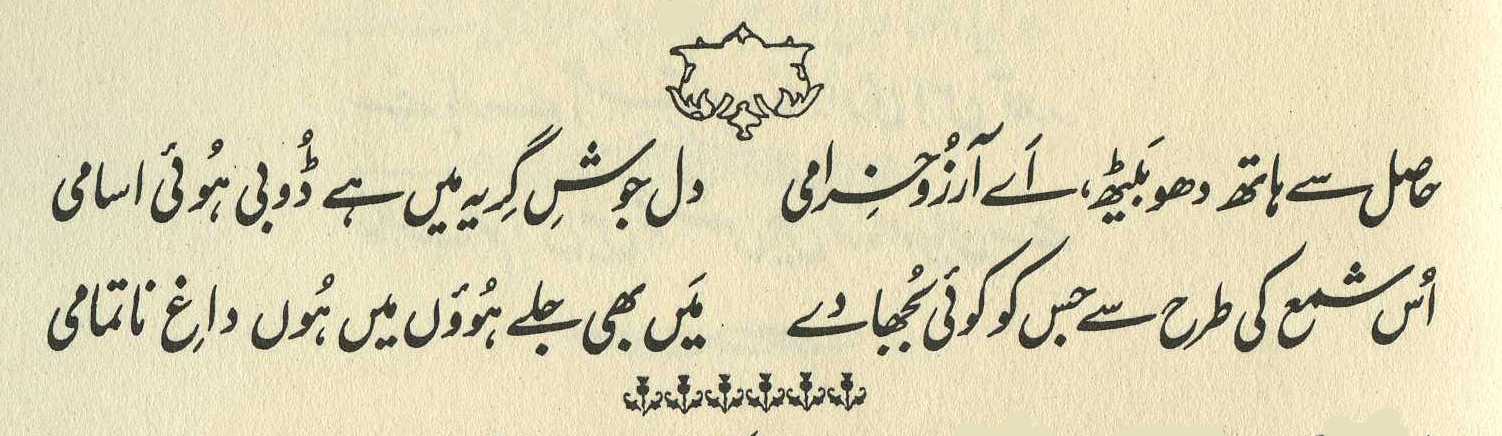
In hopelessness, Asad no longer had any need even of the Cupbearer, and he dispensed/finished even with him. So to speak, the thirsty-throatedness of the intoxicated ones passed, dry, through/by the sea.
== Asi, p. 218
That is, no thirsty one at all, not even if intoxicated, would fail to see the water by the shore of the river, and would remain thirsty. This is the situation of Asad-- that the assault of despair has taken him out of himself in such a way that does not approach even the Cupbearer; he sits disengaged even from him.
== Zamin, p. 322
Since I have an intensity of despair, I have no hope/expectation that the Cupbearer will give me wine. Thus I have become detached/independent from him. For a thirsty wine-drinker to pass by a river and remain thirsty is a strange thing, but just this has happened to me.
== Gyan Chand, p. 334
For background see S. R. Faruqi's choices . This verse is NOT one of his choices; I thought it was interesting and have added it myself. For more on Ghalib's unpublished verses, see the discussion in 4,8x .
The first line is just a kind of teaser (how could any drinker dispense with the Cupbearer ?!), but the second line line has a powerful, paradoxical resonance. And since it's an 'A,B' verse, we're left to pull it all together for ourselves. Why have the thirsty wine-drinkers (or, literally, why has their 'thirsty-throatedness') passed through the river w hile remaining 'dry'? Here are some possibilities:
=When they arrived at the river, it was already dry. (Perhaps others had already drunk it up.)
=They drank the river dry, and found its water entirely insufficient to slake their thirst (compare the inadequacy of the river of sinfulness in 38,6 ).
=They did try to drink from the river, but they found that its water unsatisfying and preferred to remain thirsty. (Cf. ' Looking for the water from a deeper well '.)
=They were not even tempted to drink from the river-- they knew it would be unfit for them, and would not satisfy their need.
Then, since in this 'A,B' verse the first line invokes wine (through the figure of the Cupbearer), while the second line invokes water (through the river, or sea), it's left up to us to decide about their relationship. If water and wine are to be equated, then Asad's dispensing with the Cupbearer is parallel to his dissatisfaction with the river; for the Cupbearer can be considered a 'river/ocean of wine', as in 12,2 . Or perhaps the lines are a sequence: first Asad dispensed with the Cupbearer, then he found the river unsatisfactory too. Or perhaps the other way around: in his wandering Asad first found the river unsatisfactory, then he dispensed even with the Cupbearer. Or perhaps one of the lines is a cause, and the other an effect (and if so, which way around)?
A final twist of wordplay (and meaning-play) comes at the last possible moment. Of course means 'thirsty-throatedness'-- but hovering in the air above , inescapably, are its related, far more common meanings of 'work, task' and-- particularly-- 'desire'. For more on this, see 22,6 . It's easy to imagine that Asad's 'despair' might result from failures in both these realms, as well as a (mystical?) 'thirst'.
graphics/thirsty.jpg