Verse 21821aamii
G10
1
like that candle that someone would extinguish
2
even/also I, among the 'burnt' ones, am a wound/scar of incompleteness
'To burn; to be burnt; to be on fire; to be kindled, be lighted; to be scorched, be singed; to be inflamed, to be consumed; to be touched, moved, or affected (with pity, &c.); to feel pain, sorrow, anguish, &c.; to burn or be consumed with love, or jealousy, or envy, &c.; to take amiss, be offended, be indignant; to get into a passion, be enraged, to rage'.
'A mark burnt in, a brand, cautery; mark, spot, speck; stain; stigma;... scar, cicatrix; wound, sore; grief, sorrow; misfortune, calamity; loss, injury, damage'.
| References | |
|---|---|
| Arshi, Imtiyaz Ali | Ghazal# 134 |
| Raza, Kalidas Gupta | 345 |
| Nuskhah-e-Hamidiyah | 184-185 |
| Asi, Abdul Bari | 217-218 |
| Gyan Chand | 333-334 |
| Hamid Ali Khan | Open Image |
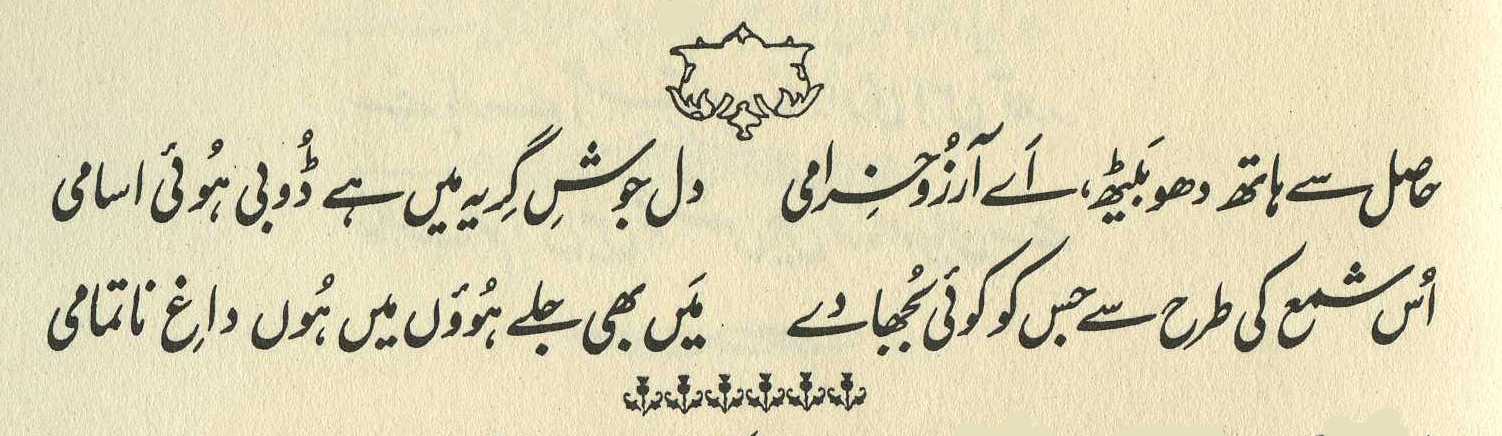
I am a wound/scar of incompleteness, that is, I bear the wound of my remaining incomplete. Those people who have girded their loins to narrow down the Urdu language, and are devoid of the art of meanings, hold the opinion that the word in this verse is only for the meter [], and after they've left off saying, and writing, and versifying . But this is used in the idiom, or it can be guessed; and both are permissible.
Mir says [M 46,2 ]:
[I am a wound/scar of the envy/jealousy of love-- so restless,
for whose comfort did I emerge from the house?] (147)
== Nazm page 147

He says, I am the wound/scar of incompleteness. That is, I bear the wound/scar of my own incompleteness as does the candle that someone would, after it had been burning for a while, extinguish, and it would remain unfinished and useless. (203)
The way an extinguished candle feels sorrow at its incomplete burning, in the same way I am grieved at not having been able to burn completely in the fire of passion. (269)
In another place he writes: 76,2 . (348)
How elegantly the word works here, along with the complexities of the ! The , the 'wound/scar of incompleteness', can be: the wound/scar 'caused by' incompleteness; or the wound/scar 'possessed by' incompleteness; or the wound/scar that itself 'is' incompleteness. But the power is also in the sound of the phrase itself, with its flow of resonant long vowels; it's the heart of the verse, and it echoes in the mind, mysterious and stark.
And in metrical terms, occupies exactly the whole second half of this metrically abrupt-sounding, self-repeating line (foot A foot B / foot A foot B), which also contributes to its effect. (In the first line, the juxtaposition , with the first long and the second short, also creates an enjoyable metrical swinginess.) But who are the 'burnt ones' among whom the speaker, like the snuffed-out candle, finds himself to be a 'wound/scar of incompleteness'?
They seem to be the fully, properly, honorably 'burnt-out' lovers and/or candles; the speaker alone is one who was not fortunate enough to manage to burn completely. It is humiliating, it is painful, it is the restlessness of unfulfillment; he 'burns' with envy at their consummation and his own failure. Through the words , the simile is made unusually explicit: He is like a half-burnt, snuffed-out candle. In the ghazal world, the ideal destiny for a candle is to burn itself out completely as it illumines a festive gathering, so that by dawn it has sacrificially given its all, and lies guttered out and 'dead' (as, most unforgettably, in 169,12 ).
As if to compensate for making the simile explicit, Ghalib has also given it an extra twist. It's not 'like a snuffed-out candle, I am unfulfilled', but 'like a snuffed-out candle, I am a wound/scar'. So the snuffed-out candle and the speaker are both wounds/scars, and the straightforward-looking simile has revealed a more baroque metaphor within it. Candles and wounds-- what more could the ghazal poet ask for in evocative imagery? Arshi points to two very suitable verses for comparison.
graphics/extinguishedcandle.jpg