Verse 21816aar;haif
G3
1
the heart 'burns'-- why didn't we burn up one time?
2
oh Incompleteness of the flame-shedding breath-- alas!
'To burn; to be burnt; to be on fire; to be kindled, be lighted; to be scorched, be singed; to be inflamed, to be consumed; to be touched, moved, or affected (with pity, &c.); to feel pain, sorrow, anguish, &c.; to burn or be consumed with love, or jealousy, or envy, &c.; to take amiss, be offended, be indignant; to get into a passion, be enraged, to rage'.
'Iniquity, injustice, oppression; a pity; --intj. Ah! alas! what a pity!'
| References | |
|---|---|
| Arshi, Imtiyaz Ali | Ghazal# 76 |
| Raza, Kalidas Gupta | 193 |
| Nuskhah-e-Hamidiyah | 125-126 |
| Asi, Abdul Bari | 143-144 |
| Gyan Chand | 235-236 |
| Hamid Ali Khan | Open Image |
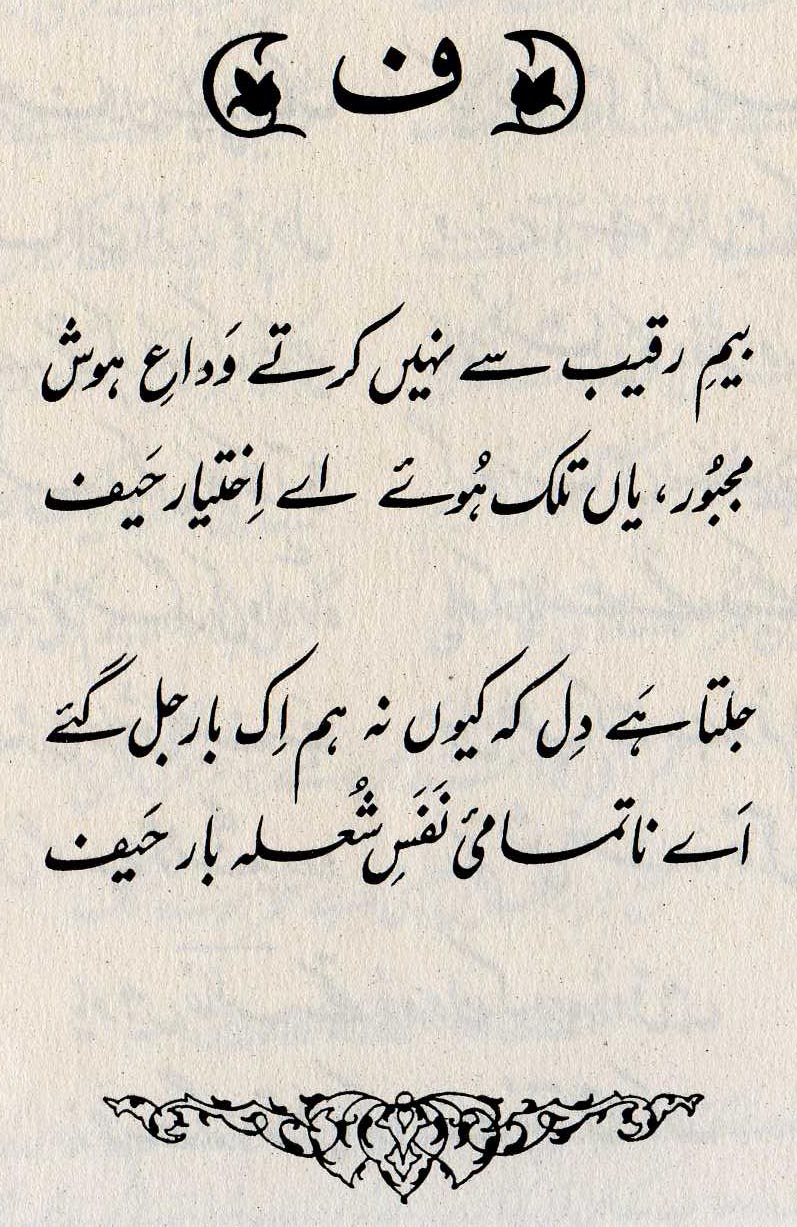
That is, the heart {feels jealous/envious / burns} over the fact that every breath produces a movement of incendiary sparks, but incomplete ones. Why don't we burn up completely, all at one time? In so many places the author has versified this medical problem []! (78)
== Nazm page 78

The fire that flames in the breast had a claim that we would all at once burn up and turn to ashes. But incompleteness and unsuccessfulness prevent us from burning all at once. (125)
This verse can also be appropriate to the disease of fever/consumption []. (161)
On the subtleties of , see 15,6 . Arshi rightfully points to 143,2 , which is really strikingly close-- it too involves , , and a that is .
But this one really reminds me of 20,8 -- especially the second line: why would the lover have minded dying, if it had taken place one time []? The possibilities here are the same as in that case. What exactly is the cause of the lover's lament? Here are three possibilities:
(1) The burning takes place not once, but many times-- so that he feels that he's died a thousand deaths.
(2) The burning takes place not all at once, but by degrees and in small increments-- so that he feels that he's being slowly tortured to death by flying sparks.
(3) The burning takes place not once, but never-- so that he's left longing vainly for the release that death would bring.
As is usual with Ghalib, each of these readings works perfectly with the second line. And in the first line, each yields a slightly different reading of in the sense of 'to feel jealousy/envy' (on this see 53,4 )-- in each case, the lover is jealous/envious of those lovers who have attained what he has failed to attain. And perhaps there's a secondary sense in which he's envious of the perfection, the completeness, that he's failed to achieve-- as in 60,1 , in which the lover {feels jealous/envious / 'burns'} over his own failure to 'burn up' completely at the sight of the beloved.
Nazm refers to the verse as describing a 'medical problem', and I think he's just teasing. But Bekhud Mohani seems to speak in all seriousness. At least he doesn't go so far as to claim that Ghalib had consumption at the time he wrote this verse-- after all, in 1816 Ghalib was only about nineteen years old. Let me not get started on another rant about the problems of as an approach to the ghazal.
graphics/firebreathing.jpg