Verse 4x1816aar;haif
G3
1
more than a/the breath, the kindness/favor of the idols did not show faithfulness
2
the palanquin/'camel-litter' of the glance-- on the shoulder of a spark, alas!
'Generosity, liberality; nobleness, excellence; goodness, kindness, benignity; beneficence; bounty; grace, favour, clemency, courtesy, graciousness'.
'That by which anything is supported, that in (or on) which anything is borne; that which carries the double load of a camel, a camel's saddle; a camel litter or dorser (in whi ch women travel)'.
'Look, glance, sight, view, regard; consideration'.
'The arm, the shoulder'.
'Iniquity, injustice, oppression; a pity; --intj. Ah! alas! what a pity!'
| References | |
|---|---|
| Arshi, Imtiyaz Ali | Ghazal# 76 |
| Raza, Kalidas Gupta | 193 |
| Nuskhah-e-Hamidiyah | 125-126 |
| Asi, Abdul Bari | 143-144 |
| Gyan Chand | 235-236 |
| Hamid Ali Khan | Open Image |
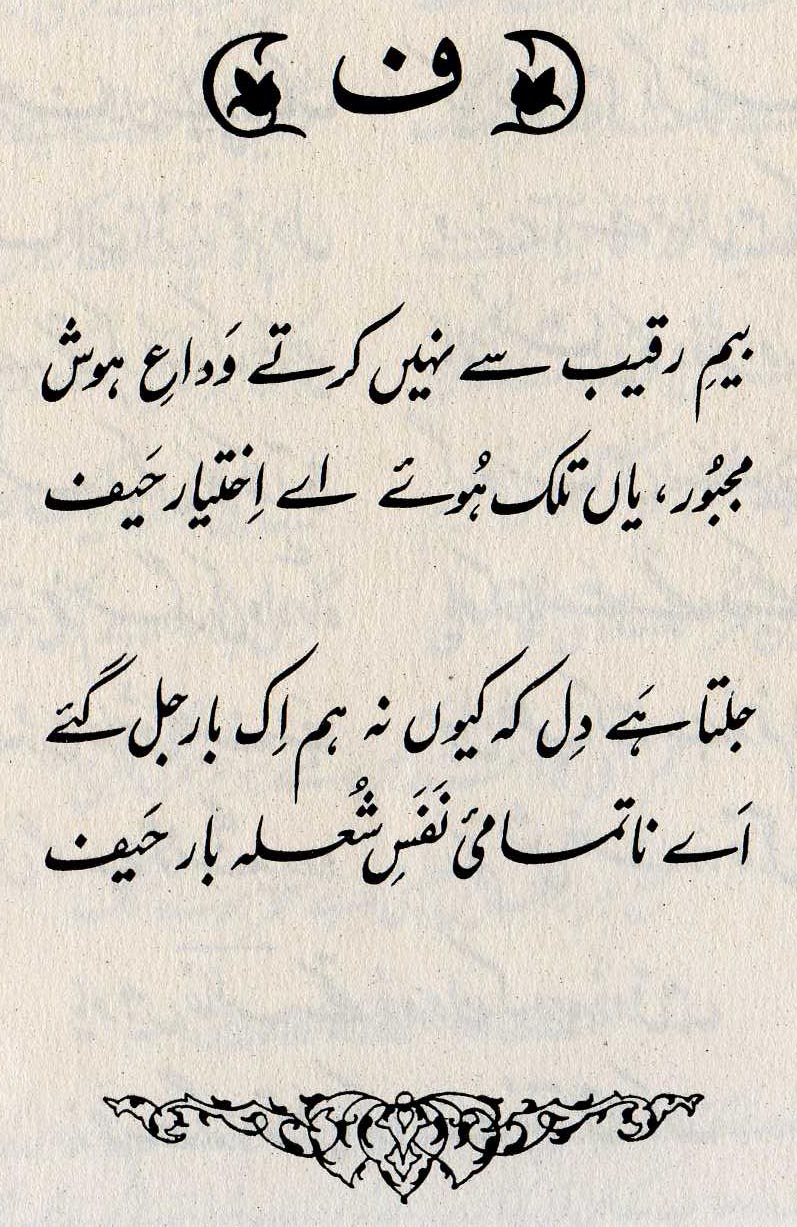
It's a pity that the kindness of beloveds was faithful for no longer than a single breath. They undoubtedly did cast a glance in my direction, but that glance was, so to speak, was here and then gone; its litter for traveling had been tied onto the shoulders of sparks-- which are extraordinarily swift-moving and do not stay motionless for longer than a single breath. The camel-litter of the glance has been said to be on the shoulders of sparks because that glance of beauty is flame-scattering; in a single breath it burns up awareness and wisdom.
== Asi, p. 143
That is, when she looked, then she turned aside her eyes, the way a spark flashes and then goes out.
== Zamin, p. 206
If the beautiful ones showed kindness/favor to me, then only as long as a single breath-- that is, for a moment. They cast a glance at me, but the litter of their glance was borne on the shoulders of a spark-- that is, as quickly as a spark flashes, for that long they glanced in my direction. Through the affinity of 'glance' and 'spark' there is also the suggestion that in the glance was a mood of fire-starting.
== Gyan Chand, p. 236
For background see S. R. Faruqi's choices . This verse is NOT one of his choices; I thought it was interesting and have added it myself. For more on Ghalib's unpublished verses, see the discussion in 4,8x .
On the uncertain nature of a , see 147,7x for discussion and examples.
The weird and fascinating thing about this verse is its play of metaphor s, its heap of bizarre, unassimilated images. We are to imagine the 'glance' or 'gaze' as riding in some kind of palanquin-- which is really almost impossible to imagine. (Vision itself, with its utter instantaneousness, needs to use a vehicle-- who knew?) Then we also are to imagine this palanquin as borne on the shoulder(s) of one or more sparks. (Sparks have shoulders-- who knew?)
This verse, in its pursuit of imaginative originality even at the cost of creating an unwieldy abstractness, is a real case of , ' thought-binding '; on this see Faruqi's commentary in M 602,6 . Compare the use of a in 29,1 , which is weird but still much more conceivable (it's easier to imagine ardor as binding a heart to a sand-grain than a glance as riding in a palanquin borne by sparks). And then, 376x,4 offers a palanquin borne on 'the shoulder of the panic of a deer'.
In the first line, , 'more than breath', can certainly mean 'any longer than a breath lasts', as the commentators maintain. It could also be taken to mean 'any more than does breath (show faithfulness)'-- which is very little, since the breath always comes and goes, and one day will desert us entirely). Then, 'breath' is also something that can act on a 'spark'-- either by fanning it into flame, as Gyan Chand suggests, or else by blowing it out entirely. (If you are uncertain about , see 15,6 .)
graphics/spark.jpg