Verse 7x1816aazhai
G1
1 a
mischievousness of expression is not other than the madness/wildness of Majnun
1 b
the madness/wildness of Majnun is not other than mischievousness of expression
'Playfulness, fun, mischief; pertness, sauciness; coquetry, wantonness; forwardness, boldness, insolence, &c.'
'A desert, solitude, dreary place; —loneliness, solitariness, dreariness; —sadness, grief, care; —wildness, fierceness, ferocity, savageness; barbarity, barbarism; —timidity, fear, fright, dread, terror, horror; —distraction, madness'.
'That by which anything is supported, that in (or on) which anything is borne; that which carries the double load of a camel, a camel's saddle; a camel litter or dorser (in which women travel)'. (Platts p.1010
| References | |
|---|---|
| Arshi, Imtiyaz Ali | Ghazal# 157 |
| Raza, Kalidas Gupta | 239-40 |
| Nuskhah-e-Hamidiyah | 229-230 |
| Asi, Abdul Bari | 235 |
| Gyan Chand | 361-363,551 |
| Hamid Ali Khan | Open Image |
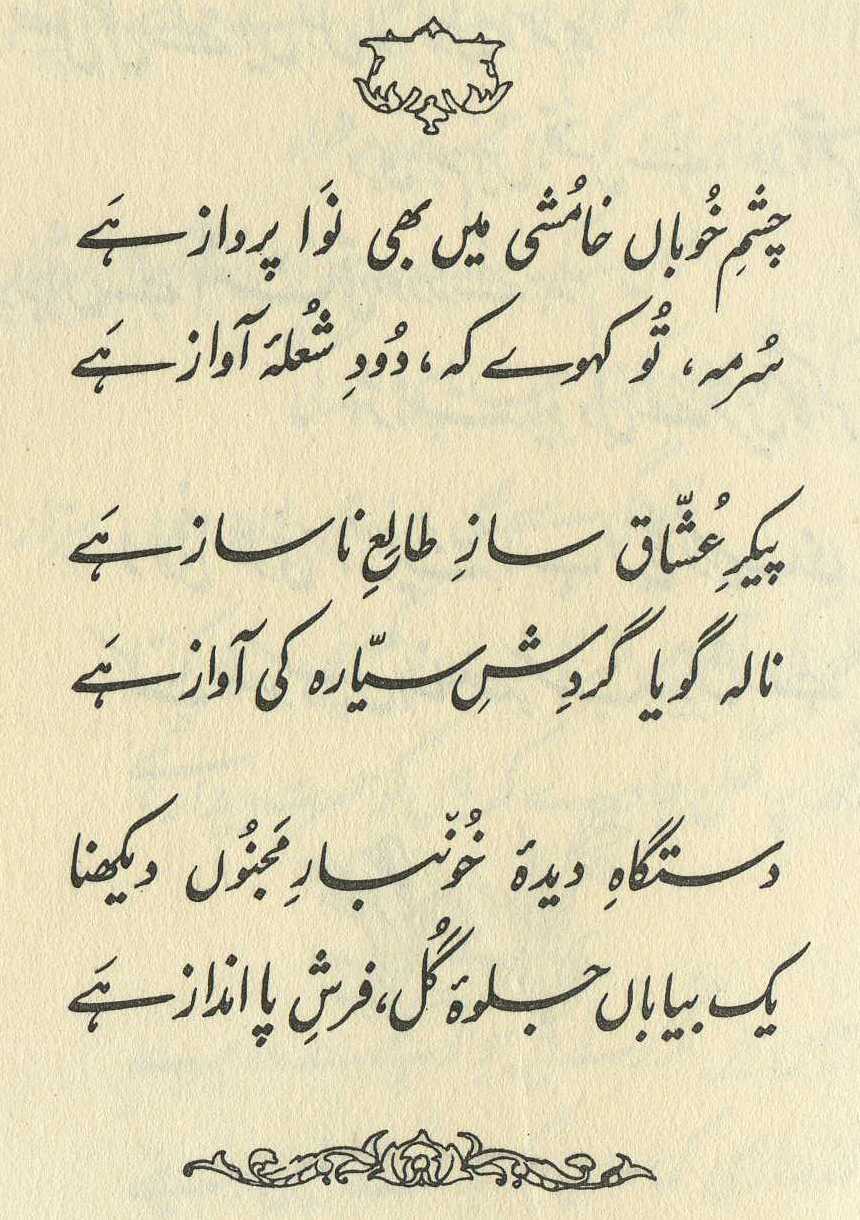
Except for the madness/wildness of Majnun, no one can express its mischievousness, because the Laila of speech/poetry is concealed in the camel-litter of secrecy/mystery. Therefore first a madness/wildness like that of Majnun should be created, then one can express its mischievousness.
== Asi, p. 235
That is, 'Oh Asad, the mischievousness of expression is not mischievousness; rather, it is the madness/wildness of Majnun. Because the meanings and theme s of poetry are seated in the camel-litter of secrecy/mystery. How in the world can they come into expression?!'
The meaning is that my poetry is secrecy/mystery upon secrecy/mystery-- thus lack of connection is seen in my meaning. He has made the madness/wildness of Majnun a metaphor for the disconnectedness of themes; thus he has called poetry a Laila seated in a camel-litter.
== Zamin, p. 355
The way Laila is concealed [] in a camel-litter, in the same way meaning is concealed in the pardah of a secret/mystery. The poet does the mischievousness of expressing it. This is exactly as if Majnun, in madness/wildness, would want to bring Laila out of the camel-litter. Majnun's madness, and the poet's effort, both to a great extent remain fruitless-- that is, meaning doesn't entirely come out from the secret/mystery.
== Gyan Chand, p. 363
For background see S. R. Faruqi's choices . For more on Ghalib's unpublished verses, see the discussion in 4,8x .
As a brilliantly 'A,B' verse, this one leaves us to put the two lines together for ourselves. Perhaps the two lines both refer to the same situation (the inability of poetry to capture the absolute beauty of Meaning). Perhaps the first line is the cause, and the second the effect (because Majnun is too crazy to describe anything accurately, the beloved of Meaning remains hidden and on the move). Perhaps the second line is the cause, and the first line the effect (because the beloved of Meaning remains hidden and on the move, Majnun is driven to crazy babbling in his longing to see her). Or perhaps the two lines present different and contrasted situations: mad poets rave on, while the veiled beloved of Meaning pursues her own quite different journey (this is my own favorite reading).
It's irresistible for us to take Majnun as representative of poets generally, in his 'mischievousness of expression'; but in grammatical terms the verse could be about him alone, or about mad lovers rather than poets. And of course, what is 'mischievousness of expression'? A deliberate attempt to flirt with the beloved of Meaning? A generalized playfulness and inventiveness of language? A symptom of Majnun's madness? A result of in some other sense? (See the definition above for the full range of this usefully versatile noun.)
ABOUT the : The emphasis on 'secrecy, mystery' suggests that the 'Laila of meaning' should be seated not 'on' any ordinary-looking camel-saddle (for an elegant one, and discussion, see 29,1 ), but 'in' something that could veil her from prying eyes. As best I can guess from Platts's use (see the definition above) of 'double load' and 'dorser' (which means something like 'carrying-basket, pannier'), we could perhaps imagine the camel-litter as a more elegant and at least semi-enclosed version of these ('Illustrated London News', 1857):
graphics/camellitter.jpg
If we imagine a 'dorser' much more elaborate and sophisticated than these, the 'Laila of meaning' could perhaps manage to veil herself from prying eyes within it. For another such , perhaps shaped like a tulip, see 8,6x . And for others that that are 'bound on' (presumably to an animal) in preparation for traveling, see 29,1 ; 314x,2 ; 352x,1 . (For altogether abstract ones, see 349x,1 ; 376x,4 ; 385x,1 ; 415x,7 .)
In fact, in Mughal times and in Ghalib's North India, aristocratic ladies seem almost never to have ridden on camels, in any fashion. Instead, they usually travelled in discreetly closed or curtained palanquin s (a crude version of which appears in the foreground of the picture above). See 76,4x for a that seems to be carried on shoulders-- or anyway, on the 'shoulder of a spark'. However, the normal word for such a shoulder-borne 'palanquin' was ; Platts gives a number of other terms for different kinds ( ), but is not among them.
Alternatively, ladies might travel in special enclosed carriages (if the state of the roads made this feasible); here's a photo of ' a zenana carriage '. Or elite ladies might use carefully pardah-curtained versions of fancy elephant howdahs like these (1867):
graphics/elephantlitter.jpg
In fact, this photo by Samuel Bourne (1860's?) of 'state elephants' seems to include at least one suitably enclosed howdah:
graphics/elephantlitter2.jpg
It's probably no coincidence that the word , which in Arabic referred to a ladies' camel-litter, in Urdu, and in India, came to refer to a similar device for an elephant (Platts p.1240). And a was a 'seat placed on an elephant (to ride in)' (Platts p.1240). Compare the use of , a canopied elephant litter, in 164,3 .
But in any case the verse imagines a ghazal kind of traveling, not a real kind. Needless to say (at least, I hope it's needless) all such speculation is quite peripheral to our understanding and enjoyment of the verse. But if we can't treat ourselves to an occasional good digression, what's a commentary for?
Here's how the artist Muhammad Abd ul-Rahman Chughtai envisioned the beloved's , in 'Muraqqa-e Chughtai, Divan-e Ghalib' (New Delhi: Ghalib Institute, 2018 [1928]).
graphics/chughtai.jpg
