Verse 21816aazhai
G1
1
the aspect/form of lovers is the maker/harmony/instrument of an inharmonious fate/star
2
lament is {so to speak / 'speaking'} the voice of the circling of a planet
'Face, countenance, visage; form, appearance, figure; resemblance, portrait, likeness'.
'Making, preparing, effecting; feigning; ... apparatus; instrument, implement; harness; furniture; ornament; concord, harmony; a musical instrument'.
taali((>> : 'Rising, appearing (as the sun), arising; —s.m. Star, destiny, fate, lot, fortune; prosperity; —the (false) dawn'.
| References | |
|---|---|
| Arshi, Imtiyaz Ali | Ghazal# 157 |
| Raza, Kalidas Gupta | 239-40 |
| Nuskhah-e-Hamidiyah | 229-230 |
| Asi, Abdul Bari | 235 |
| Gyan Chand | 361-363,551 |
| Hamid Ali Khan | Open Image |
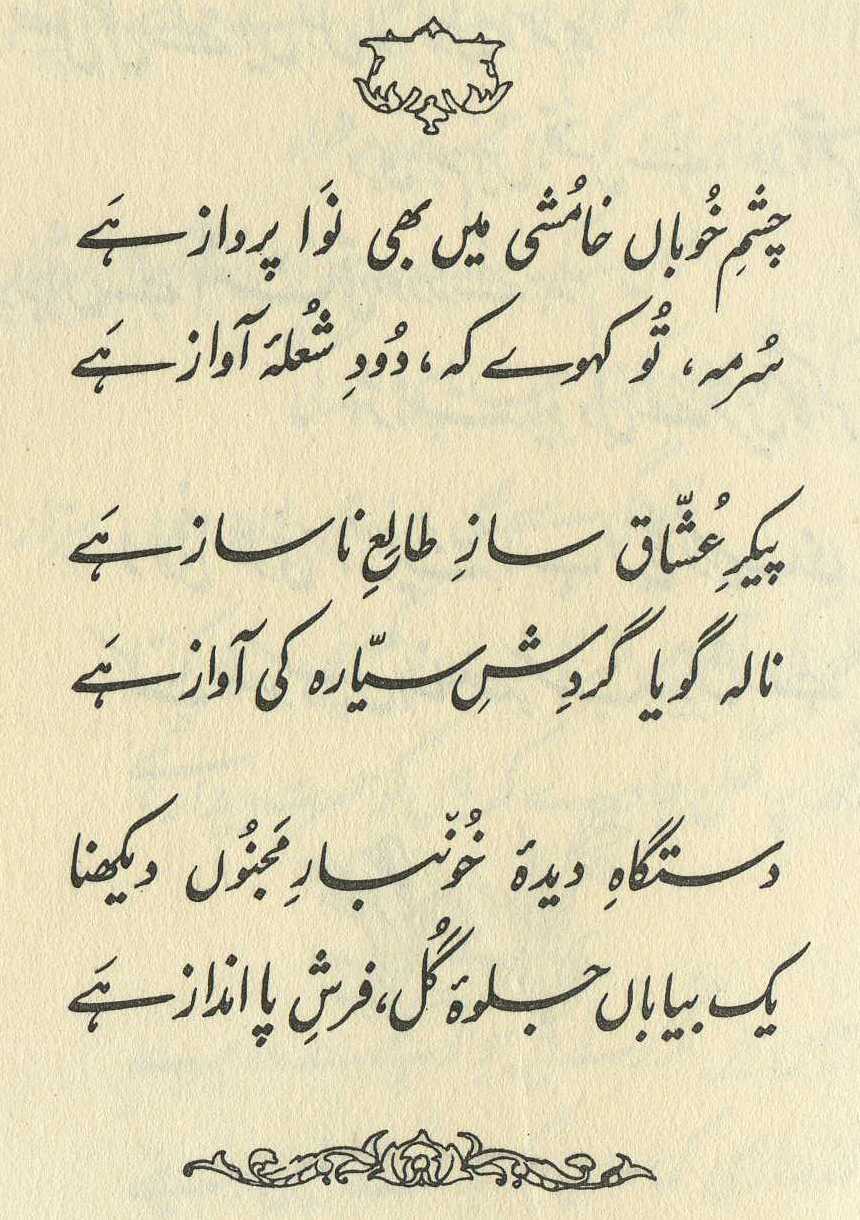
At the hands of 'inharmonious fate', like a harmonious organ, the aspect of the lover is entirely complaint and lament. Thus his lament is, so to speak, the voice of the circling of the planets, because the circling of the planets and inharmonious fate are causes for complaint and lament. The word in this place is a word of for . In the Persians' music, is the name of a melody []. (155)
== Nazm page 155

When the stars circle, a voice emerges from them.... At the hands of evil fortune, the form of a lover is an organ, and it has lamented. The voice of the circling of the planets he has written as the lovers bewailing their fate. To call a lament the circling of the planets is a new idea. (284)
If we take in the sense of -- that is, 'having become' []... then a very fine meaning emerges.... Now the meaning will be that the lover's body is made from the dust of inauspicious stars, or is made from inauspicious stars (that is, a fragment has been taken from them and the lover's body sculpted from it). The lover's lament is not commonplace lamentation, but rather the voice that is born in the circling of a planet. Now from the verse comes the vision of a broad expanse of space, in which a planet is circling all alone-- alone because space is an unstable border, and even the nearest things are very far; and also because the planet is inauspicious, and no one meddles with it. The harmony in weeping and lamenting has an affinity with the harmony of the circling planet; and a grieving voice is extremely beautiful and appropriate.
The lover remains constantly entrapped in desert-wandering and roaming. For the lover's solitude and wandering in the desert of life, what better image can there be than to suppose him to be an inauspicious planet? Stars are connected with circling, they have nothing to do with wandering. This is exactly the lover's state. The planet circles around some star. That is, in the star's place is the beloved. The affinity between the sun and the beloved is obvious. The planet is dark; the lover's world too is shadowy and dark. The way that the circling of a planet inevitably creates a voice-- in the same way the circling of the lover creates lamentation....
Leaving aside all these things, in the verse have interconnected wordplay s to such an extent that justice must be done to the imaginative reach of the young poet....
[Some commentators maintain that if used independently, cannot have the sense of . But there is much evidence against their view.] Ghalib himself, in one verse, uses in a way that points to this meaning: 172,3 .
== (1989: 268-70) 2006: 291-94
This verse invokes three different meanings of (see the definition above)-- they are so diverse, yet all three so elegantly allowed for, so clearly invited into the verse, and so cleverly caressed through wordplay.
If we take as meaning 'harmony', we have the paradoxical vision of the lover's aspect as the 'harmony of inharmonious fate'. How punchy and tight it sounds-- . Does it mean the (quote-unquote) 'harmony' of inharmonious fate-- in that it's not really a harmony at all? Or does it mean that it's in harmony with inharmonious fate, such that it too is inharmonious?
If we take as meaning 'musical instrument', the lover's form is itself the instrument on which 'inharmonious fate' plays its 'music'. It's passive and helpless in the hands of fate, but it can still wince at the terrible sounds being played on it. And perhaps it is like an instrument with a broken string, and thus doubly inharmonious.
If we take as meaning 'maker', as Faruqi does, we have the lovely reading that he explains so eloquently.
In all three cases, we have the impressive variety and interconnectedness of the wordplay, as Faruqi points out. It's so dense you have to feel your way through it like a jungle. Almost every word in the verse is involved, and in not one but at least two or three of the possible readings. (On in particular, see 5,1 .)
And in addition to everything else, we have to decide for ourselves the relationship between the two 'A,B' lines. Do they describe the same situation, through two different but related metaphors? Or do they describe two different situations, which are parallel in some ways (but perhaps contradictory in others)? And in this case, what are the significant parallels (or differences)? After all, the 'aspect/form of the lover' and the 'lament' might have some quite different features in their destinies.
The second line also surely invokes the Pythagorean 'music of the spheres'. Pythagoras observed that vibrating strings produce harmonious tones when the ratios of the lengths of the strings are whole numbers; this was part of his mysticism of the mathematics of music, which made such resonances a sign of cosmic harmony. His work was well-known in the medieval Islamic world, and it's so suited to Ghalib's purposes that it's hard to believe that he wouldn't mean subtly to invoke it in a verse like this. Turning the whole cosmic harmony inharmonious in the lover's case is in fact exactly the kind of thing Ghalib would imagine. And he does it with such a deceptive ease and unobtrusiveness!
graphics/sevenspheres.jpg.png