Verse 31816aazhai
G1
1
look at the power/'hand-place' of the blood-scattering eye/gaze of Majnun !
2 a
a whole-desertful of the glory/appearance of roses is a 'foot-wiper'-carpet
2 b
the 'foot-wiper'-carpet is a whole-desertful of the glory/appearance of roses
'Power, strength, ability, means; understanding; intellect; knowledge'.
'The eye; the sight; a wanton or impudent eye'.
'Manifestation, publicity, conspicuousness; splendour, lustre, effulgence'.
'Spreading (a carpet, &c.); paving; — what is spread (of household furniture, &c.), carpeting'.
'Carpet spread at the entrance of a room for cleaning the feet on, door-rug'.
| References | |
|---|---|
| Arshi, Imtiyaz Ali | Ghazal# 157 |
| Raza, Kalidas Gupta | 239-40 |
| Nuskhah-e-Hamidiyah | 229-230 |
| Asi, Abdul Bari | 235 |
| Gyan Chand | 361-363,551 |
| Hamid Ali Khan | Open Image |
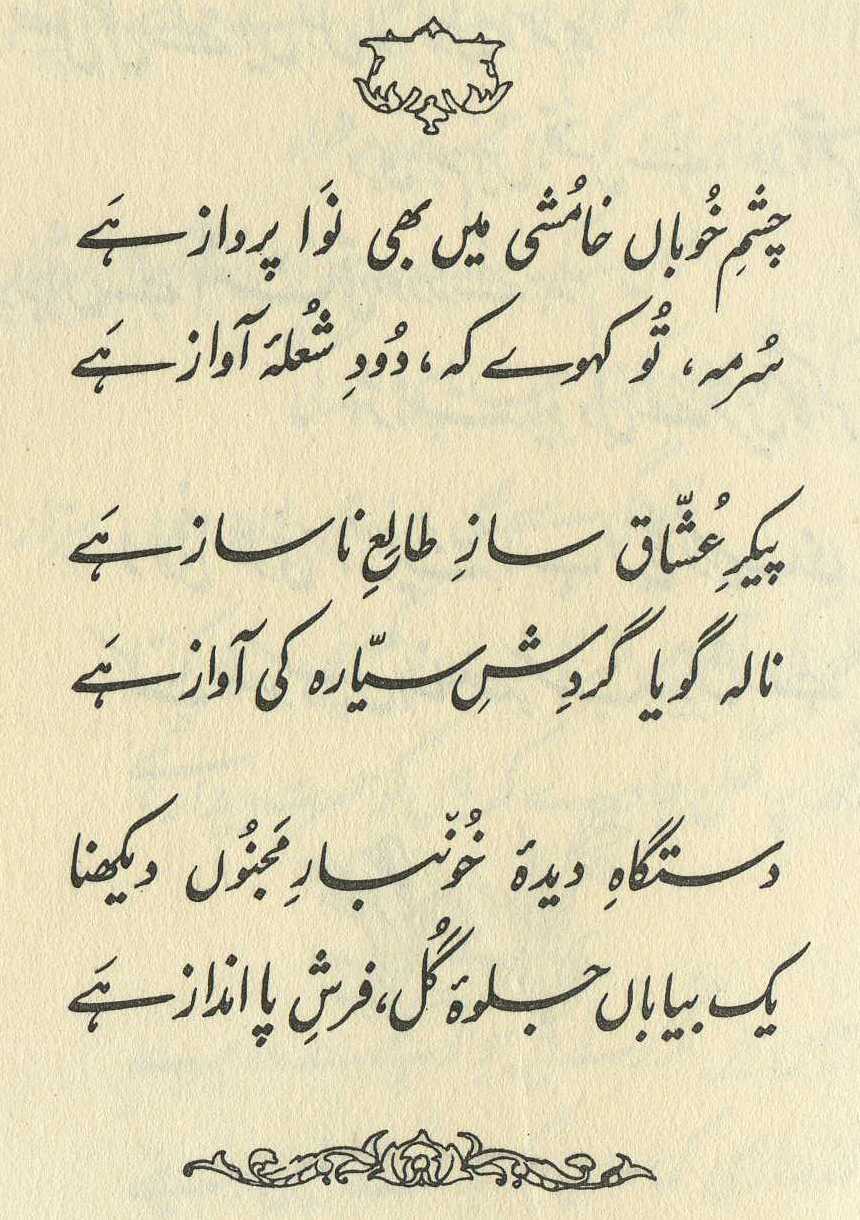
That is, the earth of Najd is becoming red with bloody tears for miles around. The word in this verse is a for , and he has introduced it artificially []; and then, between the two words there's also a full hand's-breadth [] of distance. (155)
== Nazm page 155

He says, please contemplate the blood-scattering eye of Majnun-- from his eyes a river of blood has flowed that has turned the wasteland of Najd into such a doormat of roses that for miles around the spectacle of the glory/appearance of roses can be seen. (213)
The lover, in the turmoil of madness, has come out into the wasteland. It's springtime; the wasteland is turning red with the abundance of flowers. Seeing this state, in the same madness he says... 'how urgently Majnun has been waiting for me, that hearing of my arrival, he has spread a carpet of flowers for miles!'....
[Or:] In his ardor for the coming of Laila, Majnun has so watered the wasteland with his heart's blood that in the whole wasteland a carpet of flowers is spread....
[As for Nazm's objections,] in connection with the first objection it is sufficient to observe that here some word was needed with the meaning of 'power', and if the author placed there the word , then what sin did he commit? And if there's so much distance between and , then that's hardly a disaster. That distance itself makes it clear that it has remained distant from artifice.... After all, there's no cause for so much distaste for affinities. (285)
The first half of the second line, freely translated, is the source of 'A Desertful of Roses', which popped into my head one day as the ideal name for the present project. Ghalib likes to measure things by the 'desertful' and other such units; for a discussion of this Persianized usage, see 11,1 , a verse which itself features 'a desertful of fatigue'.
As in so many verses, the first line is almost uninterpretable until we hear the second. As Nazm observes (sorry, sorry, I can't help it), (literally 'hand-place') does seem a less than obvious word to apply to an eye or gaze. Along with the neutral imperative , it thus alerts us to expect further wordplay-- about parts of the body, like hands and eyes? and/or about sight and vision?
And as in so many verses, the second line overshoots our expectations, leaving us in the usual richochet pattern, back and forth among multiple nodes of meaning. Our expectations of further wordplay and verbal affinity are amply fulfilled: to go with the hand and eye, we now have a foot as well; to go with the redness of Majnun's tears of blood, we now have roses; and to go with sight and vision, we now have an extraordinary, and very possibly hallucinatory, scene.
The first line has invited us to contemplate, possibly with amazement, the power of the mad Majnun 's blood-scattering eye/gaze. That gaze has certainly, in the second line, achieved something remarkable-- but what exactly? Here are some of the ways the second line might be read:
=Majnun disdains a whole desertful of rose-glory, considering it a mere doormat.
=Majnun has commandeered a desertful of rose-glory to use as a doormat.
=Majnun sees a desertful of rose-glory and mistakes it for a mere doormat.
=Majnun imagines, with the gaze of madness, that his doormat is a desertful of rose-glory.
=Majnun has so spattered his doormat with bloody tears that he mistakes it for a desertful of rose-glory.
=Majnun has in fact, through the power of his passionate gaze, turned his doormat into a desertful of rose-glory.
The first three readings are based on (2a), the latter three on (2b). The 'symmetry' of the second line is here powerfully effective, because both the readings are plausible, and both work brilliantly with the first line. Then of course, there's the question of tone-- do we read the line with wonder, or melancholy, or pity, or sarcasm, or the detachment of a neutral observer?
The use of the colloquial 'doormat', literally 'foot-thrower' [] reminds me of the even more dismissive 'dust-bin' [] in 68,5 . Then there always remains the question: does a 'desertful of the glory/appearance of roses' actually involve any real roses? How many roses would make a 'desertful'? (Is the expression perhaps parallel to 'a desertful of fish'?) We can well imagine that Majnun is wildly crazy, and/or that some other presence is providing the glorious 'appearance' of roses.
As a further elegant touch of wordplay, Maria K. has pointed out (Dec. 2012) that is also the name of a musical modal system in Persian (which is subdivided into units called ), while too is a musical term; it's used not only for 'manner, style', but also for 'time (in music)' (cf. Platts p. 90). As Maria observes, 'The previous two verses are based on musical metaphors, why not this one also?' In the case of this verse I think we really need the usual definitions of both terms to be paramount, in order to make sense of the verse; but surely the musical associations become part of the penumbra of wordplay that adds to our pleasure.
In fact, if there's a flaw to be found in this ravishing verse, it might be the word , which doesn't seem to add anything. (For a discussion of 'padding', see 17,9 .)
graphics/rosecarpet.jpg