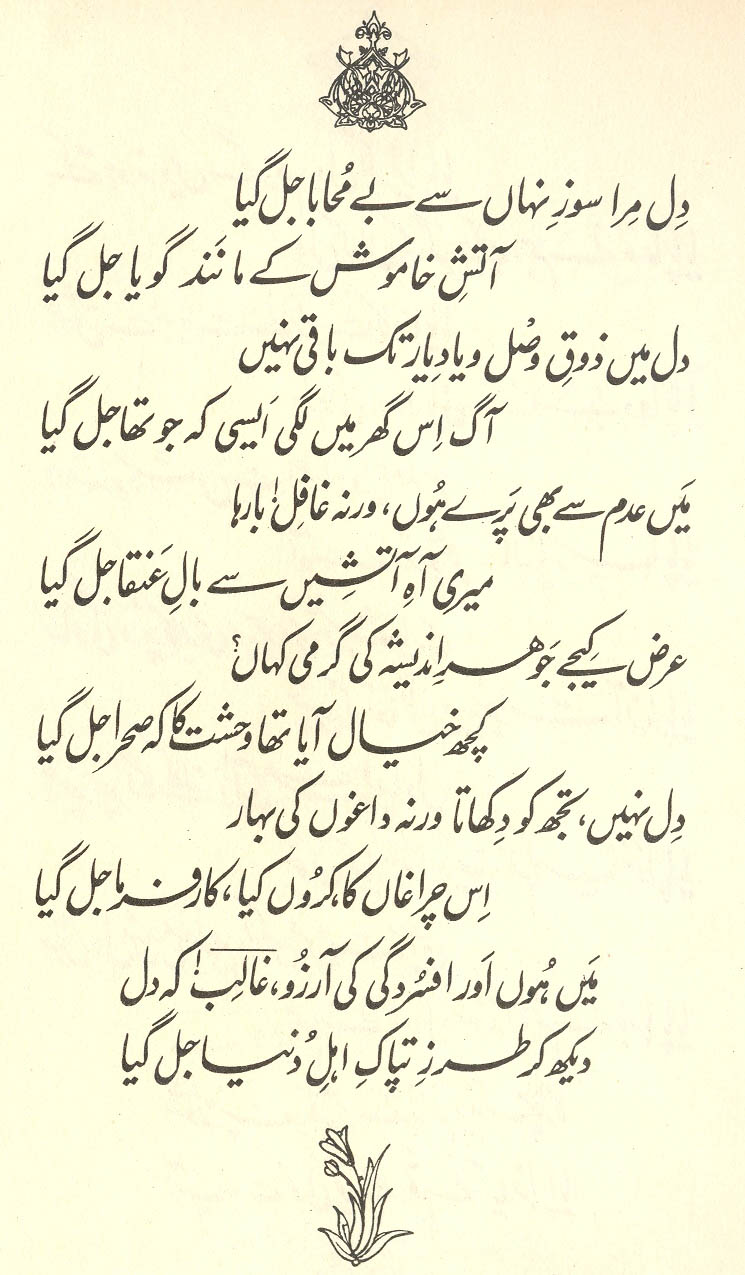
Verse 11816aajal gayaa
G1
1
my heart, through hidden flame, roughly/unceremoniously burned up
2
like glowing-coals/'silent fire', {so to speak / 'speaking'}, it burned up
'Partiality (for); lenient or gentle treatment, kind behaviour; respect, regard, friendship, affection; —caution, care'.
'Saying, speaking; --conversible; talkative, loquacious; eloquent; --a speaker; a singer; --adv. As you (or as one) would say, as it were, as though, so to speak; thus, in this manner'.
'Saying, speaking; a speaker, singer; loquacious, talkative; the tongue; a singing-bird; well-tuned (instrument); thus, in this manner, as you would say, as it were; chiefly, principally, apparently, probably'. (Steingass p.1107)
'To burn; to be burnt; to be on fire; to be kindled, be lighted; to be scorched, be singed; to be inflamed, to be consumed; to be touched, moved, or affected (with pity, &c.); to feel pain, sorrow, anguish, &c.; to burn or be consumed with love, or jealousy, or envy, &c.; to take amiss, be offended, be indignant; to get into a passion, be enraged, to rage'.
'(intens.) To be burnt up, be consumed (with, -)'.
| References | |
|---|---|
| Arshi, Imtiyaz Ali | Ghazal# 26 |
| Raza, Kalidas Gupta | 166-167 |
| Nuskhah-e-Hamidiyah | 73-74 |
| Asi, Abdul Bari | 69-70 |
| Gyan Chand | 109-110 |
| Hamid Ali Khan | Open Image |
[1863, to Surur:] That 'something else' [] has been vouchsafed to the Persians. Though indeed, in the Urdu language the people of Hind have found that thing. [He lists a verse by Mir, one by Sauda, one by Qa'im, and finally the verse of Momin's that Hali mentions below.]
==Urdu text: Khaliq Anjum , vol. 2, p. 615
In the same way, when he heard this verse of Momin Khan's:
[you are with me {so to speak / 'speaking'}
when no other is there]
then he praised it greatly and said, 'If only Momin Khan had taken my whole divan , and had given me only this one verse!' This verse too he has copied out in a number of his letters.
==Urdu text: Yadgar-e Ghalib , p. 83
That is, it burned quietly, in such a way that no one knew of it. (5)
== Nazm page 5

Urdu text: Vajid 1902 {5}
is a fire that burns invisibly/hiddenly and from which flame doesn't arise. To use it in the second line in juxtaposition to is the extreme limit of eloquence []. Among the special features of Mirza Sahib's style is that without intention and 'search' [] verbal and wordplay -based forms appear [in his verses] that are counted among the verbal devices []. (14)
My heart has burnt to ashes in the suppressed fire of love. And it burned in the manner of suppressed fire, that is, it burned me to ashes in such a way that until the fire was was burnt out and extinguished I didn't even know it. (9)
ABOUT : A great part of the excellent wordplay of the verse is in the use that Ghalib has made of , which in Persian means both 'speaking' and-- by extension, as in the English 'so to speak'-- 'as if'. (See in the definitions above how Platts and Steingass struggle to pin down this latter sense.) For other such double-meaning uses of , see 4,12x ; {5,1}; 39,3 ; 66,4 ; 91,10 ; 101,8 *; 111,9 ; 111,13 ; 147,2 ; 157,2 ; 231,4 // 361x,3 *. (There are also ordinary uses of , where only 'so to speak' is intended; a very clear one is 155,5x .) For a discussion of the value of , see 111,13 , both Nazm's comment and Faruqi's response. (In discussing Mir's M 1725,6 , Faruqi suggests that Ghalib may have gotten the idea for the in the present verse from that verse of Mir's; but I find this a bit of a stretch and have made a counter-argument there.) Compare the similar use of in 147,1 .
The beautiful evocation of 'silent fire' is at the heart of this verse. How does 'silent fire' burn? Remorselessly, no doubt, and in a very hidden way. The fierce smoldering of hot coals is the nearest analogy to how the speaker's heart burned. In an elegant paradox, the fire was both silent [] and 'speaking' []. In a famous anecdote reported by Hali (see above), Ghalib is said to have offered his whole divan in exchange for a verse of Momin 's, the chief charm of which was a subtle, complex use of . (For another verse from this same lovely ghazal of Momin's, see 179,2 .)
A verse with the imagery of a 'silent flame': 237x,3 ; another 'silent fire' verse: 312x,6 .
Here he has also juxtaposed with , 'like; in the style of'. The effect is to place the analogy at two removes: the speaker's heart burned 'as if' 'in the style of' silent fire. Perhaps his heart in fact burned so uniquely that nothing was very comparable to it after all.
A long time ago I really worked at translating this ghazal: version 1 (1985) ; version 2 (1991) . My failure with this one was part of what taught me about Ghalib's fundamental untranslatability, and about the need for a commentary instead.
graphics/glowingcoals.jpg