Verse 2after 1826ilme;N hai
G1
1
look at the pleasure/relish of speech-- {for / since / in that / what} she said
2 a
I considered/felt this: that 'It's as if this too is in my heart'
2 b
I considered/felt this: that 'This too is speaking in my heart'
'Speaking, discoursing; relating; explaining; confirming; speech, discourse, statement, declaration, assertion, relation, recital, narrative, account, detail; exposition; avowal, confession; ascertainment; confirmation'.
'To say, utter, speak ... ; to tell, declare, mention, state, deliver, relate, repeat, recount; to acquaint ... ; to advise, admonish; to affirm, assert, aver, avow'.
'Pleasure, delight, enjoyment; sweetness, deliciousness; taste, flavour, relish, savour; -- an aphrodisiac;... sensual pleasures'.
| References | |
|---|---|
| Arshi, Imtiyaz Ali | Ghazal# 201 |
| Raza, Kalidas Gupta | 375 |
| Hamid Ali Khan | Open Image |
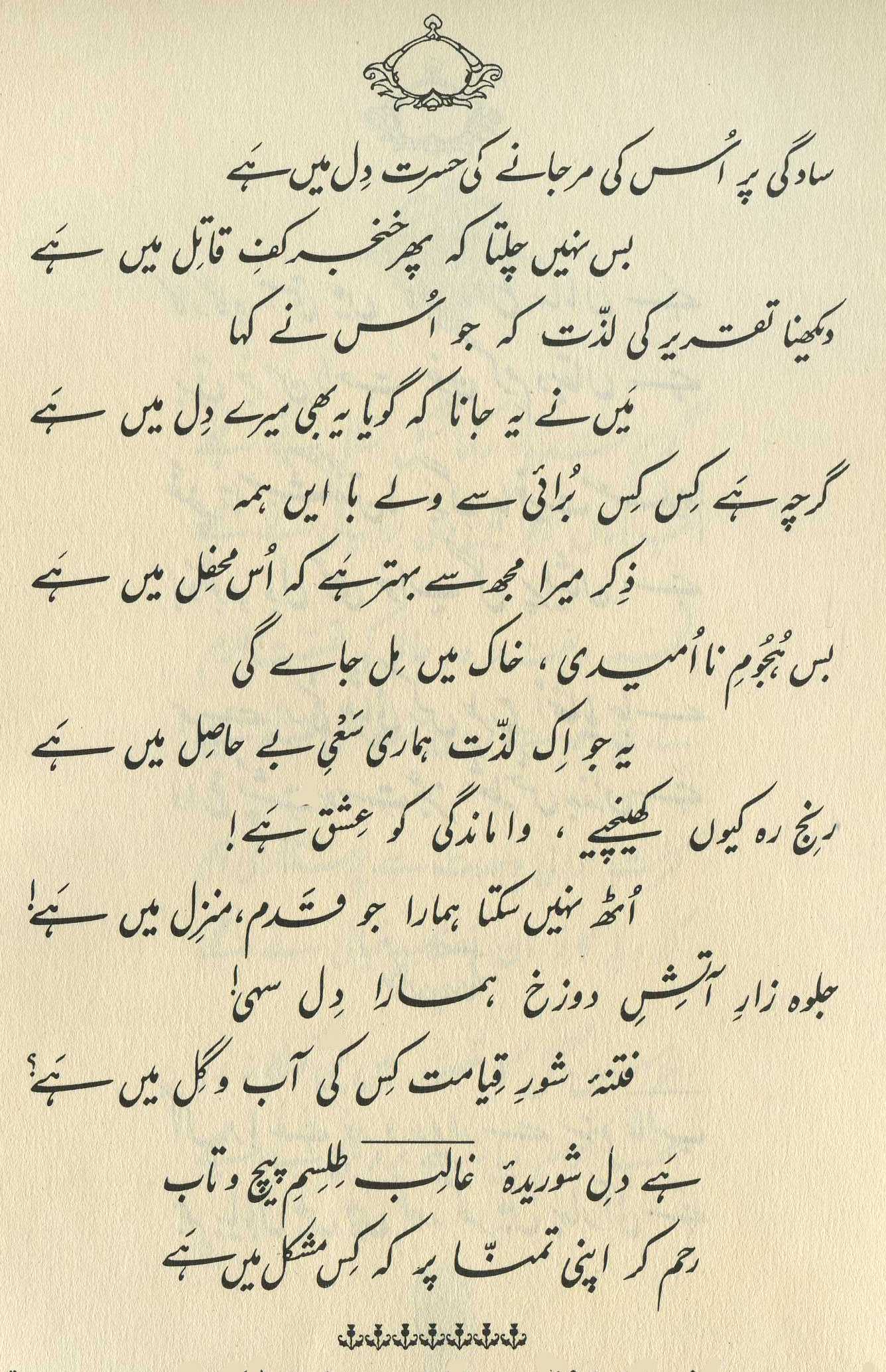
There can be no better praise of anyone's beauty of speech than that whatever idea emerges from the speaker's mouth enters into the listener's heart in such a way that he suspects that this idea was in his heart even beforehand.
==Urdu text: Yadgar-e Ghalib , p. 125
That is, it seemed to me that whatever thing she said, she said the thought of my heart. (168)
== Nazm page 168

God, God, what pleasure in speech would be greater than this, that whatever thing she said, it established itself in my heart in such a way that I considered that I too used to say this! The word is meaningful-- that is, whatever sort of thing at all it might be. (301)
SETS == BHI; WORDPLAY
SPEAKING: 14,4
Bekhud Mohani singles out for special attention, and I'd add two other words as well: , and . But I think he's right that is the most crucial; for a detailed discussion of its multivalent possibilities, see 12,2 . It's able cleverly to keep open the question of who speaks the second line. If we take to mean 'in that she spoke', or else 'what she said' (with in its normal correlative sense), then the speaker of the second line would be the lover, the voice of the whole verse: 'when she said something' (or 'what she said')-- he felt that he already agreed with it. Let's first deal with this obvious, straightforward reading.
For we encounter a small shock of unexpectedness in the phrasing of the second line. The first line leads us to expect the obvious tribute to a fine orator: whatever she says, the listener is instantly persuaded: he thinks, 'Oh yes, this is what I think too, this is what is in my heart too'. And that's almost what we get-- but not quite. For instead of 'this is in my heart too' [, or ] we get, quite unmistakably, 'this too is in my heart' []. The focus is thus shifted from the group of things that she says (which the listener now endorses) to the group of things that are in the listener's heart (of which this now becomes one). (The 'even/also' range of seems in this case best captured by the 'too'.)
This too is in the lover's heart-- in addition to what? To her? To all the moods and modes of passion? To all the things that he'd like to reply to what she's just said? And of course, for something to 'be in his heart' is more intimate and less explicit than for him to simply endorse or accept something. He absorbs her words into his heart because they're hers and are thus precious little parts of her; and not because they are formed into rhetorically persuasive ideas or even because they're words at all (he'd perhaps love a lock of her hair just as much). The lushness and sensuality of works perfectly with this interpretation. All this richness of implication is achieved by the careful, subtle positioning of .
Then there's the clever double use of , which literally means 'speaking' or 'speaker' (2b), and by extension comes to mean 'so to speak' or 'as if' (2a); for more on this versatile expression, see 5,1 . As so often, the wordplay points to meaning-play. Then, there's a very notable affinity among -- and in addition, as counterpoints to speech, we also have 'knowing' [] and 'seeing' [].
Nor is that all, for the versatility of too is beautifully appropriate. The can be either the pleasure of the beloved's speech, or the pleasure of the lover's speaking. Since the verse begins with a neutral imperative, 'look at', there is plainly an implied addressee, and the lover is a 'speaker' himself. He is also an inward speaker, quoting in the second line the words that he spoke to himself. And of course, what he said to himself was, in effect, that he claimed her words as his own.
graphics/inmyheart.jpg