Verse 5after 1826ilme;N hai
G1
1
why endure the sorrow/trouble of the road? 'bravo' to laggingness!
2
it cannot rise up, our foot/footstep which is {on the road to /'in'} the destination
'The remaining or lagging behind (esp. from fatigue); -- openness, exposure'.
'An exclamation of praise; excellent! well done! bravo!'.
'The foot; sole of the foot; a foot's length; a footstep, step, pace; --a going before'.
| References | |
|---|---|
| Arshi, Imtiyaz Ali | Ghazal# 201 |
| Raza, Kalidas Gupta | 375 |
| Hamid Ali Khan | Open Image |
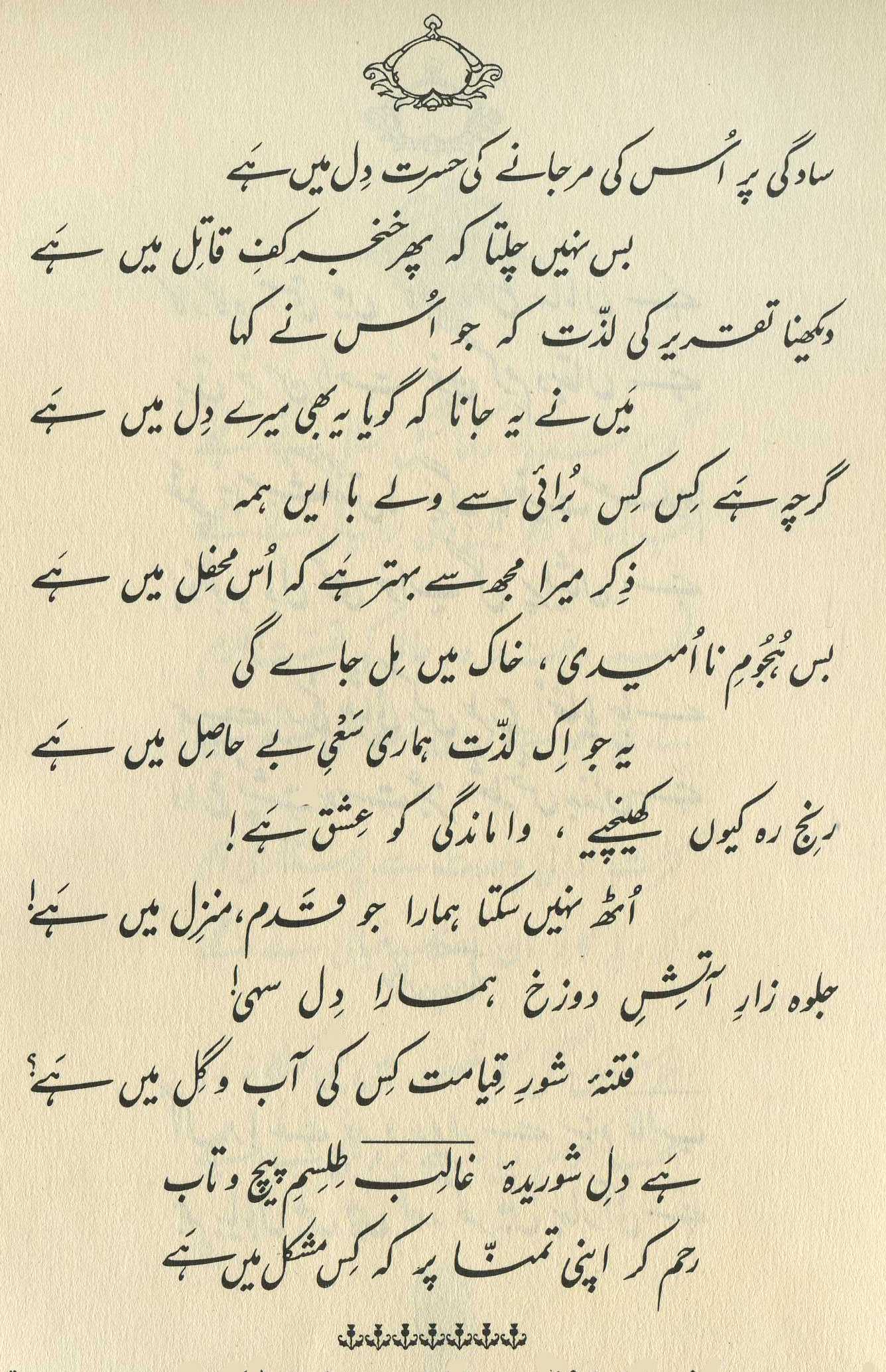
In this verse it seems that to put in place of is an error of the calligrapher [], and in this case the meaning is clear. But it wouldn't be strange if he had composed itself, because then the meaning will be a bit more elaborate. That is, fatigue has come to have a passion for my footstep, and doesn't release it so that I might go toward the desired destination. In the verse the author has intended by 'destination' the 'road to the destination'; the word 'in' proves this. That is, in the idiom, when people say it with 'in', they mean the 'road to the destination'; and when they say it with 'to', they mean the destination itself.
And in the idiom of the Persian-speakers means 'peace and acceptance' [z], and in that case is correct. That is, we accept fatigue, and thanks to it our footstep which is in the road cannot be lifted. (169)
== Nazm page 169

Why would the troubles of the road be undertaken, and why would an inappropriate attempt be made? Fatigue has come to have a passion for us. That is, unsuccessfulness and non-attainment are in love with us. And when it has been proved that fatigue is absorbed in us, and we will never be able to reach the desired destination, then our every footstep has come to weigh hundreds of pounds. That is, our inner self has absolutely turned aside from going along the road. (225)
[in Persian]= that is, I am a lover of fatigue, or fatigue is a lover.... We are madly in love with weakness and helplessness. Now our foot cannot be lifted to go further. Weakness and helplessness are in love with us. (302)
Compare 11,1 . (166)
SETS == WORDPLAY
ROAD: 10,12
Why can't our foot or footstep rise up? Two possible reasons seem to be proposed:
=Because it's already at the destination, since it is in love with laggingness and/or laggingness is in love with it, and only the place where the beloved is can be the lover's true destination; so that where 'laggingness' is, is where the foot should be.
=Because it's being detained on the road to the destination, by its love for laggingness and/or laggingness's love for it.
Nazm and Bekhud Mohani twist themselves into knots to explain ; Bekhud Dihlavi awkwardly personifies a 'Laggingness' that has developed a passionate love for the speaker. Surprisingly, none of them seem to notice the idiomatic phrase (see the definition above). Faruqi too notes in M 480,4 , 'The phrase is an idiom, with the meaning of 'bravo' or 'praise be' []'. For another example of its usage, see 251x,5 .
For in fact the real complexities center on . Since it comes from the Arabic root , which means 'going before' (Platts p.789), it has its own enjoyable wordplay with 'lagging'. And its meanings include 'foot'-- something that would definitely be expected to rise up-- but also, through 'footstep', veer toward the idea of 'footprint'-- something that would never be expected to rise up, but would by definition always be 'lagging' or left behind.
This latter sense emerges clearly in 123,1 , in which the 'ground-kissing of the footstep' is part of the lover's literal collapse and prostration on the ground. Compare also 116,8 , in which the behavior of the footprint [] is a guide for the lover's own behavior. And this sense of 'footprint' becomes a perfect lover and/or beloved for 'laggingness' to have, since the two are inseparable by definition. Arshi cites 11,1 , another very abstract verse in which the footprint [] is compared to a bubble.
So there we have it. One can assemble all the parts, and enjoy all the wordplay. But behind it there's not as rich a network of meanings as in his truly great verses. I don't consider this one as problematic as the previous one, 157,4 , but it's certainly far from the top of Ghalib's game. This one reminds me in fact of 8,2 , in its ostentatious metaphysicality with no real world of meaning behind it.
Compare the much more successful 190,1 .
graphics/footsteps.jpg