Verse 3after 1826ilme;N hai
G1
1
although it is with what-all badness, but nevertheless, despite all this
2
my 'mention' is better than I, for it is in that gathering
'Although'. (Steingass p.135)
'With all; with all that, nevertheless'. (Steingass p.1512)
'Remembering, remembrance; memory; commemoration; — mention, telling, relating, relation, recital, report, account'.
| References | |
|---|---|
| Arshi, Imtiyaz Ali | Ghazal# 201 |
| Raza, Kalidas Gupta | 375 |
| Hamid Ali Khan | Open Image |
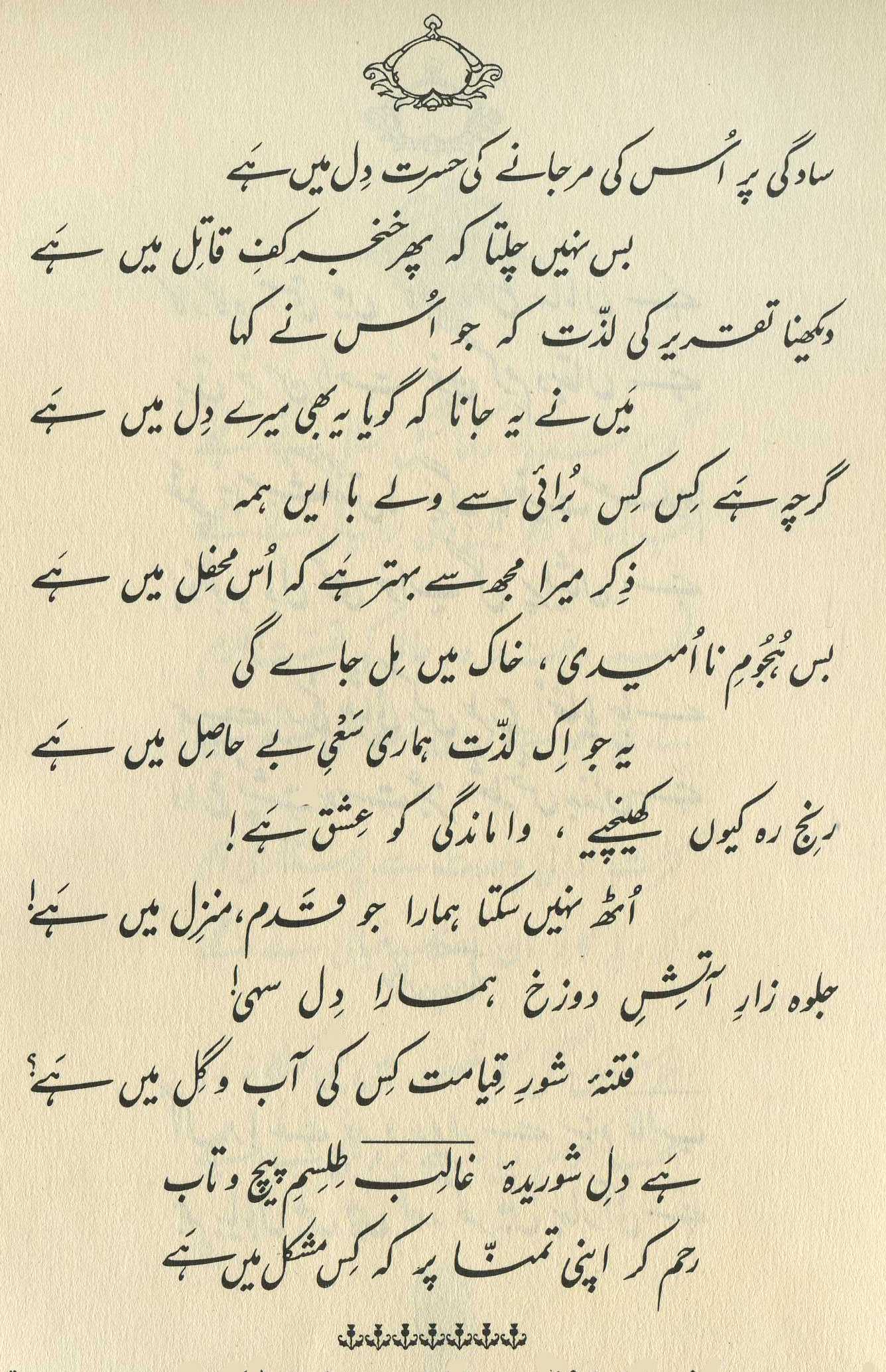
The main clause, which is the important one, has remained till very late. That is, the word 'mention' and its explanation, which are primary, have been placed last. (168)
== Nazm page 168

He says, 'Although my mention is made before her in a bad way, and the Other s make that mention, still in any case it is better than I, for it does come into that gathering'. (225)
The phrase is short, but as many evils as there can be in one man are all comprehended within it.... It makes it clear that extreme humiliation and abuse are performed there, but even so, the lover's ardor is so extreme that it's in no way reduced. And how could it be? If there's enough progress so that his mention occurs there, then he feels envious of his mention. (301-02)
[See his comments on Mir's M {609,3 .]
SETS == MUSHAIRAH
GATHERINGS: 6,3
GOOD/BAD: 22,4
This must be one of the world's ultimate mushairah verses. Nazm observes, in a somewhat crotchety tone, exactly this typical mushairah-verse structure. The first line lacks a subject, and thus remains completely uninterpretable. The pompousness of having not only and , but also the apparently redundant, extremely Persianized (literally, 'with all this') occupying the whole latter part of the line, adds insult to injury. We're exasperated with such obscurantist otiosity (there, see?); we think, 'get to the point, will you!'. All the more so because after such an elaborately bombastic introduction, we deserve something special-- the point should surely be an interesting one.
Then in the carefully staged oral performance arena of a mushairah, the usual tantalizing delay is imposed before we're permitted to hear the second line. And even when we're allowed to hear it, we can't really 'get' the verse until the last possible moment. This is because the reason for the superiority of the 'mention' only becomes apparent when the rhyming elements, , are heard. And then we get it amusingly and completely, all at once, with a sudden ruefully enjoyable comic punch.
And then-- also in classic mushairah-verse style-- that's it, and it's time to move on to the next verse; this verse wouldn't repay even five minutes of extra thought or attention. Once we get the good/bad wordplay of and -- and it's hard to imagine that anybody wouldn't-- the verse has exhausted its treasures, and lies collapsed like a burst balloon. But that's no insult; a burst balloon that has made the party-goers laugh has done its work well.
In English we'd be more likely to say 'the mention of me' in this situation, and to save 'my mention' for a mention that I make. I preserved the awkward form in my translation, to show the amusing semantic parallelism: 'my mention is better than I [am]', just as you might say 'my brother is better than I'. (Of course, nowadays in American practice we'd be likely to say 'better than me', but let's maintain at least a tiny shred of .) For more on this question of grammar and translation of the possessive, see 41,6 .
graphics/gossip.jpg