Verse 6after 1826ilme;N hai
G1
1
a {glory/appearance}-garden of the fire of Hell, our heart-- so be it!
2
the mischief of the tumult of Doomsday-- in whose constitution/'water-and-clay' is it?!
'Water and clay, i.e. the human frame'. (Steingass p.3)
'Earth, mud, clay, bole'.
| References | |
|---|---|
| Arshi, Imtiyaz Ali | Ghazal# 201 |
| Raza, Kalidas Gupta | 375 |
| Hamid Ali Khan | Open Image |
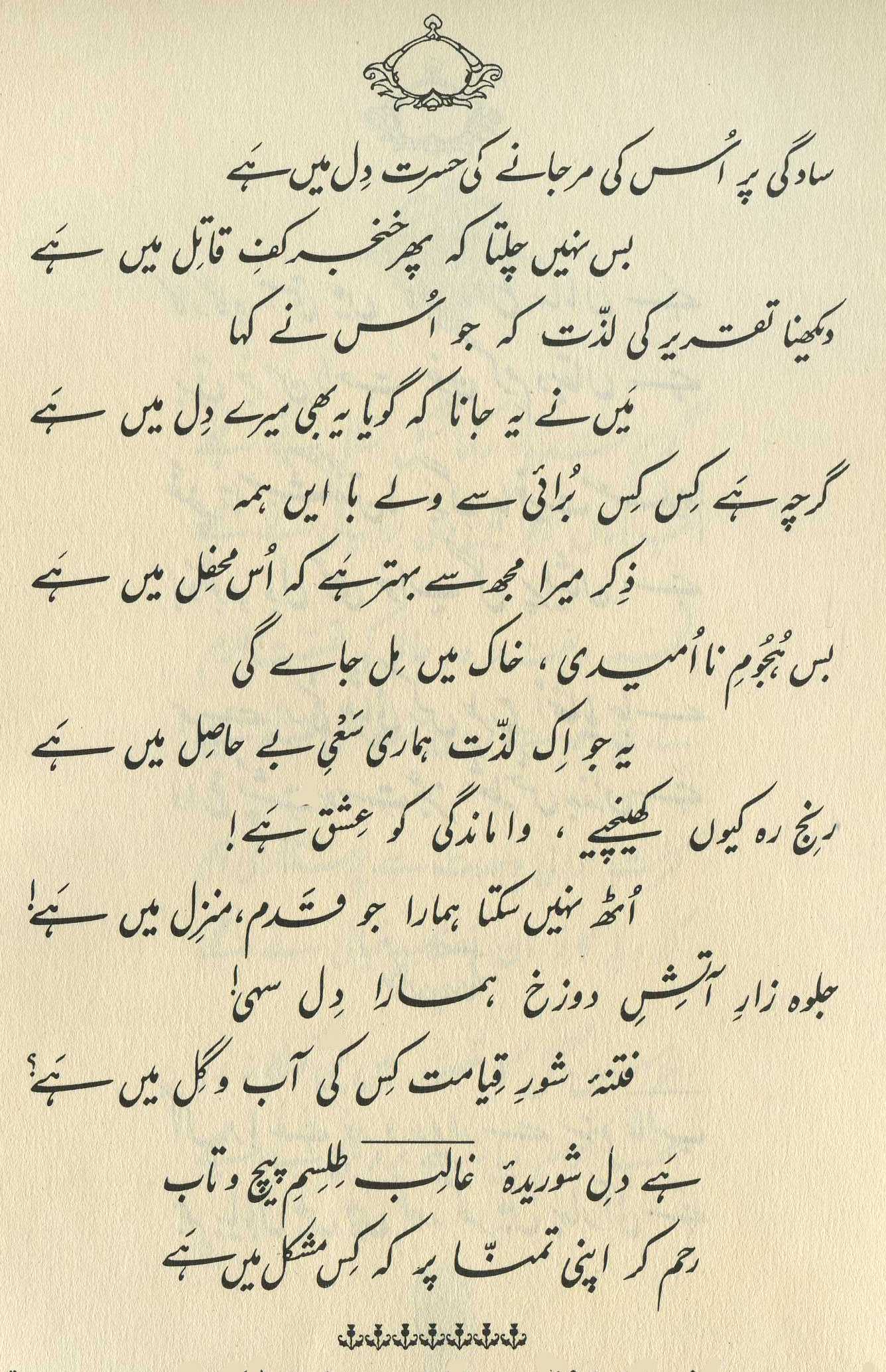
He has said the words sarcastically. The gist is that in your constitution is the mischief of Doomsday. That is, we've granted that our heart is filled with the fire of Hell; your saying this is true. But take a look at yourself too-- you too have become from head to foot the mischief of Judgment Day. (169)
== Nazm page 169

He says, 'You say truly that our heart is filled with the fire of Hell; but in whose constitution does the mischief of Judgment Day participate?' The meaning is that you are from head to foot an example of the mischief of Doomsday. (225)
Seeing the lover heaving hot sighs, the beloved has said to him: 'It's hardly your heart-- it's Hell!' He says, 'All right, our heart is indeed so, but tell me this: in whose essence is the tumult of Doomsday?' That is, what are you saying-- you yourself are made of Doomsday from head to foot! (302)
SETS == PARALLELISM
DOOMSDAY: 10,11
JALVAH: 7,4
The commentators point out the repartee-- the verse seems to reply to a sort of teasing remark or taunt. (For more on this colloquial use of , see 9,4 .) The idea would be, 'If I'm (like) the fire of Hell, then you're (like) the turmoil of Doomsday!'. (And, of course, if the lover is to be blamed for hotly and passionately desiring the beloved, she's to be blamed for provoking and inciting him with her disastrous beauty.)
There's also a fine affinity among the elements named here: the 'fire' of Hell is supplemented by the 'water' and 'earth' of the petrified phrase , meaning 'constitution, composition'. And of course, the heart is a {glory/appearance}-garden, while the water and earth/'clay' are elements of such a garden. Then , with its double meanings of 'water' on the one hand, and the fire-evoking 'radiance' or 'luster' or 'splendor' on the other, is a perfect crowning touch.
The second line is in Ghalib's favorite mode: it asks a simple question-- and of course implies the answer. The first example of this excellent device is the first line in the whole divan : 1,1 . It's also a device beautifully suited to counterattack in an argument ('Well, whose idea was it to go to the party?').
Comparing the beloved to Doomsday is no uncommon idea. My favorite example is the very explicit 96,3 , in which the beloved and Doomsday are actually measured against each other.
graphics/hellflower.jpg