Verse 4after 1826ilme;N hai
G1
1
enough, rush/attack of hopelessness! it will go down into the dust--
2
this our single/particular/unique/excellent pleasure/relish, which is in fruitless endeavor/effort
'Rushing (upon, or at, ); attacking; crowding; swarming...; --assault, attack; effort; impetuosity'.
'Pleasure, delight, enjoyment; sweetness, deliciousness; taste, flavour, relish, savour; —an aphrodisiac; an amorous philter'.
| References | |
|---|---|
| Arshi, Imtiyaz Ali | Ghazal# 201 |
| Raza, Kalidas Gupta | 375 |
| Hamid Ali Khan | Open Image |
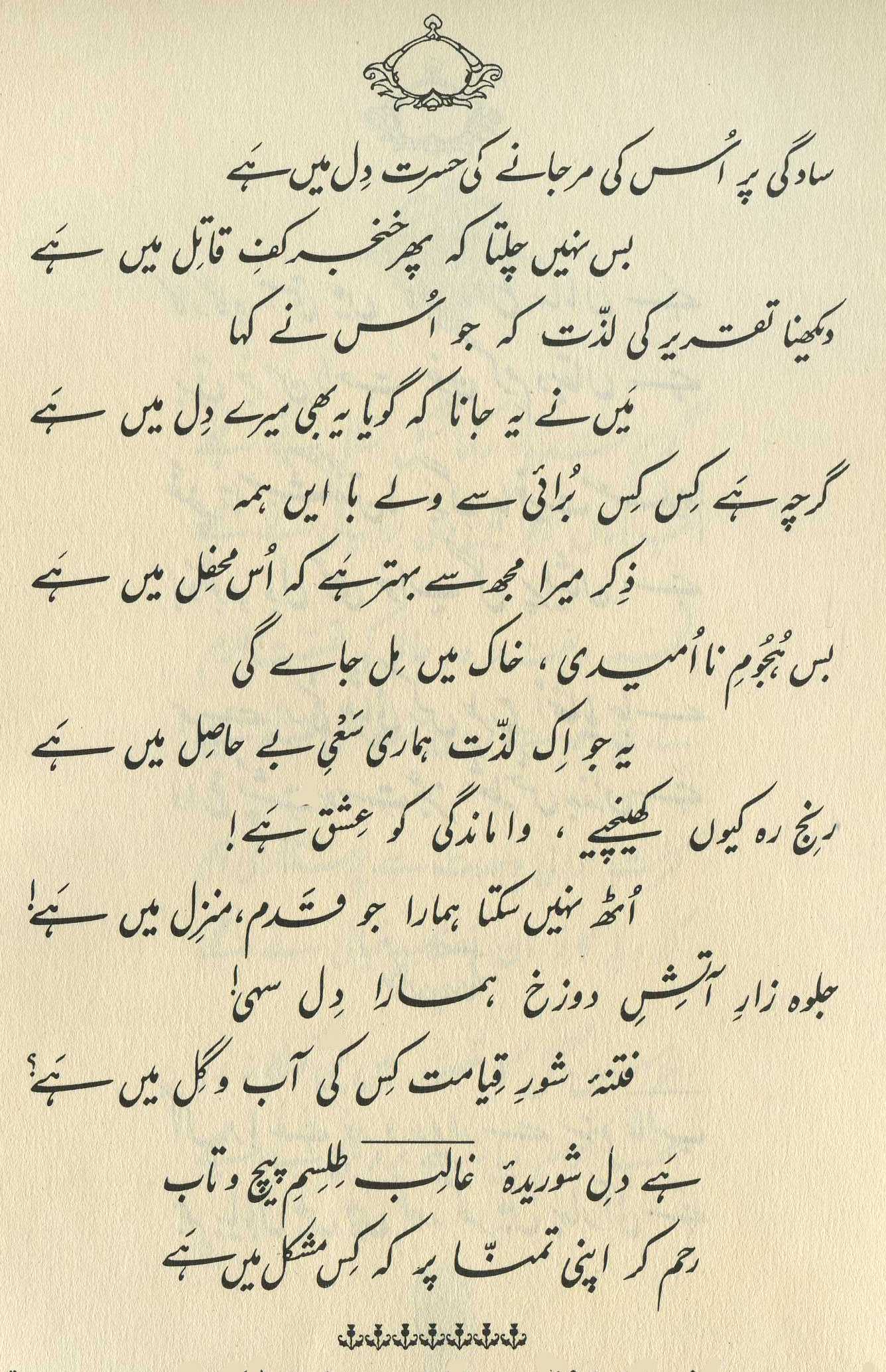
[1865, to Majruh:] How can I describe the state I'm in? Formerly I used constantly to recite this verse of mine: {157,4}. Now I'm no longer even fit for that kind of tune. That is, the pleasure of my fruitless endeavor has gone down into the dust []. (Arshi p. 305)
==Urdu text: Khaliq Anjum vol. 2, p. 543
Oh rush/attack of despair, leave off! Let it not be that the unique/sole pleasure I find in my useless endeavor would also be trampled underfoot! That is, among the crowd of despairs and hopelessnesses, the pleasure that comes from an endeavor without results will also be mingled with the dust. The meaning is that the state of despair is terrible, and although endeavor may be without results, it is not without pleasure. (168)
== Nazm page 168

He says, 'Oh rush/attack of despair, leave off! Let it not be that the one small pleasure that is left in our fruitless endeavor would also mingle with the dust.' (225)
When there is despair, then no pleasure comes from effort. Oh rush/attack of despair, leave off! Let it not be that the pleasure I get from my unsuccessful effort would also be erased. That is, despite the fact that no intelligible outcome emerges from my effort, and my effort is without result, I still find a pleasure in it. (302)
SETS ==EK; EXCLAMATION
This one was a bit confusing; I was glad of Nazm's strong lead (and so were the other commentators, I suspect). Ghalib's own paraphrase also suggests that Nazm is on the right track. Since both and are feminine, there can be some confusion as to what's at risk of going down into the dust; and the grammar of the second line opens several conceivable ways to parse it (what does modify? what does the really apply to?). On the whole, though, I think teasing out those small permutations doesn't add any real pleasure to the verse, or provide any fresh or valuable readings, so I'll refrain.
There are plenty of small word- and meaning-plays: pleasure versus despair; one versus a crowd (see the definition of above); a rush or attack, versus a passive going down into the dust. The secondary meaning of as 'effort' resonates particularly well: we have then an 'effort of despair' in the first line and a 'fruitless effort' in the second line.
The speaker is exclaiming to a rush or attack of despair, urging it to back off, for fear that something feminine singular will be trampled into the dust in the crush. In classic mushairah style, the first line is cryptic and incomplete, but tantalizing, so that we wait impatiently to hear what all the fuss is about. Even the first half of the second line gives us no real clue, except that it's probably something valuable and unique (though the remarkable multivalence of leaves a lot of room for maneuver). Not until the rhyming elements do we learn that the precious, vulnerable thing in need of protection from the rush or despair is the speaker's 'fruitless endeavor'.
But having enjoyed the realization and the wordplay, is there anything more? Beyond the level of wordplay, the verse doesn't really seem to hang together very well. If the 'endeavor' is something that can be trampled into the ground by a rush or attack of despair, it seems that it might be at least somewhat personified. But then the effort, though fruitless, is a special (unique? sole?) source of pleasure; and it's in danger of being destroyed by the rush/attack/'effort' of despair. So is the 'effort' of despair successful (in overpowering the speaker's 'fruitless endeavor'), while his own 'effort' remains perpetually unsuccessful? Or is his 'fruitless endeavor' what generates the 'rush/effort of despair' in the first place? The verse refuses to click into place in any exciting way. The four primary images-- rush/attack; going into the dust; pleasure; and fruitless endeavor-- are simply not richly intermeshed with each other, as they so often are in Ghalib's great verses. This one lacks the deeper kinds of connection .
But then, there's always a 'connection' with the figure of Sisyphus :
graphics/sisyphus.jpg