Verse 31816amdekhte hai;N
G12
1 a
one Adam /man}-height, compared to your cypress of stature
1 b
one Adam /man}-height, by means of your cypress of stature
2
we see the turmoil of Doomsday [to be] less
has an implicit over the because of the presence of an ; this metrically convenient augmentation can happen only with very short words.
| References | |
|---|---|
| Arshi, Imtiyaz Ali | Ghazal# 88 |
| Raza, Kalidas Gupta | 202-203 |
| Nuskhah-e-Hamidiyah | 148-149 |
| Asi, Abdul Bari | 163-164 |
| Gyan Chand | 261-262,538-539 |
| Hamid Ali Khan | Open Image |
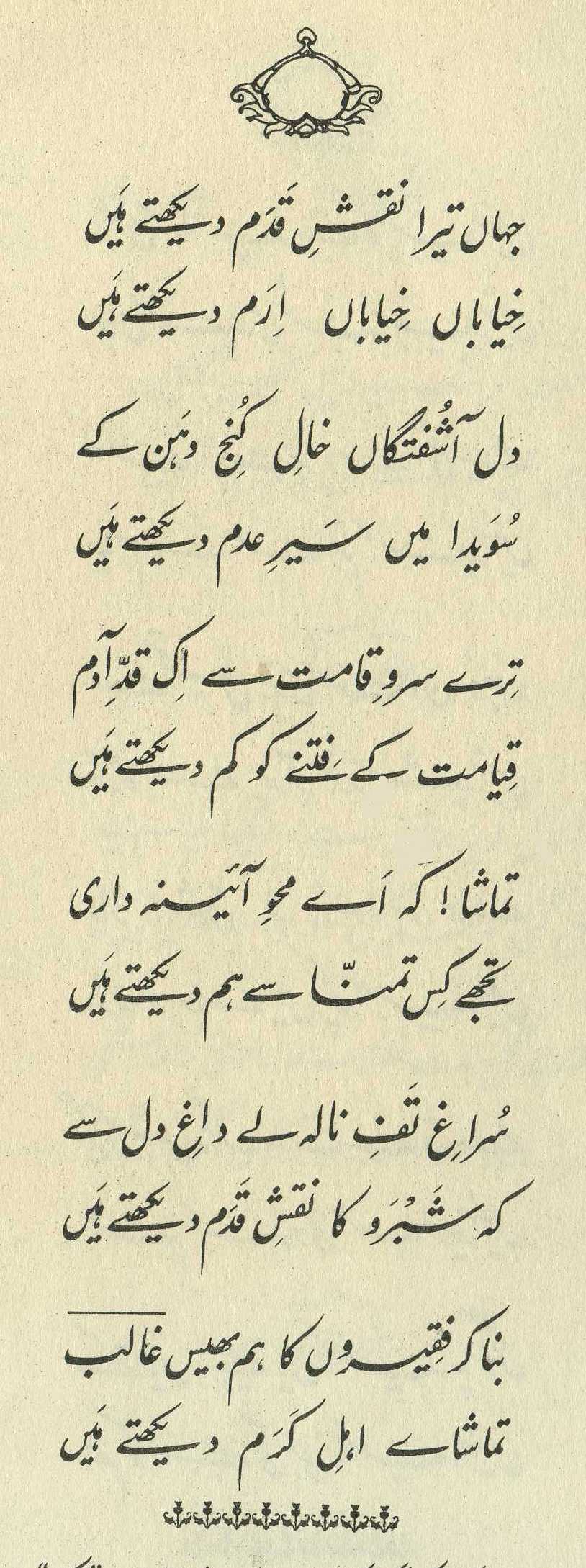
One meaning of it is this: that the turmoil of Doomsday is less than your cypress of stature. And there's a second meaning too: that your stature has been made out of exactly this, so that it has become one man-height less.
==Urdu text: Yadgar-e Ghalib , p. 132
That is, the cypress of stature is a whole [man-]height greater than the turmoil of Doomsday. It's an extremely subtle/enjoyable [] theme .
== Nazm page 97

Your turmoil of stature shows one man-height beyond the turmoil of Doomsday. That is, the latter is that much less than it.
[Or:] Your cypress of stature has been made out of the turmoil of Doomsday. So the turmoil of Doomsday has become one man-height less. (192)
Compare 38,4 . (176)
Hali announces, maybe even with a special flourish, that in this verse 'there's a second meaning too'. (As if it were something unusual!) Almost always, Hali is a 'one verse, one meaning' kind of commentator. I wonder whether some hint from Ghalib might be behind his remark, as in the case of 57,7 .
See Nets of Awareness , Chapter 6, pp. 95-103, for analysis of a series of Persian and Urdu 'cypress' verses.
This verse has some very fine wordplay-- and of course echo each other wonderfully closely in sound, even as the verse compares them to each other. (Parts of their sounds are also echoed in .) Moreover, the literal meaning of is 'rising up' (since it's the day the dead will be recalled to life and judged by God), so it works well when juxtaposed to something as tall and straight as the beloved's 'cypress of stature'.
The mention of Adam, the father of the human race, adds further subtle pleasures. It suggests that we're actually present on Doomsday, where all the dead are gathered, including Adam-- which is why he can be used as a convenient measuring-rod for comparing the beloved's height with the height of the Doomsday-turmoil. And, of course, it's amusing in itself that on a cataclysmic and terrifying day like that, all the lover thinks about is relishing the beauties of the beloved and comparing them favorably with everything else.
By comparing her height to the height of the 'turmoil of Doomsday', the speaker also reminds us of her deadly mischievousness and irresponsible power. (Since she's already like an anticipatory slice of Doomsday, it's no wonder that the actual day will be a bit lessened in its height when it finally arrives.)
The 'cypress of stature' [] feels backwards-- the usual thing for someone to have would be 'the stature of a cypress' []. The verse has thus literally endowed the beloved with a large tree, and even the escape-hatch of metaphor can barely save her from having to haul one around with her. Perhaps this tree is meant to resonate with the 'height of Adam/man' []. Adam himself is only a minor measuring-rod, while the beloved as a cypress tree stands so tall that she invites comparison with Doomsday.
For more on the beloved's tallness, see 38,4 .
graphics/adam.jpg