Verse 71821aamere ba((d
G5
In this meter the first long syllable may be replaced by a short; and the next-to-last long syllable may be replaced by two shorts.
1
who is [habitually] a confronter/peer of the man-killing wine of passion?!
2
there is repeatedly on the lips of the Cupbearer a call/invitation/challenge, after me
'A fellow-worker (in one's craft or ordinary occupation), an associate, a partner, a mate; --a rival, opponent, adversary, antagonist; an enemy'.
'Calling or inviting (beggars, &c.), to receive or partake of food; invitation; annunciation; proclamation; voice, call, cry (of an auctioneer, or salesman, &c.); shout, challenge (of a foe)'.
| References | |
|---|---|
| Arshi, Imtiyaz Ali | Ghazal# 57 |
| Raza, Kalidas Gupta | 330 |
| Nuskhah-e-Hamidiyah | 100-101 |
| Asi, Abdul Bari | 109-110 |
| Gyan Chand | 194 |
| Hamid Ali Khan | Open Image |
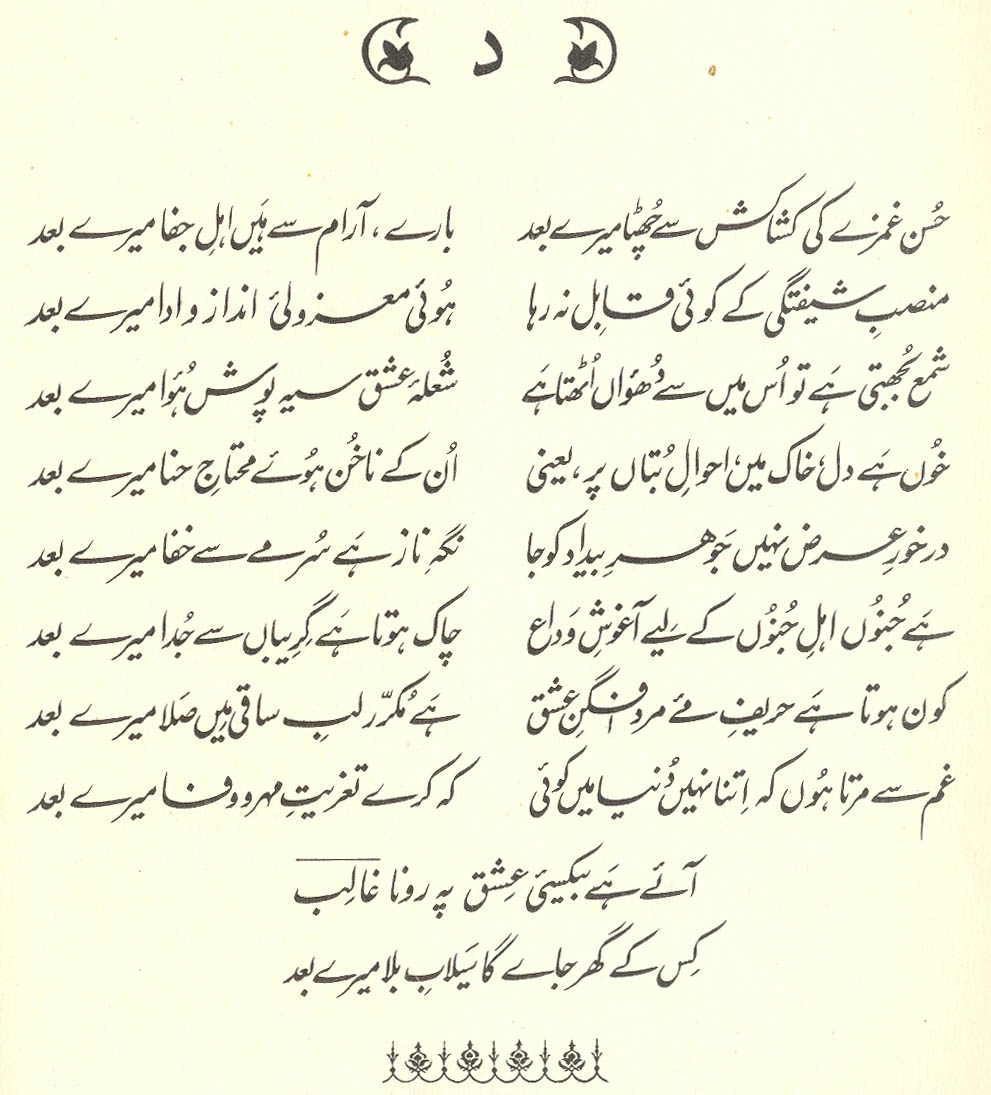
The apparent meaning of this verse is that since I have died, the Cupbearer of the man-killing wine of passion-- that is, the beloved-- many times gives the call-- that is, summons people to the wine of passion. The meaning is that after me, no buyer of the wine of passion remained; thus he had to give the call again and again. But after further reflection [ziyaadah ;Gor karne ke ba((d], as Mirza himself used to say, an extremely subtle meaning [] appears in it, and that is, that the first line is the words of this very Cupbearer's call; and he is reciting that line repeatedly. One time he recites it in a tone of invitation.... Then when in response to his call no one comes, he recites it again in a tone of despair-- Who can withstand the man-killing wine of passion! That is, no one. In this, tone [] and style of presentation [] are very effective. The tone of calling someone is one thing, and the way of saying it very softly, in despair, is another. When you repeat the line in question in this way, at once the meanings will enter deeply into your mind.
==Urdu text: Yadgar-e Ghalib , pp. 130-31
seems to be a calligrapher's error; or should be here. Most people have done a lot of subtle analysis of this verse's meaning, but it is outside the established path []. (53)
== Nazm page 52 ; Nazm page 53


In my opinion, there's no need for or . Because after once calling out like this, when no one hears then he goes on saying these words to himself, and this was the reason Mirza said . (125)
According to Hali, the obvious meaning of the first line is a general reflection, and the second line is an illustrative sequel to the first--
(1) Who can withstand the man-killing wine of passion?! (Not me, I died of it!-- and not anybody else either!)
(2) [Thus] after my death the Cupbearer repeatedly calls out [for drinkers, but in vain].
But Hali then tells us that Ghalib used to say that 'after further reflection' another meaning--in fact, an 'extremely subtle/refined/delightful meaning'--arises in the verse. And how is that meaning created? By rearranging the relationship of the two lines, so that we read the first as a result of the logically prior second:
(2) After my death the Cupbearer goes around calling out repeatedly,
(1) 'Who can withstand the man-killing wine of passion?'
In short, more meanings can-- and should!-- be brought out by rearranging the logical and semantic relationships of the two lines. Hali's commentary analyzes the verse through its 'A,B' structure (and through the multivalence of , which offers a version of what I call the 'kya effect').
Ghalib has been guiding Hali not only to read the verse with two different internal line-relationships, but also to create a range of effects by reading it with different kinds of intonation or ' tone ' []. This analytical approach is almost a charter for what I am doing in this commentary. The only surprising thing, to me, is that the traditional commentators show so little interest in this really very obvious kind of analysis.
But in his letters, Ghalib himself doesn't show much interest in such analysis either. He's much more inclined to tailor his comments according to the abilities and concerns of his addressee, the framework of their relationship, and the space constraints of the page, than to actually get into complexities. Perhaps his heart used to sink at the thought of trying to get it all across.
Here, in Hali's account, we see Ghalib acting as a helpful teacher, suggesting that the subtleties of the verse become evident not at once but 'after further reflection'. What is this except a courteous form of moral support? Obviously Ghalib himself didn't 'discover' these subtleties at a later stage, after 'reflection'-- he built them in from the beginning, and indeed built the verse around them-- as he had built many other verses using the same devices. But he's trying to guide Hali in an encouraging way, as any good teacher would. For another example of such guidance on his part, see 230,5 .
For more on dead-lover-speaks verses, see 57,1 .
Compare Mir's more personal, informal version of the same general idea: M 1161,4 .
graphics/battlemask.jpg