Verse 91821aamere ba((d
G5
In this meter the first long syllable may be replaced by a short; and the next-to-last long syllable may be replaced by two shorts.
1
at the forlornness of passion, weeping comes, Ghalib
2
to whose house will the flood of disasters go, after me?!
is an archaic form of ( GRAMMAR )
'Forlorn state, friendlessness, destitution'.
'A flood, torrent, stream, deluge, inundation'.
| References | |
|---|---|
| Arshi, Imtiyaz Ali | Ghazal# 57 |
| Raza, Kalidas Gupta | 330 |
| Nuskhah-e-Hamidiyah | 100-101 |
| Asi, Abdul Bari | 109-110 |
| Gyan Chand | 194 |
| Hamid Ali Khan | Open Image |
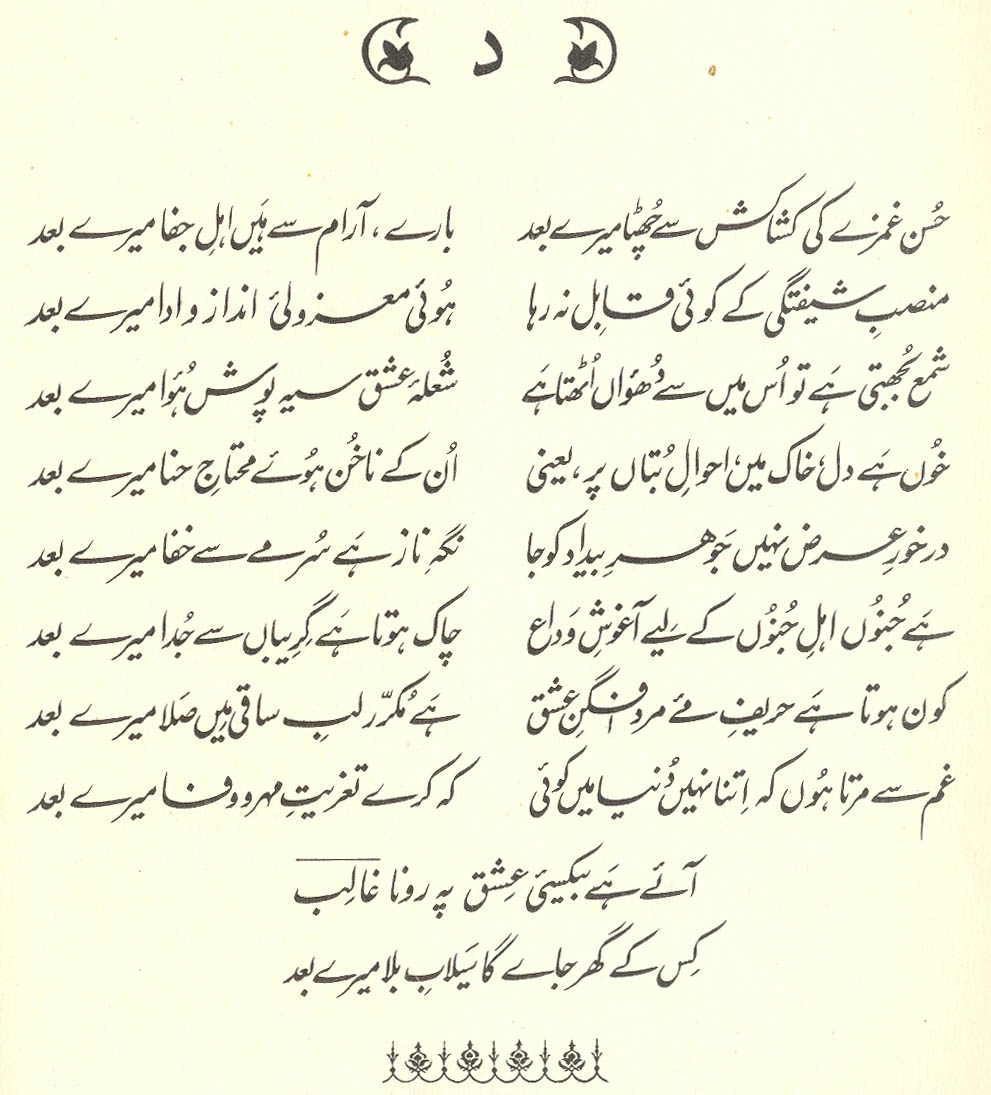
In the second line, he has constructed passion itself as the flood of disasters. (53)
== Nazm page 53

He says, oh Ghalib, I weep for the loneliness and helplessness of passion. After my death, who will become its host, and to whose house will the flood of disasters-- that is, passion-- go? (99)
That is, I don't see in anyone else the courage to accept this flood of disasters. (126)
Two independent 'A,B' lines-- how to connect them? The commentators want to apply them to the same situation by taking 'flood of disasters' as an epithet applied to passion, so that the verse expresses compassion for a homeless orphan. Thus the lover weeps for the plight of hapless Passion, who will be without a home once the lover himself is gone-- to whose house will Passion, the poor forlorn disaster-filled thing, be able to go then?
Yet we needn't equate the two, to make the verse work. The 'forlornness of passion' could be simply the inability of the passionate lover to continue his activities beyond the grave. Throughout his life he was always available for the 'flood of disasters' that constantly poured down on him from the heavens; who will show them such hospitality after he is gone?
Or perhaps the lover sympathizes with the plight of those equally forlorn lovers, his fellow victims of passion, whom he is leaving behind. While the 'flood of disasters' was falling on his house, others escaped. Now that he is not available to take the punishment, on whom will the flood of disasters descend next? (In a nice bit of wordplay, tears 'come' to him about where the flood will 'go'.)
And of course, 'tears' come to the lover in his anxiety over the future of the 'flood' of disasters. Could he be somehow creating the torrent himself? In 111,16 he suggests this threatening possibility, and in 233,17 he calls his tears 'equipment for a typhoon.' There's also 58,2 , in which the lover describes what his tears have done to his own house.
graphics/iln1856flood.jpg