Verse 17after 1816aa;Nkiye hu))e
G3
1
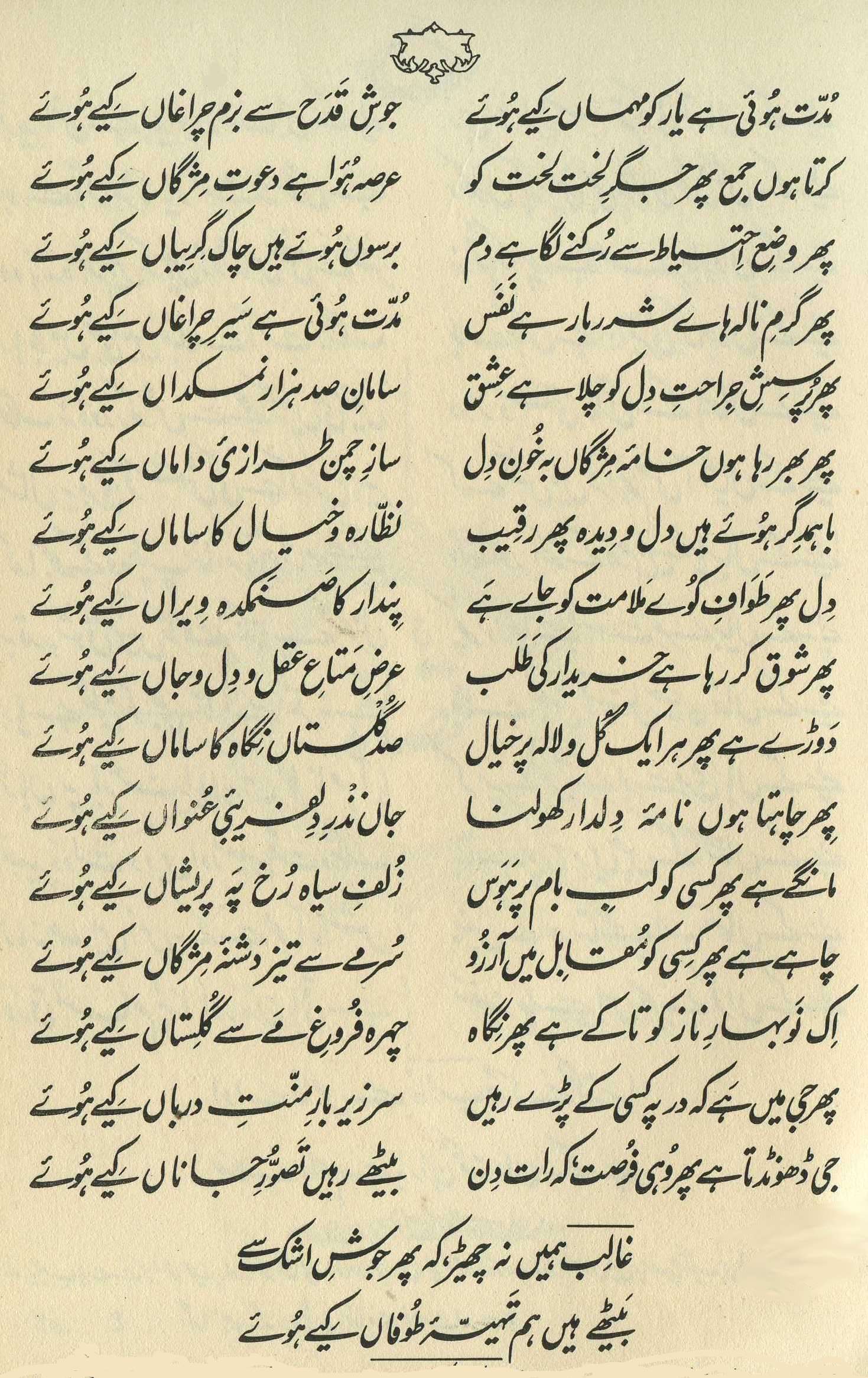
Ghalib, don't tease/torment us, for again with/through a turmoil of tears
2
we are settled/brooding, having made provision/arrangement for a typhoon
'To touch, lay the hand on, pass the hand over; to meddle with, molest, interrupt, disturb, trouble, annoy, tease, torment, worry, irritate, vex, excite, provoke; to touch up, stir up, incite, stimulate, jog, urge, spur; --to question closely, or searchingly, or strictly, to call to account, take to task, censure, rebuke; to address unseemly language to, to abuse, insult; to laugh at, quiz, deride'.
'To seat oneself, sit down, be seated, be unemployed or idle; to sit, brood, incubate; to alight, settle'.
'To do effectually or thoroughly; to do deliberately, or composedly, or unconcernedly'.
'Preparation, provision; putting in order, arrangement'.
| References | |
|---|---|
| Arshi, Imtiyaz Ali | Ghazal# 190 |
| Raza, Kalidas Gupta | 301-02 |
| Nuskhah-e-Hamidiyah | 284-286 |
| Hamid Ali Khan | Open Image |
Here the author has used 'typhoon' with the meaning of 'in order to raise a typhoon'; it's hard to find a warrant [] for this. (265)
== Nazm page 265

He says, 'Oh Ghalib, don't tease us, for again through the turmoil of tears we are settled/brooding with the intention of raising a typhoon'. (323)
[Disagreeing with Nazm:] The author hasn't used 'typhoon' with the meaning of 'in order to raise a typhoon'. Rather, the meaning 'to raise a typhoon' is included within 'provision for a typhoon'. Examples of this are common.... In any case, if a 'warrant' will be demanded for every single common word, then except for silence, what answer can there be? (501)
On the structure of this ghazal as a kind of loosely 'continuous' one, see 233,1 .
The enjoyable contrast is between the threat of , with its active overtones of stirring up, inciting, exciting; and the threat of , with its ominously stubborn suggestions of settling down, brooding, incubating. Surely in there's also an echo of the idiomatic (see the definition above), with its strong sense of stubbornness and wilfulness.
The typhoon consists of wind and rain, and the lover with his sighs and tears is more than ready to produce one. Maybe, after all these years, it's time once again?
graphics/typhoon.jpg