Verse 11after 1816aa;Nkiye hu))e
G3
1
again I want to open a {heart-possessor's / heart-possessing} letter
2
having made my life an offering to the heart-beguilingness of the superscription
'A vow; an offering, anything offered or dedicated; a gift or present (from an inferior to a superior)'.
'Heart-alluring, enticing, bewitching, enchanting, fascinating, charming, beautiful, lovely'
'(as last member of compounds), Deceiving, deluding, defrauding, cheating; alluring, beguiling, winning (e.g. )
'Superscription, title, or title-page (of a book, &c.); preface; anything that serves as an indication (of another thing); that which is understood (by anything); --mode, manner'.
'Title-page, frontispiece, or lettering of a book (generally gilded and highly ornamented); superscription; address of a letter; preface; beginning of anything; mode, manner'. (Steingass p.871)
| References | |
|---|---|
| Arshi, Imtiyaz Ali | Ghazal# 190 |
| Raza, Kalidas Gupta | 301-02 |
| Nuskhah-e-Hamidiyah | 284-286 |
| Hamid Ali Khan | Open Image |
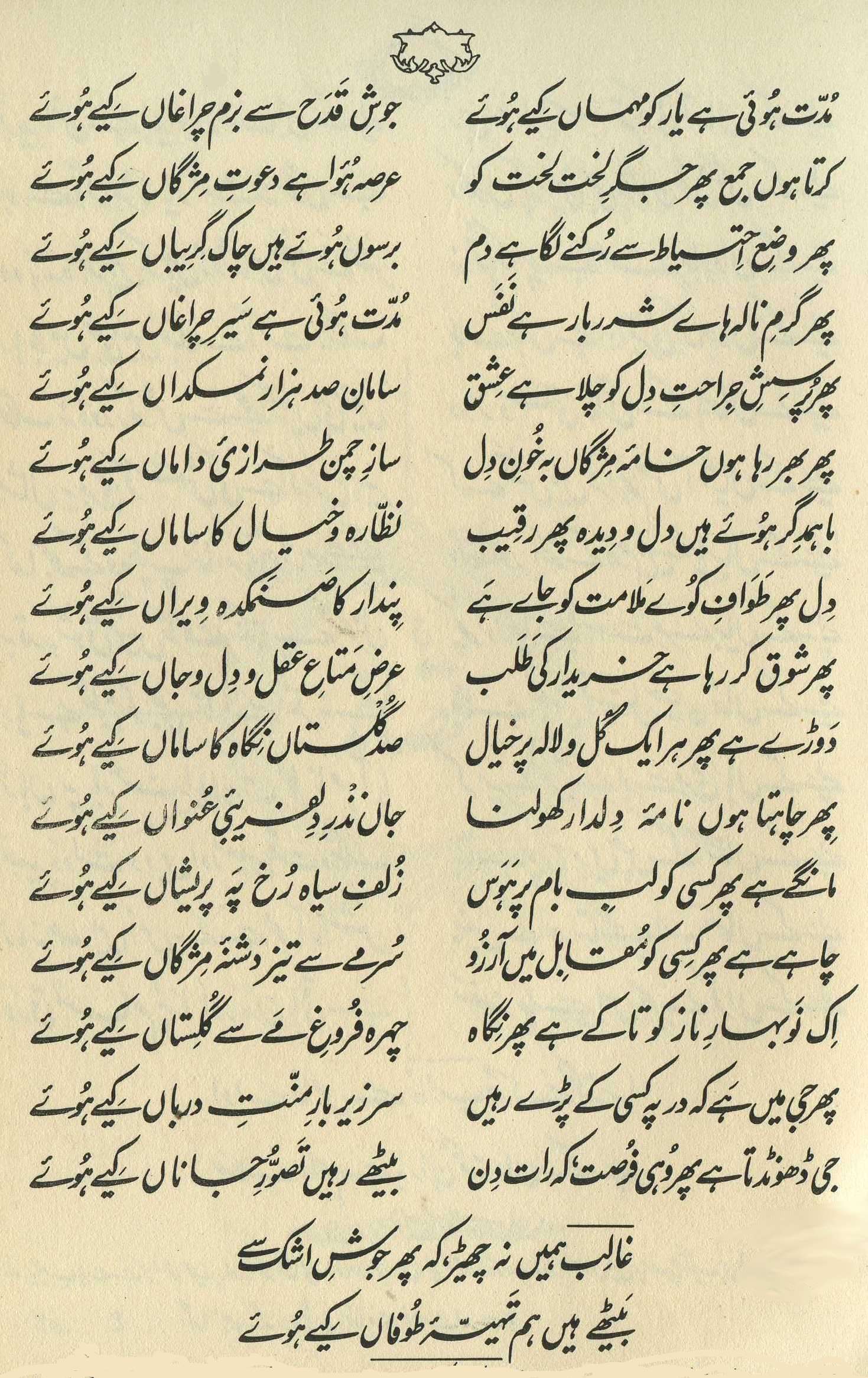
[No commentary is provided.]
== Nazm page 264

He says, I again want to open the beloved's letter. The way she has written my name and address on the envelope is heart-beguiling, so that I want to offer up my life to it. (322)
= redness [of ink], title. (499)
= redness [of ink]. (552)
On the structure of this ghazal as a kind of loosely 'continuous' one, see 233,1 .
Thanks to the ambiguities of the , the letter can be that of a 'heart-possessor', or can itself be 'heart-possessing'. In either case, the heart in question is obviously that of the infatuated lover. The beloved (or her letter) has either stolen his heart, or else he has freely given over his heart into her (or its) custody.
Both these possibilities work cleverly with the second line, which in fact creates a kind of 'catch-22' situation. The lover wants to open the beloved's letter-- after he has offered up his life to the charm of the superscription. But of course, once he has offered up his life he will be dead, and then (probably) can't open the letter.
The 'superscription' might be something written on an envelope (see the definitions above); or perhaps the letter itself is folded and sealed, and has the recipient's name written on the visible outside part of the folded letter. Another possibility took me by surprise: to Bekhud Mohani and Baqir, the idea of 'superscription' can be defined as 'redness [of ink]' [], as for a (decorated) title or heading. Red ink for a superscription that calls for the sacrifice of the recipient's life-blood is obviously an elegant touch. Whether or not Ghalib knew this idiomatic usage, he would surely have approved.
My favorite part of the verse is the elegant use of , which I've translated as 'heart-beguilingness' in an attempt to evoke both its senses at once. The basic meaning of is trickery, deceit, cheating, defrauding-- all the exploitative things that a con artist would practice (see the definition above). But is so well established in its own right that it's become largely domesticated: it refers generally to the charming beloved's (heart-) winning ways. But the presence of can't entirely be overridden, and the overtones of trickery, treachery, deceit are always hovering somewhere around it. (Compare the use of in 208,10 .) These overtones reinforce the circular, 'catch-22') effect of this witty little verse.
graphics/loveletter.jpg